


Choosing the right sourcing country is a critical decision when purchasing frozen fruits and vegetables for food manufacturing, foodservice, distribution, or retail. Buyers need more than competitive pricing. They need dependable agricultural raw materials, consistent product specifications, suitable processing capabilities, food safety controls, and a supply chain that can support repeated shipments.
Vietnam has become a practical sourcing market because its agricultural regions produce a broad range of tropical fruits and vegetables, while its processing sector has developed capabilities in IQF freezing, prepared formats, packaging, and export supply. For companies looking for a Vietnam frozen fruit and vegetable supplier, the opportunity is not simply access to lower-cost raw materials. The greater advantage is the combination of agricultural diversity and increasingly capable processing infrastructure.
This article examines why Vietnam can be a strong sourcing origin, what product and manufacturing advantages buyers can expect, and what they should evaluate before selecting a long-term supplier.
Why Is Vietnam a Strong Source of Frozen Fruits and Vegetables?
Vietnam offers an unusually diverse agricultural base within a relatively compact sourcing market. Different growing regions support different fruit and vegetable categories, allowing processors to build sourcing networks rather than depending on a single agricultural area.
The Mekong Delta is particularly important for fruit production, while the Central Highlands and other agricultural regions contribute products such as avocado, passion fruit, vegetables, and other crops. This geographical diversity matters for frozen food production because processors can work with different growing regions and harvest periods to maintain raw material availability across the year.
For buyers, the benefit is practical. A supplier with access to multiple agricultural regions may be better positioned to manage seasonal fluctuations, raw material availability, and differences in crop conditions than a supplier dependent on one local growing area.
Vietnam’s agricultural diversity also supports a broad frozen product portfolio. Common commercial categories include mango, dragon fruit, passion fruit, avocado, jackfruit, durian, eggplant, okra, corn,...
How Does Vietnam Support Year-Round Frozen Food Sourcing?
Seasonality is one of the biggest challenges when purchasing fresh agricultural products. A crop may be abundant during its peak harvest but difficult to source consistently outside that period. For food manufacturers, this can create problems with production planning, product consistency, and supply continuity.
Frozen processing changes this equation. When suitable raw materials are available, they can be processed and frozen to extend commercial availability beyond the fresh harvest period. However, this only works effectively when the processor has a strong sourcing network and sufficient processing and storage capacity.
Vietnam’s different growing regions and crop calendars provide an important foundation for this model. The country’s fruit and vegetable harvest calendar covers multiple product categories across different months, supporting a more continuous supply structure rather than concentrating all sourcing into one short season.
This is particularly relevant for manufacturers that need frozen ingredients throughout the year. Instead of repeatedly sourcing fresh products according to local harvest conditions, they can work with a processor that manages raw material procurement, processing, freezing, storage, and export as one supply chain.
What Frozen Fruit and Vegetable Products Can Be Sourced From Vietnam?
Vietnam’s advantage is not limited to supplying whole frozen produce. Modern processors can prepare fruits and vegetables into formats designed around different commercial applications.
IQF Fruits and Vegetables
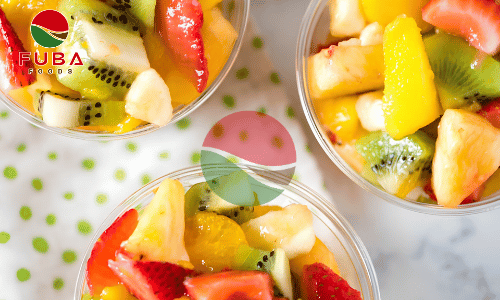
IQF, or Individual Quick Freezing, is particularly useful for manufacturers because individual pieces remain separated after freezing. This makes portioning, handling, and further processing more convenient than frozen products that form large blocks.
Depending on the crop and application, Vietnamese suppliers can offer products in formats such as cubes, slices, halves, chunks, whole pieces, and purees. The appropriate format depends on the buyer’s production process and final application.
For example, mango may be supplied as IQF cubes, half cuts, or puree, while dragon fruit can be processed into cubes, slices, or puree. Passion fruit and avocado can also be supplied in processed formats suited to beverages, dairy products, bakery applications, desserts, smoothies, and other food manufacturing uses.
This format flexibility allows buyers to source ingredients closer to their required production specifications instead of purchasing raw frozen produce and carrying out extensive preparation themselves.
Value-Added Frozen Products
Vietnamese frozen food processing also extends beyond basic IQF fruit and vegetables. Depending on the factory, value-added processing can include products that have already been cut, blanched, grilled, fried, or otherwise prepared for specific applications.
This can reduce preparation work at the customer’s facility and make the frozen ingredient more suitable for ready meals, foodservice, pizza, pasta, stir-fries, bakery products, beverages, and industrial food processing.
For a buyer, the important point is to evaluate whether the supplier can consistently reproduce the required cut, size, texture, and processing specification rather than simply offering a broad product list.
Why Does Factory Processing Capability Matter When Sourcing From Vietnam?
A strong agricultural supply base does not automatically guarantee a reliable frozen food supply. The processing factory determines how effectively raw materials are converted into a consistent commercial product.
A capable frozen food manufacturer should control the process from incoming raw material inspection through cleaning, sorting, preparation, freezing, inspection, packing, storage, and shipment. This integrated flow helps reduce variation between raw material batches and finished products.
FUBA combines raw material inspection, washing and cleaning, sorting and grading, product preparation, IQF freezing, metal detection, packing, cold storage, and export shipment within its manufacturing flow. The factory also operates multiple IQF, contact-freezing, and air-blast freezing systems, providing different processing options according to product requirements.
For buyers, this factory-level control is more valuable than simply knowing that a supplier is located in Vietnam. It indicates whether the supplier has the infrastructure to convert agricultural raw materials into standardized frozen ingredients at commercial scale.
Can Vietnam Provide Consistent Quality for Export Markets?
Consistency is one of the main concerns when sourcing agricultural products internationally. Natural raw materials vary in size, maturity, color, moisture, and other characteristics. The processing system therefore needs to control as much variation as possible before the product reaches the customer.
Sorting and grading are important early stages because raw materials can be selected according to defined quality and size requirements. Product preparation must then follow the agreed specification, while freezing needs to be controlled to preserve the intended characteristics of the product.
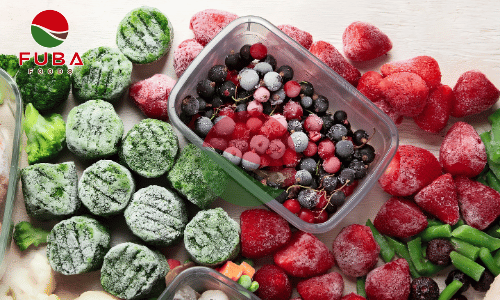
Quality control should continue after freezing. Inspection systems, packaging controls, cold storage, traceability, and export procedures all contribute to the final product delivered to the customer.
For international buyers, these capabilities provide a more useful basis for supplier evaluation than country of origin alone.
How Does Vietnam Help Optimize Frozen Food Sourcing Costs?
Cost competitiveness is another reason companies consider Vietnam, but the strongest cost advantage should come from the supply chain rather than simply from a low product price.
Direct access to agricultural raw materials can reduce unnecessary intermediary layers between farms and processing facilities. Efficient production lines can then convert those raw materials into standardized frozen products at scale.
Processing close to the sourcing origin can also create operational advantages. Fruits and vegetables do not need to travel long distances in fresh form before processing when the supplier has suitable facilities near the relevant sourcing network. Once processed and frozen, the products can enter a controlled cold-chain system for international distribution.
However, buyers should evaluate total sourcing cost rather than comparing only the quoted price per kilogram. Product yield, specification consistency, packaging, storage requirements, shipment efficiency, rejected quantities, and supply reliability can all influence the real cost of procurement.
A manufacturer with efficient sourcing and production systems can therefore offer competitive pricing while maintaining the processing controls needed for export-quality frozen products. This combination is more sustainable than competing purely through a low initial quotation.
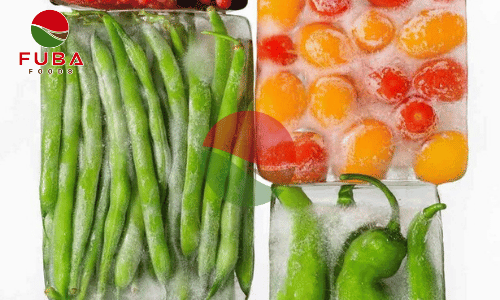
What Should Buyers Look for in a Vietnam Frozen Fruit and Vegetable Supplier?
Selecting a Vietnam frozen fruit and vegetable supplier should start with the buyer’s actual product requirements. The supplier should be able to clearly define the raw material origin, product format, cut size, processing method, packaging, storage conditions, and shelf life for the relevant product.
Manufacturing capability should then be examined. Buyers should look for evidence of controlled processing rather than relying only on a product catalogue. Questions around raw material inspection, sorting, IQF capability, foreign-material detection, quality control, cold storage, and traceability can reveal how mature the supplier’s production system is.
Supply capacity is equally important for long-term commercial orders. A supplier may be able to produce a small trial shipment but struggle to maintain volume once demand increases. Production capacity, equipment availability, storage capacity, and sourcing relationships should therefore be considered together.
Packaging and customization can also affect suitability. Depending on the market, buyers may require foodservice packs, bulk export cartons, specific inner liners, or private-label packaging. A supplier with OEM and private-label capabilities can provide greater flexibility when specifications or branding requirements differ between customers.
Why Is Vietnam Suitable for Long-Term Frozen Food Supply?
The strongest sourcing relationships are built around repeatability. Buyers need a supplier that can deliver the same specification across multiple production cycles, maintain communication during seasonal changes, and support international logistics requirements.
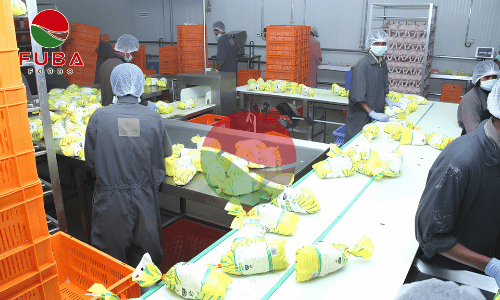
Vietnam’s combination of agricultural diversity, processing infrastructure, IQF technology, and export-oriented manufacturing creates a strong foundation for this type of relationship. However, not every supplier will offer the same level of capability. The factory behind the product remains a critical part of the sourcing decision.
For this reason, buyers should assess both the country and the individual manufacturer. A reliable sourcing partner should demonstrate control over raw materials, processing, quality assurance, storage, packaging, and export logistics rather than functioning only as a trading intermediary.
For companies looking to develop a broader frozen fruit and vegetable portfolio, this approach can also simplify procurement. Instead of managing multiple suppliers for different products, a capable manufacturer may provide several fruit and vegetable categories through one controlled supply relationship.
Conclusion
Vietnam is an increasingly practical origin for frozen fruit and vegetable sourcing because it combines diverse agricultural regions with established food-processing capabilities. Its range of tropical fruits and vegetables, different harvest periods, IQF processing, value-added formats, and export infrastructure can provide meaningful advantages for international food manufacturers, distributors, and other commercial buyers.
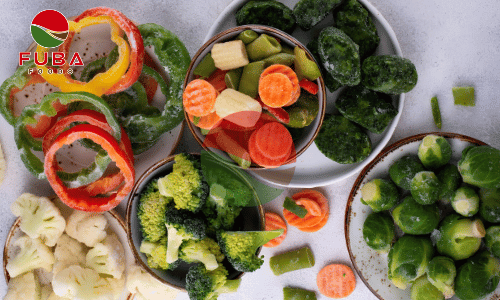
The key, however, is choosing the right Vietnam frozen fruit and vegetable supplier. Country of origin alone does not guarantee quality or supply reliability. Buyers should evaluate the factory’s raw material network, processing technology, quality-control system, production capacity, packaging capabilities, cold-chain infrastructure, and ability to maintain consistent specifications over repeated orders.
When these elements are in place, Vietnam can offer more than competitive sourcing. It can provide a scalable supply base for frozen fruits and vegetables that supports consistent production, flexible product formats, and long-term international distribution.


