

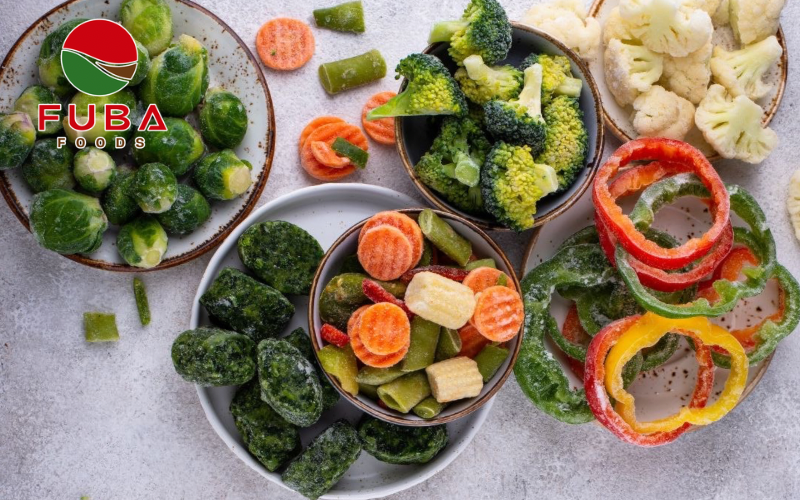
A dependable Vietnam frozen food supply chain starts with much more than access to agricultural products. For importers, distributors, and food manufacturers, the real challenge is maintaining consistent raw material quality, stable production, controlled freezing, reliable storage, and uninterrupted export logistics from one shipment to the next. Vietnam has a strong agricultural base, but turning that advantage into a dependable international frozen food supply requires close control at every stage.
From farm sourcing to global shipment, the supply chain needs to connect agricultural regions with a capable processing facility. This includes selecting suitable raw materials, inspecting incoming produce, sorting and preparing products to specification, freezing them with appropriate technology, completing food-safety checks, and maintaining the cold chain through storage and transportation. With more than 15 years in frozen fruit and vegetable processing and export, FUBA Foods operates this model through sourcing partnerships across Vietnam and a processing facility in Ca Mau, supporting customers in more than 30 countries.
For global buyers, understanding how this supply chain works makes it easier to assess a supplier beyond product samples and price quotations. This article examines the key stages that determine whether a Vietnam-based frozen food supplier can provide consistent quality and reliable long-term supply.

How Does the Vietnam Frozen Food Supply Chain Work?
The Vietnam frozen food supply chain is an interconnected manufacturing process that begins with agricultural sourcing and ends with international delivery. Raw materials are sourced from suitable growing regions, transported to the processing facility, inspected, washed, sorted, graded, and prepared according to product specifications. They are then frozen, inspected, packed, stored under controlled temperatures, and released for export shipment.
Each stage affects the next. Poor raw material selection can create inconsistent product sizes and textures. Inadequate preparation can reduce freezing consistency. Weak temperature control after production can compromise the condition of finished goods. For this reason, a reliable supplier needs to manage the entire flow rather than treating freezing or export as isolated services.
At FUBA Foods, the documented processing flow covers farm sourcing, raw material inspection, washing and cleaning, sorting and grading, cutting or preparation, IQF freezing, metal detection, packing, cold storage, and export shipment. Finished products are stored at controlled temperatures below -18°C before shipment.
This factory-based approach is particularly important when buyers require repeat orders. Consistency depends on whether the same controls can be applied from one production batch to the next, not simply whether a supplier can provide an acceptable first shipment.
Why Is Farm Sourcing Important to Frozen Food Supply?
The quality of frozen food is largely determined before the raw material reaches the freezing line. Fruits and vegetables differ according to growing region, harvest period, maturity, variety, and physical condition. A factory therefore needs an agricultural sourcing network capable of supplying raw materials that match the required processing specifications.
Agricultural Regions and Product Availability
Vietnam’s diverse agricultural regions provide access to a broad range of tropical fruits and vegetables. The supply base includes mango, dragon fruit, passion fruit, avocado, jackfruit, durian, eggplant, zucchini, okra, corn, sweet pepper, edamame, sweet potato, and pumpkin. These products can be processed into formats such as slices, chunks, halves, puree, and customized specifications.

How Does Seasonal Availability Affect Supply?
Seasonality is one of the most important factors in agricultural sourcing. A supplier that depends heavily on a single location or short harvest window may face raw material shortages or significant quality variation outside peak season.
A broader sourcing network helps manufacturers coordinate procurement with different growing regions and harvest periods. FUBA Foods works with farming regions and growers across Vietnam and uses a harvest calendar covering multiple fruit and vegetable categories throughout the year. This supports more consistent raw material planning rather than relying solely on spot purchasing when an order is received.
For buyers, this is an important distinction. “Year-round supply” should not simply mean that a supplier keeps finished products in stock. It should reflect the manufacturer’s ability to plan raw materials, production, and inventory around agricultural seasonality.
How Does Factory Processing Affect Frozen Food Quality?
Once raw materials arrive at the factory, processing control determines how consistently agricultural products can be converted into commercial frozen ingredients. Inspection, washing, sorting, grading, and preparation are critical because different products require different handling before freezing.

Sorting, Grading, and Product Preparation
Sorting and grading help control characteristics such as size, color, and quality. Cutting must follow the agreed product specification, whether the final product is diced, sliced, chunked, halved, or supplied as puree. This becomes particularly important for food manufacturers that incorporate frozen ingredients directly into standardized recipes or production lines.
Manufacturing Flexibility
A factory with multiple processing capabilities can also adapt the manufacturing process to different product requirements.
This manufacturing depth can reduce dependence on external processors and gives buyers a clearer connection between the agreed specification and the actual production process.
Why Is IQF Important in the Vietnam Frozen Food Supply Chain?
IQF, or Individual Quick Freezing, is widely used for frozen fruits and vegetables because individual pieces can be frozen separately rather than forming one large frozen block. This makes products easier to portion, handle, and use in subsequent food preparation.
The freezing process needs to be matched to the product’s form and specification. Cubes, slices, chunks, and other shapes have different dimensions and characteristics, so freezing conditions need to be controlled accordingly. The purpose is to achieve a stable frozen product while helping preserve desirable characteristics such as color, texture, flavor, and nutritional value.

How Is Food Safety Controlled Before Export?
A frozen food supply chain needs quality controls that extend beyond visual inspection. Incoming raw materials need to be assessed before processing, while finished products require appropriate inspection before shipment.
At the factory level, metal detection is an important control for metallic foreign materials. Additional inspection systems can provide further control depending on the product and production requirements. FUBA Foods operates five metal detection systems, three X-ray inspection systems, and an in-house microbiological laboratory. Its documented quality assurance framework includes FDA, HACCP, ISO 22000, HALAL, and BRCGS.
These systems support a broader quality-control process that begins with raw material selection and continues through final shipment. The catalogue specifically describes quality control from raw material selection to final shipment, rather than positioning food safety as a single inspection point.
For international buyers, this distinction matters because product consistency and food safety depend on process control throughout production, not only on the final product inspection.
Can a Vietnam Frozen Food Factory Support Long-Term Supply?
Production capacity is another key factor when evaluating a supplier for recurring orders. A factory may produce a good sample but still struggle to maintain delivery schedules when volumes increase. Capacity therefore needs to be considered alongside raw material sourcing, processing equipment, storage, and export operations.
FUBA Foods’ factory in Ca Mau has a stated annual supply capacity of 20,000 MT, more than 600 workers, and more than 15 years of experience in frozen fruit and vegetable processing. The facility also includes three cold-storage units with a capacity of 500 MT each, supporting the storage requirements of finished frozen products.

How Does Cold-Chain Management Complete the Supply Chain?
The final stages of the Vietnam frozen food supply chain are just as important as production. After freezing and packing, finished products must remain under appropriate temperature conditions during storage and transportation.
Packaging and Storage Requirements
Packaging needs to be aligned with the destination market and intended application as well. Frozen products can be prepared in retail, foodservice, or bulk export formats, with bulk packaging examples including 10 kg cartons with PE inner liners.
Export Logistics and Traceability
This is where a factory’s supply chain capability becomes commercially important. Maintaining product quality from the processing line to cold storage is only part of the job; the same discipline needs to continue through shipment preparation and international logistics.
FUBA Foods stores finished products at controlled temperatures below -18°C and incorporates product traceability and food-safety compliance into its cold-storage system. Its export operation also supports logistics, documentation, and international trade requirements, helping connect factory production with overseas delivery.

What Should Buyers Look for in a Vietnam Frozen Food Supplier?
Agricultural Sourcing and Supply Stability
Evaluating a Vietnamese frozen food supplier should start with the supply chain rather than the quotation. Buyers should first understand where the supplier obtains its raw materials and whether it has access to multiple agricultural regions. This helps determine how realistically the supplier can maintain availability across different harvest periods.
Manufacturing and Quality Control
The next consideration is manufacturing control. Buyers should look at whether the supplier operates its own processing facilities, what freezing systems are available, how raw materials are inspected, and how the factory manages sorting, preparation, food-safety inspection, packaging, and storage. These factors provide a much stronger indication of supply reliability than a product catalogue alone.
Product Specifications and Customization
Product flexibility is also important when specifications vary between markets or applications. Different customers may require different cuts, sizes, varieties, puree characteristics, packaging formats, or private-label solutions. A manufacturer with customized specifications and packaging capabilities can adapt production more effectively to these requirements.

Export and Cold-Chain Capabilities
Finally, buyers should evaluate whether the supplier can support the complete export process. Documentation, logistics coordination, cold-chain management, traceability, and communication all influence the reliability of international supply. A supplier that manages these elements alongside manufacturing can provide a more integrated sourcing relationship.
Conclusion
A reliable Vietnam frozen food supply chain is built from the farm upward. Agricultural sourcing provides the raw material foundation, but consistent international supply depends on what happens after harvest: inspection, grading, preparation, freezing, quality control, packaging, cold storage, and export logistics must work together.
Vietnam’s diverse agricultural regions give manufacturers access to a broad range of fruits and vegetables, while modern processing facilities allow these raw materials to be converted into standardized frozen products for global markets. For buyers, the strongest sourcing relationships come from suppliers that can demonstrate control over both sides of the equation: stable agricultural sourcing and dependable factory execution.
When evaluating a Vietnam frozen food supplier, look beyond price and individual product samples. Assess the complete supply chain, from where the raw material comes from to how the finished product is frozen, inspected, stored, and shipped. That is what ultimately determines whether a supplier can move from a one-time order to a reliable long-term supply partner.


