

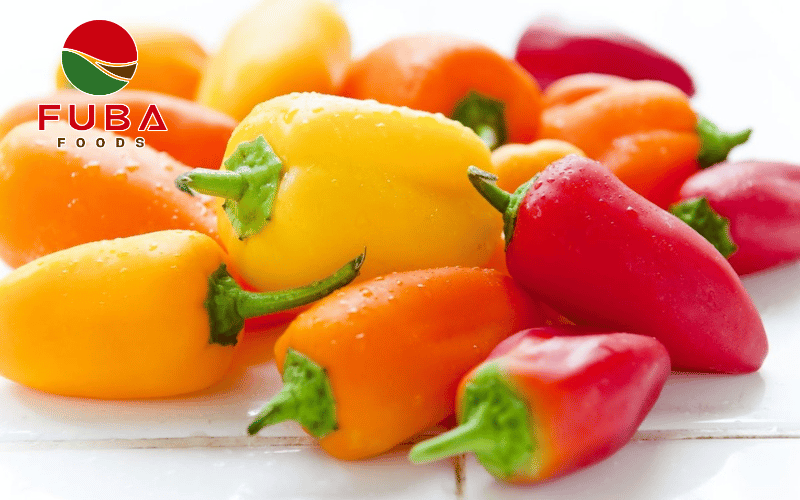
Finding the right frozen sweet pepper supplier Vietnam is about more than securing a competitive quotation. For food manufacturers, the more important consideration is whether the supplier can consistently deliver the required color, cut size, texture, food safety, and supply volume across repeated production cycles.
Frozen sweet pepper can provide manufacturers with a convenient alternative to fresh peppers by reducing preparation requirements and supporting more predictable ingredient availability. However, product performance depends on more than freezing alone. Raw-material sourcing, preparation methods, cut specifications, IQF technology, packaging, cold storage, and export handling all contribute to the consistency of the finished ingredient.

For buyers sourcing from Vietnam, understanding these factors is essential when evaluating a supplier for long-term commercial supply. This article examines what makes a reliable frozen sweet pepper supplier Vietnam, which product specifications matter most, and how manufacturers can assess supplier capability before entering a regular purchasing program.
Why Source Frozen Sweet Pepper from Vietnam?
Vietnam has developed a diverse agricultural supply network covering several major growing regions, creating opportunities for processors to source a broad range of fruits and vegetables for international markets.
For frozen sweet pepper buyers, however, agricultural availability is only the starting point. The more important question is whether raw materials can be converted into a consistent frozen ingredient with defined specifications and reliable year-round supply.
Fresh sweet peppers naturally vary in size, color, maturity, moisture, and texture. If these variations are not controlled before processing, they can affect the appearance and performance of the finished frozen product.
A reliable supplier should therefore have a structured sourcing and raw-material selection process that connects agricultural supply with factory production requirements.
Raw-Material Sourcing and Consistency
A stable frozen sweet pepper supply begins with suitable raw materials. Peppers should be selected according to characteristics relevant to the intended application, including maturity, color, size, firmness, and overall condition.
An established sourcing network can help processors coordinate raw-material availability with production schedules and quality requirements. This is particularly important for international buyers that need repeated shipments rather than occasional spot purchases.
For manufacturers, greater consistency at the sourcing stage can reduce variation further down the production line. It can also help minimize additional sorting or adjustment after the product arrives at the buyer’s facility.
This makes raw-material sourcing an important part of supplier evaluation, rather than a factor that should be considered separately from processing capability.

How Frozen Sweet Pepper Is Processed for Industrial Use
The quality of frozen sweet pepper is influenced by how the product moves through the entire processing chain. A controlled production flow should connect raw-material inspection, cleaning, preparation, freezing, inspection, packaging, and storage.
A typical process includes:
- Raw-material inspection
- Washing and cleaning
- Sorting and grading
- Cutting or preparation according to specifications
- IQF freezing
- Foreign-material detection
- Packaging
- Cold storage
- Cold-chain transportation
Each stage can influence the final product. For example, inconsistent raw materials may affect color and texture, while inappropriate cutting can create variation in cooking performance and portion size.
For buyers, understanding this production flow provides a more useful basis for supplier evaluation than looking at the finished product alone.
Why Cut Size and Processing Format Matter
Frozen sweet pepper is not a one-format ingredient. Different manufacturing applications require different shapes, preparation methods, and levels of processing.
A pizza manufacturer may need diced pepper for even topping distribution, while a ready-meal producer may prefer strips that remain visually recognizable. Other applications may benefit from pre-grilled or blanched formats that reduce preparation requirements at the buyer’s facility.
Available formats can include:
Frozen Sweet Pepper Slice Cut
Slice-cut sweet pepper is suitable for applications where the shape of the vegetable remains visible in the finished product.
It can be used in salads, pasta, stir-fries, prepared meals, and other products where recognizable pepper pieces contribute to visual presentation.
For manufacturers, receiving a pre-cut ingredient can also reduce labor associated with washing, trimming, and cutting fresh peppers before production.
Frozen Sweet Pepper Dice
Frozen sweet pepper dice provides a convenient, pre-cut ingredient for manufacturers that require consistent piece size and efficient handling during production. Uniform dice can support portion control and even distribution in prepared meals, fillings, sauces, vegetable mixes, pizza toppings, and other processed foods.
The appropriate dice size and processing method should be selected according to the intended cooking conditions, texture requirements, recipe formulation, and finished-product specifications. This allows manufacturers to reduce on-site preparation while ensuring the frozen pepper integrates effectively into their existing production process.

IQF Technology for Better Industrial Handling
IQF, or Individually Quick Frozen, technology rapidly freezes individual pieces rather than freezing the product into one solid block.
For frozen sweet pepper, this separation provides a practical advantage for industrial users. Manufacturers can take the required quantity from a package without having to thaw or break apart a large frozen mass.
Individual freezing can also support more efficient weighing, portioning, blending, and distribution during production.
Beyond handling convenience, freezing conditions can influence the preservation of important product characteristics such as color, texture, and flavor. This makes freezing technology an important consideration when comparing frozen sweet pepper suppliers.
FUBA Foods applies IQF freezing within its frozen vegetable processing operations, alongside raw-material inspection, preparation, quality control, packaging, and controlled cold storage. This integrated approach supports the production of frozen vegetable ingredients for international applications.
Frozen Sweet Pepper Applications for Food Manufacturers
The versatility of frozen sweet pepper allows manufacturers to incorporate the ingredient into multiple product categories without performing all fresh-product preparation internally.
Salads, Pasta and Stir-Fry Products
For salads and pasta products, color and cut consistency can influence the visual quality of the finished food.
Slice-cut or diced frozen sweet pepper can provide a standardized ingredient while reducing the need for on-site preparation.
In stir-fry products, the selected cut and processing method become particularly important because the pepper must integrate with the cooking process while maintaining an appropriate texture and appearance.

Pizza Toppings and Ready Meals
Pizza and ready-meal manufacturers often require ingredients that can be portioned and distributed consistently across high-volume production lines.
Uniformly cut frozen sweet pepper can simplify this process while helping maintain a consistent visual appearance between production batches.
Different color options can also be combined to create specific product concepts, such as mixed vegetable formulations or visually differentiated ready meals.
Further Food Processing
Frozen sweet pepper can also function as an ingredient in sauces, fillings, vegetable blends, prepared foods, and other processed products.
In these applications, buyers should pay particular attention to technical specifications such as cut size, color, texture, moisture, packaging, and preparation method.
The supplier should understand the intended application so that the product specification can be aligned with the manufacturer’s actual production process.
What Should Buyers Check When Choosing a Frozen Sweet Pepper Supplier?
Supplier evaluation should go beyond product photographs and price quotations. For international food manufacturers, the more useful question is whether the supplier has the systems required to reproduce the same product specifications across future shipments.

Quality and Food-Safety Controls
A reliable supplier should have quality controls covering the entire production process, from incoming raw materials to final storage and shipment.
Important areas to assess include:
- Raw-material inspection
- Sorting and grading
- Processing controls
- Foreign-material detection
- Microbiological testing
- Product traceability
- Packaging inspection
- Cold-storage control
- Export documentation
These controls become especially important when frozen sweet pepper is used as an ingredient in finished foods, because any variation or quality issue can affect the buyer’s own production process.
Production and Cold-Storage Capacity
Production capacity should also be considered when moving from sample orders to regular commercial supply.
A supplier may successfully provide a small trial shipment but face difficulties when required to handle significantly larger recurring volumes. Buyers should therefore evaluate processing lines, cold-storage capacity, workforce, production planning, and experience with international shipments.

The supplier should also maintain suitable frozen conditions after processing. Temperature stability throughout cold storage, loading, transportation, and delivery is essential for protecting product quality.
Packaging and Custom Specifications
Packaging should match the buyer’s distribution model and operational requirements.
Retail, foodservice, and industrial buyers may require different pack sizes and packaging configurations. Bulk export customers may prioritize efficient carton sizes and inner liners, while foodservice distributors may require more manageable pack weights.
For private-label or customized programs, buyers should also confirm whether the supplier can support customized specifications, packaging, labeling, and other market-specific requirements.
Why Factory Capability Matters for Long-Term Supply
For international buyers, supplier reliability is not determined by the product sample alone. The real test is whether the same quality can be reproduced across multiple production cycles and delivered according to schedule.
A factory-based supplier can provide greater visibility into raw-material sourcing, processing, quality control, production planning, packaging, cold storage, and export logistics.
This can also make technical communication more efficient. Buyers can discuss specifications directly with the production side rather than relying on multiple intermediaries to communicate requirements.
For long-term purchasing, this level of coordination can help reduce risks associated with inconsistent specifications, shipment delays, unsuitable packaging, and unexpected changes between batches.

Conclusion
Choosing a frozen sweet pepper supplier Vietnam requires a broader assessment than comparing prices per kilogram. For food manufacturers, consistent raw materials, suitable cut formats, IQF processing, food-safety controls, packaging, cold storage, and reliable export handling all contribute to the overall value of the supply relationship.
Vietnam provides a strong agricultural and processing base for frozen vegetable sourcing, but the supplier’s ability to control these stages determines whether the product can perform consistently in commercial production.
For buyers evaluating long-term suppliers, the priority should be finding a manufacturer that can align product specifications with the intended application while maintaining consistent quality and supply across repeated orders. This factory-level capability is ultimately what turns frozen sweet pepper from a commodity purchase into a dependable industrial ingredient.


