

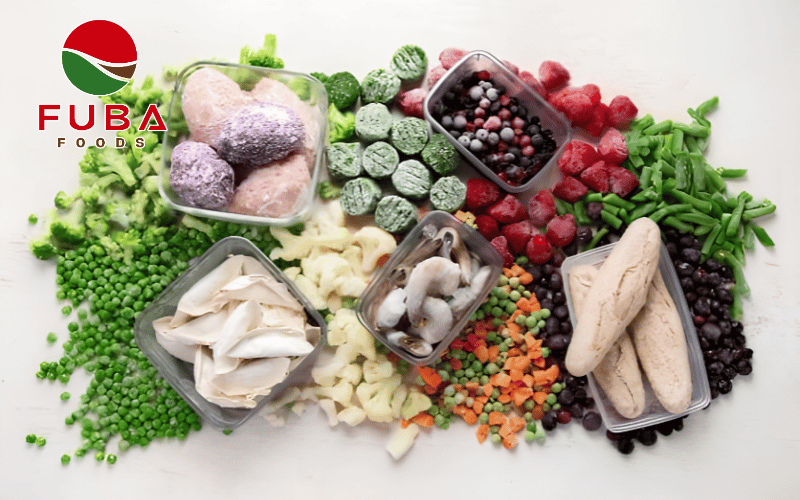
Private label frozen fruits and vegetables enable brands to develop their own frozen product lines without investing in dedicated processing facilities. Instead of purchasing finished goods under a manufacturer’s brand, buyers collaborate directly with factories to produce frozen fruit and vegetable products based on defined specifications, packaging requirements, and brand standards.
For international brands, distributors, and food businesses, private label frozen fruits and vegetables represent a strategic approach to product development and market expansion. However, choosing the right manufacturing partner involves more than simply applying a brand label. The supplier must be capable of managing raw material sourcing, processing, IQF freezing, quality control, packaging, cold storage, and export logistics with consistent and reliable performance.

In Vietnam, established frozen food manufacturers offer integrated solutions that combine agricultural sourcing, advanced processing, customized specifications, and export support. This makes it possible to develop private label frozen fruits and vegetables tailored to different market requirements, regulatory standards, and commercial objectives.
This article explains how private label frozen fruits and vegetables are developed for international brands, outlining the production process, customization options, quality control systems, and the key factors to evaluate when selecting a reliable manufacturing partner.
What Are Private Label Frozen Fruits and Vegetables?
Private label frozen fruits and vegetables are products manufactured by a food factory for another company and sold under that company’s own brand. The manufacturer handles production, while the brand owner controls the commercial identity of the product, including branding, packaging, product positioning, and agreed specifications.
The product itself can range from basic frozen fruit and vegetable formats to more customized products. Depending on the factory’s capabilities, buyers may request whole, sliced, diced, cubed, halved, pureed, blanched, grilled, or other processed formats. The freezing method and preparation process can also be specified according to the intended application.
This distinction is important because private label manufacturing is not simply contract packing. A capable factory should be able to translate a buyer’s product concept into a practical production specification. That includes raw material requirements, cut size, processing conditions, freezing technology, packaging format, storage conditions, and quality parameters.
How Does Private Label Frozen Food Manufacturing Work?
The private label process normally starts before production begins. The buyer first provides information about the product they want to develop, including fruit or vegetable type, format, target market, packaging concept, expected volume, and quality requirements. The factory then evaluates whether those requirements can be achieved consistently at commercial scale.

Product Specifications and Factory Feasibility
A clear product specification is one of the most important parts of private label manufacturing. Buyers should define the variety or raw material type, size range, cut dimensions, appearance, color, texture, moisture requirements, packaging weight, and storage conditions wherever applicable.
The factory needs to assess these requirements against its raw material supply and processing equipment. A specification that works for a small sample may not necessarily be practical for large-scale production. This is why experienced manufacturers review technical requirements before confirming a quotation or production schedule.
For example, a buyer ordering IQF mango cubes may need a specific cube size and maturity level. The factory must be able to source suitable mangoes, maintain the required preparation process, and produce a consistent cut throughout the production run. The same principle applies to frozen avocado, passion fruit, dragon fruit, and processed vegetables.
Sampling, Approval, and Commercial Production
After the initial specification is confirmed, the factory typically prepares samples for evaluation. Samples allow the buyer to assess appearance, taste, texture, cut consistency, packaging, and other product characteristics before commercial production.
This stage is particularly important for private label products because the approved sample effectively becomes a reference point for future production. A strong manufacturing process should therefore connect sample approval with documented production specifications rather than treating the sample as a one-time demonstration.
Once the product is approved, the buyer and factory can move toward packaging confirmation, production planning, quality inspection, and shipment. This creates a clearer connection between what the buyer approved and what eventually reaches the market.
What Can Be Customized in Private Label Frozen Fruits and Vegetables?
One of the main reasons brands choose private label production is the ability to develop products around their own market requirements. However, the level of customization depends on the manufacturer’s equipment, raw material supply, and production capabilities.

Fruit and Vegetable Formats
The physical format can often be adapted to the intended application. Depending on the product, manufacturers may produce slices, chunks, cubes, halves, puree, or other customized specifications. IQF processing is particularly useful when the buyer needs individually frozen pieces that are easier to portion and handle during distribution or further processing.
For products requiring additional processing before freezing, manufacturers may also provide value-added preparation such as blanching, grilling, or frying. These options can help brands develop products that are closer to their final application instead of purchasing a basic frozen raw ingredient.
FUBA combines fruit and vegetable processing with IQF freezing and customized specifications, covering formats such as slices, chunks, halves, and puree. This type of processing flexibility can be valuable when a brand needs different product formats from one manufacturing source.
Packaging and Private Label Branding
Packaging is another major component of private label production. Buyers may specify bag size, net weight, packaging material, label design, carton configuration, pallet requirements, and other packing details according to their market.
The factory must ensure that the packaging specification is compatible with the product, freezing process, storage conditions, and export handling. Label information also needs to be reviewed carefully because requirements can vary between destination markets.
For international brands, packaging consistency is particularly important. A visually correct package is not enough if the product weight, labeling information, sealing performance, or carton configuration does not match the approved specification.
How Do Manufacturers Control Quality in Private Label Frozen Fruits and Vegetables?
Quality control in private label manufacturing needs to cover the entire production chain rather than focusing only on the final frozen product.
Raw materials should be inspected when they arrive at the factory. Suitable materials are then washed, cleaned, sorted, and graded before processing. Depending on the product, preparation may include cutting, peeling, deseeding, blanching, grilling, frying, or other treatments.
Freezing is another critical stage. IQF technology rapidly freezes individual pieces, helping maintain separation between pieces while supporting the retention of natural color, texture, flavor, and nutritional characteristics. After freezing, products can pass through metal detection and other inspection procedures before packaging and cold storage.
For private label brands, these controls are especially important because inconsistency can affect the brand itself. If one production lot has significantly different color, cut size, texture, or weight from another, the problem is no longer only a factory issue. It can directly affect customer perception and repeat purchasing.

What Should Brands Check When Choosing a Private Label Manufacturer?
Choosing a manufacturer requires looking beyond product samples and quotation prices. The real question is whether the factory can reproduce the approved product consistently while maintaining supply and quality over multiple production cycles.
Raw Material Sourcing and Production Capacity
Raw material stability is one of the most important factors in frozen fruit and vegetable manufacturing. Seasonal variation, maturity, weather conditions, and regional supply can all influence the quality of agricultural raw materials.
A factory with a strong sourcing network can reduce some of these risks by working with farming regions and growers across different areas. Production capacity is equally important. A manufacturer may produce an excellent sample but still struggle to fulfill larger or recurring orders.
FUBA operates a frozen food manufacturing facility with an annual supply capacity of around 20,000 MT, more than 600 workers, and export experience across more than 30 countries. These capabilities provide a useful example of why production scale and export experience should be evaluated alongside product quality when selecting a long-term private label partner.
Food Safety and Quality Management
International brands also need confidence that the factory can operate according to recognized food safety and quality management requirements. Certifications should be considered together with the actual systems used inside the factory.
This includes raw material inspection, process controls, traceability, foreign-object detection, laboratory testing, packaging inspection, and temperature management. The factory should also be able to maintain records that support quality verification throughout production.
FUBA’s manufacturing infrastructure includes systems associated with FDA, HACCP, ISO 22000, HALAL, and BRCGS requirements, together with cold storage maintained below -18°C and traceability controls. For brands entering international markets, this type of integrated quality and cold-chain infrastructure can provide greater confidence in production consistency.

How Much Does Private Label Frozen Fruit and Vegetable Manufacturing Cost?
Private label pricing cannot be determined by the fruit or vegetable itself. The final cost depends on several production variables, including raw material availability, product format, processing complexity, freezing method, packaging specifications, order volume, and destination market requirements.
For example, IQF diced mango and mango puree require different processing systems and therefore have different production costs. A product requiring grilling or frying will also involve additional processing compared with a basic frozen product.
Packaging can have a significant impact as well. Custom printed packaging, smaller retail packs, special carton configurations, and specific labeling requirements may increase the total cost compared with standard bulk packaging.
For this reason, buyers should compare quotations based on the complete product specification rather than choosing a supplier simply because its initial price is lower. A cheaper quotation may not represent a lower total cost if it involves different raw material grades, packaging specifications, yield, or service conditions.
What Is the MOQ for Private Label Frozen Fruits and Vegetables?
MOQ is one of the first questions international brands should ask because private label production usually requires more planning than standard bulk purchasing.
The MOQ can depend on the product, packaging format, production line, raw material availability, and whether custom packaging is required. A factory may be able to produce the requested product technically but still require a certain volume to make customized packaging or production setup commercially viable.
Buyers should therefore ask for the MOQ based on the exact product and packaging specification they intend to order. They should also clarify whether the MOQ applies per SKU, per packaging design, or per production batch. This prevents unexpected requirements after the product development stage.

How Long Does Private Label Frozen Food Production Take?
Lead time depends on whether the product is already standardized or requires new product development and packaging preparation.
A standard frozen product with an established specification can generally move faster because the raw material, processing method, and packaging process are already defined. A new private label product may require sample development, approval, packaging artwork, material preparation, production scheduling, and additional quality checks before shipment.
Seasonality should also be considered for agricultural products. A factory with access to multiple sourcing regions and an established harvest management system may have more flexibility in planning raw materials throughout the year.
What Happens After Production?
Production is only one part of the supply chain. Once frozen products pass final inspection, they need to be packed correctly, transferred to cold storage, and maintained under appropriate temperature conditions until shipment.
Cold-chain management is particularly important for international distribution. Products should remain frozen during storage and transportation to protect the quality achieved during processing.
Export documentation and logistics coordination are also part of the manufacturing relationship. An experienced factory should understand international shipment requirements and be able to coordinate the necessary production and export processes without creating unnecessary delays between factory release and shipment.
Is Private Label Frozen Fruits and Vegetables Right for Your Brand?
Private label is particularly suitable for brands that want control over their market positioning without establishing their own food processing facility. It allows companies to build a branded product range while relying on an established factory for raw material sourcing, processing, freezing, packaging, and production management.
However, private label works best when the relationship is treated as a manufacturing partnership rather than a simple purchasing arrangement. The buyer needs a clear specification, realistic volume expectations, suitable packaging requirements, and a factory capable of reproducing the approved product consistently.
The right manufacturer should also have enough flexibility to support product development while maintaining the production discipline required for larger commercial orders.

How to Choose the Right Private Label Frozen Food Manufacturer
The strongest private label partner is not necessarily the factory offering the lowest quotation. It is the manufacturer that can connect product development, raw material sourcing, processing, quality control, packaging, storage, and export into one reliable production system.
Before placing a large order, brands should evaluate the factory’s processing capabilities, freezing technology, sourcing network, production capacity, food safety systems, packaging options, quality controls, and export experience. Samples should be evaluated against clear specifications, and the approved product should be documented carefully before commercial production begins.
It is also worth examining whether the supplier is a genuine manufacturer with its own processing infrastructure or primarily an intermediary coordinating production elsewhere. Direct factory relationships can provide clearer communication around specifications, production schedules, quality issues, and capacity planning.
Conclusion
Private label frozen fruits and vegetables offer international brands a practical way to develop branded frozen food products without building their own manufacturing infrastructure. But successful private label production depends on much more than packaging and branding.
The manufacturer must be able to control the complete process, from agricultural raw material sourcing and product preparation to freezing, quality inspection, packaging, cold storage, and export. When these capabilities are properly integrated, brands can achieve greater consistency, better supply visibility, and a more reliable foundation for long-term market growth.
For international brands, the most important step is therefore to choose a manufacturing partner that can turn product specifications into consistent commercial production. A factory with the right technology, sourcing network, quality systems, and production capacity can make private label frozen fruit and vegetable development significantly more predictable from the first sample to recurring international shipments.


