

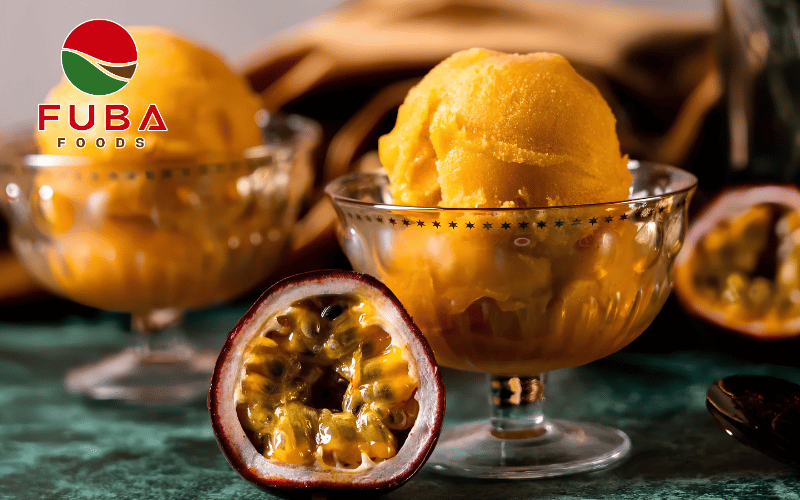
Passion fruit is a familiar ingredient in tropical beverages, valued for its distinctive aroma, bright acidity, and intense fruit character. It can give juices, fruit drinks, smoothies, cocktail bases, dairy beverages, and other commercial formulations a recognizable tropical profile without requiring manufacturers to process fresh fruit at every production stage. However, when passion fruit becomes a regular production ingredient, choosing the right puree involves more than simply looking for a strong fruit flavor.
Passion fruit puree for beverage manufacturing should be evaluated according to its flavor profile, Brix and acidity, texture, fruit consistency, processing method, storage conditions, and ability to perform consistently across commercial batches. The right specification helps manufacturers control formulation, maintain a consistent drinking experience, and reduce adjustments caused by variations in raw fruit.
For beverage manufacturers, distributors, and ingredient buyers, the supplier’s manufacturing capability matters just as much as the puree itself. This article looks at the key factors to consider when sourcing passion fruit puree for commercial beverage production, with a focus on ingredient performance, factory processing, quality control, and supply reliability.

What Makes Passion Fruit Puree Suitable for Beverage Manufacturing?
A puree intended for beverage production needs to deliver more than the natural taste of passion fruit. It must work predictably within a formulation and remain compatible with the manufacturer’s processing conditions.
Passion fruit naturally has a pronounced aromatic profile and relatively high acidity. These characteristics can be desirable in tropical beverages, but they also mean that the puree needs to be selected according to the desired flavor balance of the finished drink. A puree that is highly concentrated in flavor may perform differently from one with a lighter fruit profile, while variations in fruit maturity can influence sweetness, acidity, aroma, and color.
For commercial production, manufacturers should therefore define the desired puree specification before comparing suppliers. The objective is not simply to find a puree that tastes good in a sample. It is to find an ingredient that can be incorporated into a repeatable formulation and supplied with consistent characteristics over time.
Key Specifications to Check When Choosing Passion Fruit Puree
Brix and Acidity
Brix is one of the first parameters beverage manufacturers should consider because it provides an indication of soluble solids in the puree. It can affect formulation ratios, sweetness perception, and the amount of additional sugar or other ingredients required in the final beverage.
However, Brix should not be considered independently from acidity. Passion fruit’s characteristic sharpness is an important part of its flavor profile, and the relationship between sweetness and acidity can influence how the finished beverage is perceived.
When evaluating suppliers, buyers should request the actual specification rather than relying on descriptions such as “sweet,” “strong flavor,” or “premium quality.” The relevant Brix range, acidity requirements, and acceptable tolerances should be established before commercial production.
Aroma, Flavor, and Color
Passion fruit is often selected specifically because it has a distinctive tropical aroma. If the puree loses too much of this characteristic during processing or storage, manufacturers may need to compensate elsewhere in the formulation.
Color is also relevant, particularly for beverages where consumers expect a recognizable passion fruit appearance. Buyers should assess whether the puree provides a consistent color and flavor profile from batch to batch rather than evaluating only one sample.
For beverage development, the puree should ideally be tested in the actual formulation. A product that performs well on its own may interact differently with sugar, water, other fruit ingredients, dairy components, stabilizers, or acids once it enters the finished beverage system.
Texture and Pulp Characteristics
Texture is another consideration, especially for beverages positioned around natural fruit content. Depending on the formulation, manufacturers may want a smooth puree or may intentionally retain certain natural fruit characteristics.
The amount and consistency of fruit solids can affect mouthfeel, appearance, separation behavior, and filtration requirements. This is why buyers should define the desired texture and processing characteristics before ordering at scale.
For industrial applications, consistency is often more important than simply having a high fruit content. The puree needs to behave predictably during mixing, homogenization, filling, and storage according to the manufacturer’s process.

Choose Passion Fruit Puree Based on the Beverage Application
The same puree does not necessarily perform equally well across every beverage category.
Juice and Tropical Fruit Beverages
In juice-based beverages, passion fruit puree is often used to create a strong tropical identity or to complement other fruit flavors. Here, aroma, acidity, color, and fruit intensity become particularly important.
Manufacturers may combine passion fruit with mango, pineapple, citrus, or other tropical fruits. In these formulations, a consistent puree specification helps maintain the intended flavor ratio from one production batch to another.
Smoothies and Fruit Blends
Smoothies and fruit blends can benefit from passion fruit puree because it provides both fruit character and body. Texture becomes more relevant in these applications, particularly when the beverage is positioned around a more natural or fruit-forward sensory profile.
The puree should therefore be evaluated together with the other fruit ingredients to determine whether its consistency and flavor intensity fit the complete blend.
Dairy and Other Specialty Beverages
Passion fruit can also be incorporated into yogurt drinks, milk-based beverages, dessert beverages, and other formulations. In these applications, acidity may interact with dairy proteins and other formulation components, making ingredient compatibility especially important.
Manufacturers should conduct formulation trials rather than assuming that a puree suitable for a juice beverage will automatically behave identically in a dairy-based system.

Why Processing Technology Matters for Passion Fruit Puree
The quality of a frozen fruit ingredient begins with the raw material but is strongly influenced by what happens inside the processing facility.
A controlled factory process should cover raw material inspection, washing and cleaning, sorting, preparation, freezing or other processing steps, foreign-material detection, packaging, and temperature-controlled storage. Each stage contributes to the consistency and safety of the final ingredient.
At FUBA, passion fruit is sourced through established agricultural regions in Vietnam, including the Central Highlands, before entering a controlled processing system. The factory’s production flow includes raw material inspection, washing and cleaning, sorting and grading, preparation, IQF freezing, metal detection, packing, cold storage, and export shipment.
For buyers, this integrated approach matters because the supplier has greater control over the product from raw material intake through finished-product storage, rather than relying entirely on independently sourced frozen fruit.
Freezing and Temperature Control
Freezing technology is particularly important when puree or other frozen passion fruit ingredients are intended for longer-term storage and international transportation.
Rapid freezing can help preserve the fruit’s natural characteristics, while controlled frozen storage helps maintain product stability after processing. Commercial freezing facilities may use different systems depending on the product format and processing requirements, including IQF freezing, contact freezing, and air-blast freezing. A large-scale operation may have multiple freezing lines to support consistent processing capacity.
The freezing system should also be considered together with the cold chain. Finished products need to remain under controlled frozen conditions after processing, with storage maintained at -18°C or below. Cold-storage capacity is also relevant when products need to be held before shipment, particularly for export orders where the time between production and delivery can be longer.

Evaluate Quality Control Before Placing a Commercial Order
A beverage manufacturer should be able to understand how a supplier controls quality before the product reaches the shipment stage.
For fruit puree, quality assurance can involve raw material inspection, microbiological controls, foreign-material detection, process monitoring, traceability, packaging checks, and finished-product verification. These controls become particularly important when the ingredient is used in high-volume beverage production, where a quality deviation can affect an entire production batch.
FUBA’s facility includes five metal detection systems, three X-ray inspection systems, and an in-house microbiological laboratory. Its quality framework includes HACCP, ISO 22000, HALAL, BRCGS, traceability, and food-safety compliance systems.
For buyers, certifications are useful evidence of an established food-safety management system, but they should be reviewed alongside the actual product specification, test documentation, and agreed quality requirements for the order.
Supply Capacity Matters for Beverage Production
A puree may meet the required specification in a sample shipment but become difficult to source consistently when production volumes increase. This is a common concern when an ingredient moves from product development into regular commercial production.
Manufacturers should therefore look beyond sample quality and examine the supplier’s raw material network, factory capacity, processing equipment, storage capability, and export experience.
FUBA has more than 15 years of experience in frozen fruit and vegetable processing, an annual supply capacity of 20,000 MT, more than 600 workers, and export experience across more than 30 countries.
Packaging and Storage Should Match Your Production Model
The packaging format should be discussed according to order volume, warehouse conditions, production frequency, and destination market.
For industrial beverage production, bulk packaging is generally more practical than small retail formats because the ingredient is transferred directly into manufacturing operations. Buyers should confirm the net weight, inner packaging, carton specification, labeling requirements, palletization, and storage conditions before finalizing an order.
Cold-chain management should also be considered beyond the factory gate. The puree needs to remain within the required frozen conditions during storage, loading, transportation, and arrival at the buyer’s facility. A supplier with established cold-storage and export processes can make this transition more controlled.
Consider Total Ingredient Cost, Not Only Price per Kilogram
The cheapest puree quotation is not necessarily the most economical ingredient for beverage production.
A lower purchase price can become less attractive if the puree requires greater formulation adjustment, produces inconsistent flavor intensity, creates more processing losses, or results in repeated quality issues between batches.
Manufacturers should instead evaluate the ingredient’s total sourcing value. This includes product consistency, usable yield, specification stability, packaging efficiency, storage requirements, shipment reliability, and the level of technical coordination available from the supplier.
A direct factory model can also improve cost control at the source. When agricultural sourcing, processing, quality control, storage, and export operations are coordinated within one production system, unnecessary intermediary stages can be reduced while production decisions remain closer to the actual raw material and manufacturing process.
What to Confirm With a Passion Fruit Puree Supplier
Before moving from sample evaluation to regular purchasing, beverage manufacturers should confirm the complete commercial and technical specification.
The supplier should be able to provide clear information about the passion fruit source, product format, Brix and acidity parameters where applicable, fruit characteristics, processing method, storage temperature, shelf life, packaging, minimum order requirements, production capacity, lead time, and available quality documentation.
It is also important to test the puree in the actual beverage formulation. A laboratory or pilot-scale trial can reveal how the ingredient behaves after dilution, blending, homogenization, heat treatment, or interaction with other components.
For long-term sourcing, manufacturers should also confirm whether the supplier can maintain the same specification across repeat orders and whether customized packaging or product requirements can be accommodated as the business grows.

Conclusion
Choosing passion fruit puree for beverage manufacturing is ultimately a matter of matching the fruit ingredient with the technical and sensory requirements of the finished beverage. Brix, acidity, aroma, color, texture, processing performance, and batch consistency all influence how effectively the puree can be incorporated into commercial production.
The supplier’s manufacturing system is equally important. Reliable raw material sourcing, controlled processing, appropriate freezing technology, food-safety management, cold storage, packaging, and sufficient production capacity provide the foundation for consistent ingredient supply.
The right passion fruit puree is therefore not simply the product with the strongest fruit flavor or the lowest quoted price. It is the ingredient that fits the beverage formulation, meets the required specification, and can be supplied consistently through a manufacturing system capable of supporting long-term production.


