

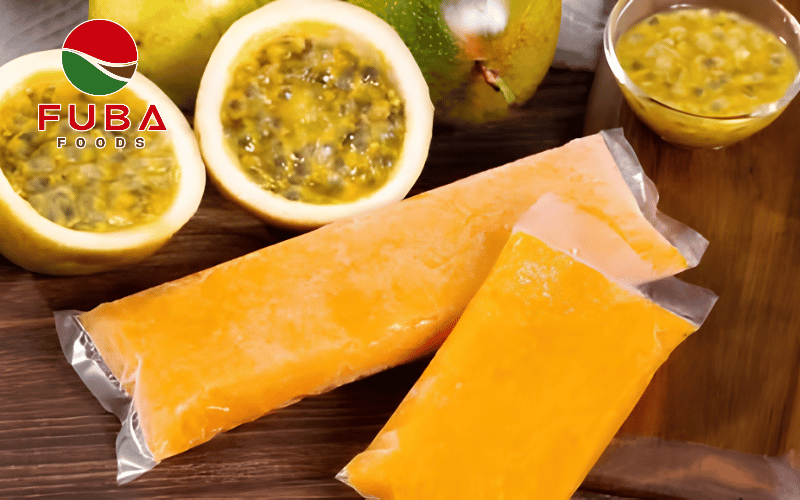
Passion fruit brings a distinctive combination of tropical aroma, bright acidity, and fruit character to dairy products. This makes it particularly interesting for yogurt, drinking yogurt, dairy desserts, fruit preparations, and other products that need a recognizable tropical flavor. At the same time, passion fruit is more technically demanding than some sweeter fruits because its natural acidity can influence the texture, stability, and overall balance of a dairy formulation.
Passion fruit puree for dairy products should therefore be selected not only for its flavor, but also for its acidity, soluble solids, texture, fruit consistency, processing characteristics, and compatibility with the intended dairy system. The right puree can provide a strong natural fruit profile while helping manufacturers develop a consistent product across commercial production batches.
For dairy manufacturers, ingredient buyers, and distributors, the supplier’s processing capability is equally important. Raw fruit variation, puree consistency, freezing conditions, food-safety controls, and supply continuity can all affect the final product. This article explains the main considerations when choosing passion fruit puree for yogurt and other dairy applications, from formulation performance to factory-level sourcing and processing.
Why Passion Fruit Works Well in Dairy Products
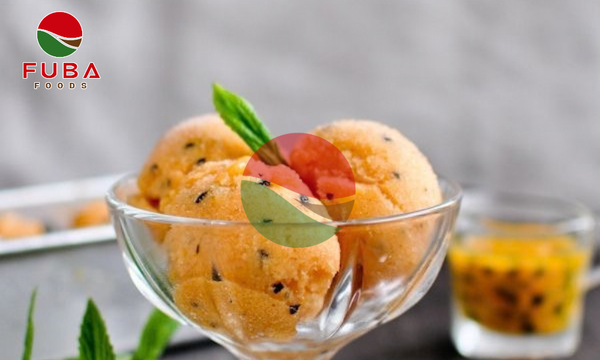
Passion fruit has a flavor profile that can create a strong contrast with the creamy and relatively mild character of dairy products. Its aromatic intensity helps the fruit remain noticeable after being blended with yogurt, milk, cream, or other dairy ingredients, while its natural acidity can add freshness to the finished product.
This combination makes passion fruit suitable for products ranging from spoonable yogurt and drinking yogurt to fruit-on-the-bottom preparations, dairy desserts, smoothies, and other tropical dairy formulations.
However, the same acidity that makes passion fruit distinctive also requires careful formulation. Adding fruit puree to a dairy system changes more than its flavor. Depending on the formulation and processing conditions, acidity can interact with milk proteins and influence viscosity, separation, mouthfeel, and physical stability.
For this reason, manufacturers should evaluate passion fruit puree as a functional ingredient within the complete formulation rather than treating it simply as a flavor component.
Key Specifications for Passion Fruit Puree in Dairy Formulation
Acidity and Brix Need to Be Considered Together
Acidity is one of the most important parameters when incorporating passion fruit into dairy products. The fruit’s naturally tart profile can be desirable in yogurt, but excessive or poorly controlled acidity may make the finished product too sharp or influence its physical characteristics.
Brix is another important parameter because it indicates the level of soluble solids in the puree and can influence sweetness, fruit intensity, and formulation ratios.
Manufacturers should therefore establish the target Brix and acidity range before selecting a commercial puree. Looking at either parameter in isolation can provide an incomplete picture of how the ingredient will perform in a dairy formulation.
The target specification should also account for the amount of puree used in the recipe. A highly concentrated fruit ingredient may require a different dosage from a lighter puree, while changes in fruit solids can affect the final sweetness and texture of the yogurt.
Flavor and Aroma Should Remain Noticeable After Blending
Passion fruit is often chosen precisely because its aroma is distinctive. A puree with insufficient fruit intensity may become difficult to perceive once it is combined with dairy ingredients.
Manufacturers should therefore evaluate the puree in the finished formulation rather than judging its aroma only in its frozen or thawed state. The interaction between fruit, milk, sugar, stabilizers, and other ingredients can change the perceived flavor balance.
For tropical yogurt, the goal is generally not simply to make the product acidic. The formulation needs to retain a recognizable passion fruit character while maintaining a balanced relationship between tartness, sweetness, and creamy dairy notes.
Texture and Fruit Solids Affect Mouthfeel
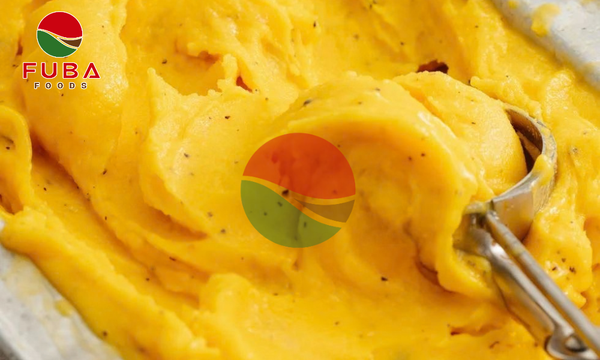
Puree texture can influence the final mouthfeel of yogurt and other dairy foods. A smooth puree may be appropriate for a uniform drinking yogurt, while a preparation with more visible fruit characteristics may be preferred for spoonable yogurt or layered products.
Manufacturers should consider particle size, pulp consistency, fruit solids, and the way the puree behaves during mixing and processing.
Consistency between batches is particularly important. If one delivery has a significantly different texture or fruit-solid content from another, the manufacturer may need to adjust the formulation or processing parameters to achieve the same finished-product characteristics.
Choosing the Right Passion Fruit Format for Dairy Products
Not every dairy application requires the same fruit format.
Smooth Puree for Drinking Yogurt and Uniform Dairy Beverages
Smooth passion fruit puree can be useful where manufacturers need a relatively uniform fruit distribution throughout the product. Drinking yogurt, dairy smoothies, and other fluid dairy beverages may benefit from a puree that can be dispersed efficiently during mixing.
The ingredient should be evaluated together with the manufacturer’s homogenization, filling, and stabilization process. Even a smooth puree needs to remain compatible with the equipment and formulation conditions used by the producer.
Fruit Preparations for Spoonable Yogurt
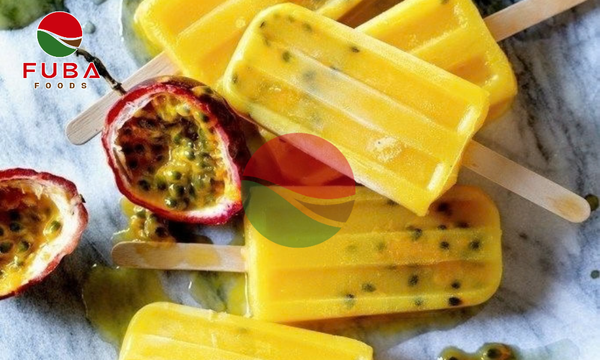
Spoonable yogurt can accommodate a more noticeable fruit component, particularly when the product is designed around a strong fruit layer or fruit-forward sensory profile.
In this case, manufacturers may prioritize fruit appearance, texture, aroma, and the ability of the preparation to remain stable during storage. The passion fruit ingredient may be combined with sugar, stabilizers, or other formulation components before being incorporated into the yogurt system.
Passion Fruit With Seeds for More Natural Applications
Some dairy products are intentionally formulated to retain the characteristic seeds of passion fruit. This can create a more visibly natural fruit appearance and introduce additional texture.
Whether this is appropriate depends on the finished product and production line. Manufacturers using passion fruit with seeds need to consider particle characteristics and equipment compatibility, particularly for products requiring pumping, homogenization, or fine filtration.
Managing Passion Fruit Acidity in Yogurt Formulation
One of the main technical challenges when developing passion fruit yogurt is controlling the relationship between fruit acidity and the dairy matrix.
Yogurt already has an acidic profile as a result of fermentation. Introducing an acidic fruit ingredient can intensify the overall tartness and may affect the physical behavior of the formulation depending on when and how the fruit component is added.
This means manufacturers should test the puree at the intended dosage rather than simply selecting an ingredient based on its standalone sensory profile.
The formulation may need adjustment through the balance of fruit puree, sugar, milk solids, stabilizers, and other ingredients. Processing sequence can also matter. A fruit preparation incorporated after fermentation may behave differently from fruit introduced earlier in the manufacturing process.
For commercial development, pilot trials are therefore important. The purpose is to establish how the puree interacts with the specific dairy base rather than assuming that one generic passion fruit specification will work across every yogurt formulation.
How Processing Quality Influences Frozen Passion Fruit Puree
The consistency of a frozen passion fruit puree begins with the raw fruit and continues through every processing stage.
Raw material maturity, sourcing region, inspection, cleaning, sorting, preparation, freezing, packaging, and storage can all influence the final ingredient. If these stages are poorly controlled, differences in fruit quality can eventually appear as changes in color, aroma, acidity, texture, or overall formulation performance.
At FUBA, passion fruit is sourced through established agricultural regions in Vietnam, including the Central Highlands, before entering a controlled factory process. The production flow includes raw material inspection, washing and cleaning, sorting and grading, preparation, IQF freezing, metal detection, packing, cold storage, and export shipment.
This integrated approach is relevant for dairy manufacturers because ingredient consistency depends on more than the final packaging. The supplier needs to control the product from the point where raw fruit enters the facility through frozen storage and shipment.
Food Safety and Quality Control for Dairy Ingredients
Dairy manufacturers typically operate under strict food-safety requirements, so the fruit ingredient entering the production system needs to meet clearly defined quality standards.
Buyers should look at how the supplier controls incoming raw materials, microbiological risks, foreign materials, traceability, packaging, and frozen storage. Quality systems should be supported by documented procedures rather than relying solely on final visual inspection.
For dairy manufacturers, this type of manufacturing infrastructure can provide greater visibility into how the fruit ingredient is controlled before it reaches the dairy production line.
Cold Storage and Freezing Are Part of Ingredient Quality
Freezing is not simply a method of extending shelf life. For commercial fruit ingredients, both the freezing process and subsequent storage conditions play an important role in maintaining the product’s intended characteristics.
Commercial freezing facilities may use a combination of IQF, contact freezing, and air-blast freezing systems depending on the product and processing requirements. Sufficient cold-storage capacity is also important, particularly when finished products need to be held before shipment. Frozen products should be maintained at -18°C or below to help preserve their quality during storage.
For international dairy ingredient sourcing, this becomes especially important because frozen puree may remain in controlled storage through factory handling, export transportation, and the buyer’s own warehouse before being used in production.
A reliable cold chain helps minimise unnecessary quality variation between the product leaving the factory and the ingredient eventually entering the dairy plant.
Evaluate Supplier Capacity Before Scaling a Dairy Product
A supplier that can provide a successful sample is not necessarily ready to support a large commercial yogurt program.
Once a product is launched, manufacturers may require recurring deliveries according to a defined specification. Any significant variation in raw material or puree characteristics can create unnecessary formulation adjustments and production complications.
FUBA has more than 15 years of experience in frozen fruit and vegetable processing, an annual supply capacity of 20,000 MT, more than 600 workers, and export experience across more than 30 countries.
The combination of agricultural sourcing, factory processing, cold storage, and international export operations provides a connected supply chain for companies that require recurring frozen fruit ingredients.
For dairy manufacturers, supply continuity should be considered during supplier qualification rather than after the product has already entered commercial production.
Packaging and Custom Specifications for Dairy Manufacturing
Packaging requirements can vary significantly according to production volume, warehouse systems, destination market, and handling procedures.
Industrial dairy manufacturers generally need bulk formats that can be stored efficiently and transferred into production without unnecessary repacking. The packaging must also protect the frozen puree throughout storage and transportation.
FUBA provides packaging according to customer and market requirements and supports customized product specifications, packaging formats, OEM, and private-label manufacturing.
For manufacturers developing a long-term yogurt or dairy product, customization can be particularly useful when the ingredient specification, packaging format, or labeling requirements differ from standard market products.
How to Test Passion Fruit Puree Before Commercial Production
A practical product trial should evaluate the puree inside the intended dairy formulation rather than only tasting the ingredient separately.
Manufacturers should assess flavor intensity, acidity, sweetness balance, color, texture, fruit distribution, and overall mouthfeel after blending with the actual dairy base. Storage trials are also useful because the product may change during refrigerated shelf life.
For yogurt, it is important to observe whether the fruit preparation affects viscosity, syneresis, separation, or overall stability. For drinking yogurt, manufacturers should additionally evaluate flow behavior, sedimentation, and compatibility with the homogenization and filling process.
The objective of the trial is to determine not only whether the puree tastes good, but whether it performs consistently throughout the product’s intended shelf life.
Conclusion
Passion fruit puree for dairy products can provide a distinctive tropical profile for yogurt, drinking yogurt, dairy beverages, fruit preparations, desserts, and other dairy foods. Its strong aroma and natural acidity make passion fruit highly recognizable, but these same characteristics mean the ingredient must be carefully matched with the dairy formulation.
For commercial production, buyers should evaluate acidity, Brix, flavor intensity, texture, fruit solids, processing compatibility, and batch consistency. The right specification should be established through formulation trials rather than selected solely from a product description or isolated sample.
The supplier’s manufacturing capability is equally important. Agricultural sourcing, controlled processing, food-safety systems, freezing technology, cold storage, packaging, and production capacity all contribute to the consistency of the ingredient delivered to the dairy plant.
Ultimately, selecting passion fruit puree for a dairy product is not simply about finding a strong tropical flavor. The better approach is to select an ingredient whose acidity, fruit character, texture, processing quality, and supply consistency work together with the dairy formulation and the manufacturing process.


