

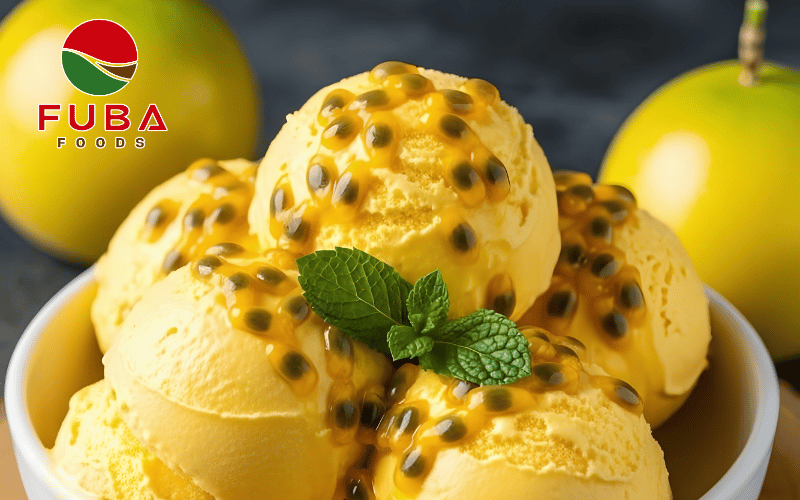
Passion fruit is naturally distinctive for more than its intense tropical aroma and bright acidity. Its small black seeds and surrounding pulp are also part of the fruit’s recognizable appearance and eating experience. In products where consumers expect to see or feel real passion fruit, removing the seeds completely can change the character of the finished product.
Passion fruit pulp with seeds is particularly suitable when manufacturers want to retain a more natural passion fruit appearance, texture, and sensory experience in food and beverage products. The seeds can contribute visual authenticity and a characteristic mouthfeel, while the surrounding pulp provides the fruit’s familiar aroma, acidity, and flavor.
However, keeping seeds is not automatically the right choice for every application. Their size, distribution, texture, and interaction with the finished formulation need to match the product concept and processing requirements. For manufacturers, distributors, and foodservice suppliers, understanding these differences is important before selecting a frozen passion fruit ingredient.
This article examines when passion fruit pulp with seeds makes sense, which applications benefit from natural seeds, what specifications buyers should evaluate, and how processing and factory controls influence the consistency of the final ingredient.
What Is Passion Fruit Pulp With Seeds?
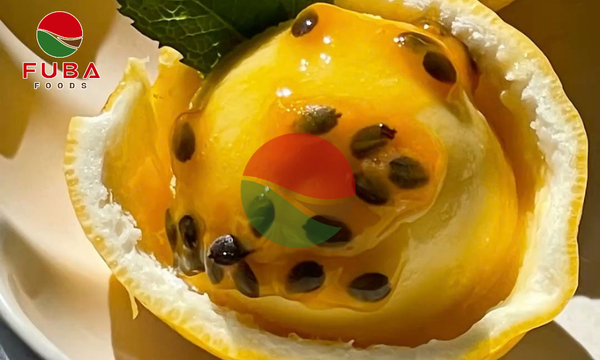
Passion fruit pulp with seeds refers to fruit pulp that retains the natural seeds of the passion fruit rather than separating them completely during processing. The product therefore contains the characteristic combination of aromatic fruit pulp and small edible seeds associated with fresh passion fruit.
The distinction is important because different passion fruit ingredients can be processed to achieve different textures. A strained or seedless puree may provide a smoother base for beverages and sauces, while pulp with seeds offers a more visibly natural fruit character.
For commercial production, the term should therefore be treated as a product specification rather than simply a description of the fruit. Buyers should clarify how much seed is retained, the expected pulp-to-seed balance, particle characteristics, and whether the product is intended for direct consumption or further processing.
Why Do Natural Seeds Matter in Passion Fruit Products?
Visual Authenticity
One of the clearest reasons to retain passion fruit seeds is appearance. The dark seeds provide an immediate visual cue that the product contains real passion fruit.
This can be particularly useful in products where fruit pieces, pulp, or natural ingredients are visible to consumers. A yogurt topping, dessert sauce, fruit preparation, beverage, or premium dessert can communicate a more recognizable passion fruit identity when the characteristic seeds remain present.
The visual effect can also support product positioning around natural fruit content. Instead of presenting a completely smooth fruit base, manufacturers can retain some of the physical characteristics consumers associate with the original fruit.
Natural Mouthfeel
Seeds can also change the sensory experience. Their presence introduces a slight texture that is different from a completely smooth puree.
Whether this is desirable depends on the product. In a fruit preparation or dessert, the texture may reinforce the perception of real fruit. In a smooth beverage intended to pass through fine filtration or filling equipment, however, the same seeds may create processing limitations.
This is why seed retention should be evaluated according to the finished product rather than treated as an inherent advantage in every formulation.
A More Recognizable Fruit Experience
Passion fruit is a fruit where consumers often recognize the whole sensory combination: strong aroma, tangy pulp, vibrant color, and characteristic seeds. Retaining the seeds can help preserve this recognizable identity in applications where authenticity is part of the product experience.
For manufacturers developing premium or fruit-forward products, this can be more relevant than simply maximizing smoothness.
Which Food and Beverage Products Can Use Passion Fruit Pulp With Seeds?
Beverages With a Natural Fruit Positioning
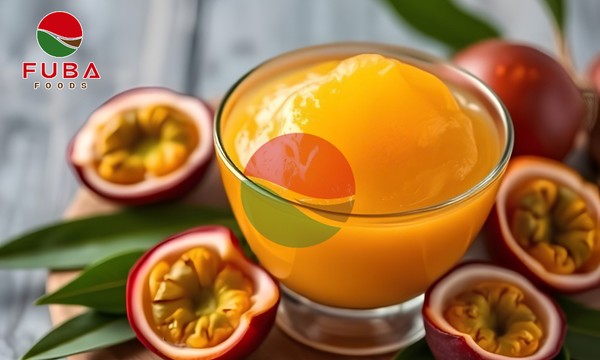
Some fruit beverages, smoothies, specialty drinks, and tropical blends can benefit from visible or perceptible passion fruit characteristics.
However, manufacturers need to consider the filling and processing system. Larger or uneven particles may affect pumps, valves, homogenization, filtration, or filling equipment. The desired seed specification should therefore be established together with the technical requirements of the production line.
For beverages where seeds are intentionally visible, a controlled and consistent distribution is preferable to random variation between batches.
Yogurt and Dairy-Based Products
Passion fruit pulp with seeds can work particularly well in fruit preparations for yogurt and other dairy products where the fruit component is expected to remain noticeable.
The contrast between creamy dairy texture and acidic passion fruit pulp creates a distinct sensory profile, while the seeds reinforce the visual impression of real fruit.
For these applications, manufacturers should also evaluate acidity, fruit solids, texture, and compatibility with the dairy formulation. The ingredient needs to be stable enough for the intended processing and storage conditions rather than being selected only for its flavor.
Desserts, Toppings, and Sauces
Desserts are another strong application because seeds can become part of the presentation rather than an unwanted particle.
Passion fruit pulp with seeds can be incorporated into dessert sauces, cake fillings, cheesecake toppings, ice cream preparations, fruit layers, and other applications where consumers can directly see the fruit ingredient.
Here, appearance and texture can be just as important as flavor intensity. Manufacturers may prefer a pulp that maintains a natural-looking distribution of seeds rather than one that has been excessively processed.
Bakery and Fruit Preparations
In bakery applications, passion fruit pulp can be used in fillings, fruit layers, creams, glazes, and other preparations. Whether seeds should remain depends on the product’s desired texture and the processing equipment involved.
For industrial bakery production, consistency becomes particularly important because the pulp may be combined with sugar, starches, fats, dairy ingredients, or other fruit components. An inconsistent seed or pulp structure can affect how the filling spreads and behaves during production.
Passion Fruit Pulp With Seeds vs. Seedless Puree
The choice between seeded pulp and seedless puree should be based on the finished product’s requirements rather than a general assumption that one format is better.
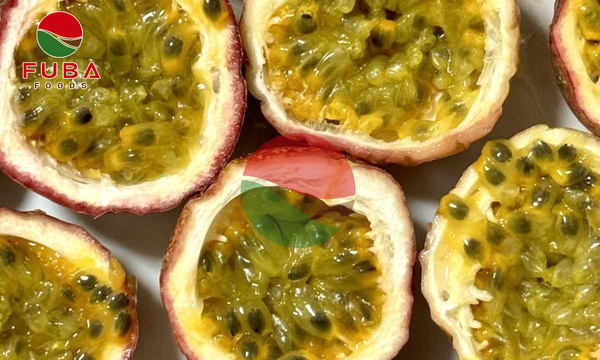
Passion fruit pulp with seeds is generally more appropriate when visual fruit identity, natural texture, and a recognizable passion fruit eating experience are important. It can work well in fruit preparations, desserts, toppings, selected beverages, and products where the seeds are intentionally part of the presentation.
Seedless passion fruit puree, by contrast, is more suitable when manufacturers need a smooth ingredient that can be blended, homogenized, filtered, or incorporated into formulations without noticeable particles. Beverage bases, smooth sauces, and certain industrial formulations may benefit from this format.
The important consideration is whether the physical characteristics of the ingredient support the manufacturing process. A product can have excellent fruit quality and still be unsuitable for a particular production line if its particle or seed characteristics do not match the equipment.
What Should Buyers Check When Sourcing Passion Fruit Pulp With Seeds?
Seed Size and Distribution
“With seeds” is not a sufficiently detailed commercial specification by itself. Buyers should clarify the expected seed characteristics and distribution.
A consistent specification helps manufacturers avoid large differences between batches. If one shipment contains significantly more seeds or different particle characteristics than another, the finished product may not look or feel the same.
For commercial sourcing, buyers should request representative samples and assess the ingredient under actual production conditions rather than relying only on photographs or a product description.

Pulp Texture and Fruit Characteristics
The surrounding pulp needs to have the right texture and flavor intensity for the intended application. Manufacturers should evaluate aroma, color, acidity, soluble solids where applicable, and overall fruit character.
These characteristics can influence the amount of puree or pulp required in the finished formulation. Consistent raw material specifications can therefore make production planning and recipe control easier.
Processing and Food-Safety Controls
The presence of natural seeds does not remove the need for strict processing controls. The raw fruit still needs to pass through appropriate inspection, cleaning, sorting, preparation, and food-safety procedures before becoming a commercial frozen ingredient.
At FUBA, the production flow begins with farm sourcing and raw material inspection before washing, cleaning, sorting, preparation, freezing, metal detection, packing, and controlled cold storage. The integrated process helps connect raw material quality with finished-product control.
The factory also operates five metal detection systems, three X-ray inspection systems, and an in-house microbiological laboratory, supported by food-safety management systems including HACCP, ISO 22000, HALAL, and BRCGS.
Why Factory Processing Matters for Seeded Passion Fruit Pulp
When natural fruit particles are intentionally retained, processing consistency becomes particularly important. The goal is not simply to keep the seeds, but to maintain the desired balance between pulp and seeds while controlling food safety, texture, and product uniformity.
A factory with integrated agricultural sourcing and processing can have greater control over this process. Working directly with farming regions and growers across Vietnam can help manufacturers maintain better control over raw material quality and consistency. Passion fruit is also widely cultivated in Vietnam’s Central Highlands, making the region an important source of raw material for processing.
Processing infrastructure also plays a role in maintaining consistency at commercial scale. Freezing facilities may include IQF, contact freezing, and air-blast freezing systems, while sufficient cold-storage capacity allows finished products to remain under controlled conditions before shipment. Finished frozen products should be stored at -18°C or below to help maintain their quality throughout the intended shelf life.
For buyers, this type of infrastructure matters because maintaining product characteristics does not end when processing is complete. Proper frozen storage and cold-chain handling are also part of preserving the ingredient until it reaches the customer’s facility.

How to Test Passion Fruit Pulp With Seeds Before Commercial Sourcing
A supplier sample should ideally be evaluated in the actual application rather than judged only after thawing in isolation.
For beverages, manufacturers can assess how the seeds move through mixing and filling equipment and whether the desired visual distribution is maintained. For yogurt and dessert applications, the focus may shift toward appearance, spoonability, texture, and fruit distribution.
A pilot trial can also reveal whether the ingredient requires additional formulation adjustments. The same passion fruit pulp may behave differently when combined with water, sugar, dairy ingredients, stabilizers, starches, or other fruit components.
For larger commercial programs, repeated samples or production batches should be compared to determine whether the supplier can maintain a consistent specification over time.
Supply Reliability Is Part of Product Quality
For a food manufacturer, product quality is not limited to the physical characteristics of one shipment. A supplier also needs to be capable of maintaining those characteristics when order volumes increase.
FUBA has more than 15 years of experience in frozen fruit and vegetable processing, an annual supply capacity of 20,000 MT, more than 600 workers, and export experience across more than 30 countries.
This production base supports customers that need recurring frozen fruit supply rather than isolated spot purchases. The company’s agricultural sourcing network and processing infrastructure also allow raw material sourcing, manufacturing, quality control, storage, and export operations to be managed as connected stages of the supply chain.
For manufacturers, this can be particularly relevant when a seeded passion fruit product becomes part of a standardized recipe that needs to be reproduced consistently across multiple production cycles.

Conclusion
Passion fruit pulp with seeds can be a valuable ingredient when natural fruit appearance, recognizable passion fruit texture, and a more authentic sensory experience are important to the finished product. Its applications can extend across selected beverages, yogurt and dairy products, desserts, toppings, sauces, bakery preparations, and other fruit-based foods.
However, retaining seeds should always be a deliberate product decision. Seed size and distribution, pulp texture, flavor, acidity, processing requirements, food-safety controls, and compatibility with the production line all need to be considered before commercial sourcing.
The right seeded passion fruit ingredient is therefore not simply the one that contains natural seeds. It is the one whose pulp, seed characteristics, sensory profile, processing quality, and supply consistency fit the exact requirements of the finished food or beverage product.


