

Mango is used across a wide range of manufactured foods, from beverages and dairy products to sauces, desserts, bakery fillings, and fruit-based formulations. While frozen mango pieces are useful when the final product needs visible fruit pieces or a defined cut, they are not always the most efficient format for recipes that require a smooth, consistent mango base.
For manufacturers, choosing between mango puree and frozen mango pieces is therefore more than a matter of product preference. The right format can affect processing time, formulation consistency, texture, yield, storage requirements, and the efficiency of the production line.
Mango puree for food manufacturing is generally the more suitable option when the recipe requires a smooth fruit base, consistent mango flavour, controlled solids, or efficient incorporation into liquid and semi-liquid formulations. Frozen mango pieces are more appropriate when the finished product needs visible fruit pieces, defined texture, or a natural fruit appearance.
This article explains when mango puree makes more sense than frozen mango pieces, which food applications benefit from puree, what specifications manufacturers should evaluate, and how processing and raw material control affect the final ingredient. It also looks at practical factors such as Brix, texture, storage, supply consistency, and supplier capabilities before making a commercial decision.

When Should Food Manufacturers Use Mango Puree Instead of Frozen Mango Pieces?
The simplest way to distinguish the two formats is to consider the role mango plays in the finished product. If mango needs to function primarily as a flavour, colour, fruit-solids, or smooth-texture component, puree is often easier to incorporate. If mango itself needs to remain recognisable as a physical fruit component, frozen pieces may be more suitable.
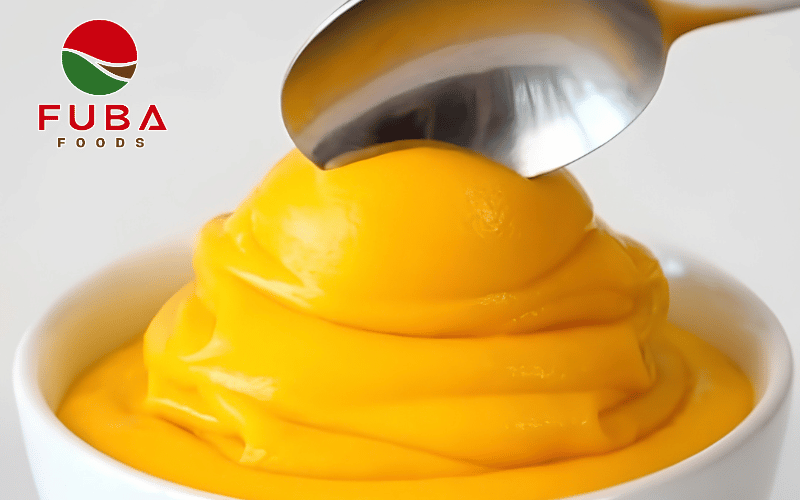
Frozen Mango Puree
Mango puree is particularly practical for formulations in which the ingredient is blended, mixed, homogenised, or pumped through processing equipment. Instead of handling individual fruit pieces, manufacturers receive mango in a form that can be incorporated directly into the formulation after the required thawing or preparation process.
This can simplify production where uniformity matters. A beverage manufacturer, for example, may need mango to disperse consistently throughout a drink rather than remain as individual pieces. Similarly, yoghurt, ice cream, dessert sauces, and bakery fillings often require mango flavour and fruit content without the physical structure of diced fruit.
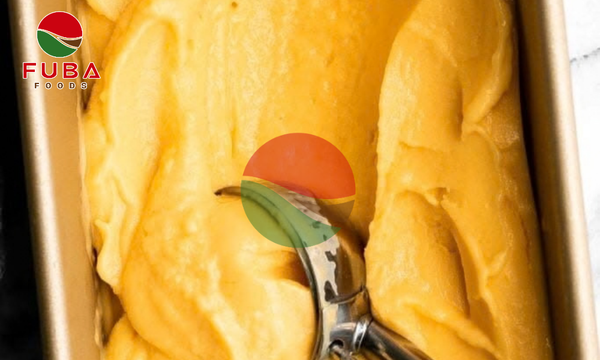
Frozen Mango Pieces
Frozen mango pieces serve a different purpose. Their defined shape and texture can be valuable in ready meals, fruit mixes, toppings, desserts, or products where consumers are expected to see or bite into mango.
The decision should therefore start with the finished product rather than the ingredient itself.
What Makes Mango Puree Suitable for Food Manufacturing?
Smooth Texture and Easy Formulation
One of the main advantages of mango puree is its ability to integrate into a formulation more easily than whole or diced frozen mango. A smooth puree can be blended with water, dairy ingredients, fruit concentrates, sweeteners, stabilisers, or other ingredients depending on the recipe.
This makes it particularly useful for manufacturers working with liquid and semi-liquid products. Instead of first breaking down frozen fruit pieces during processing, the mango component is already in a prepared form.
For high-volume production, this can reduce unnecessary preparation steps and make ingredient handling more predictable. It also allows manufacturers to focus more closely on formulation parameters such as fruit content, sweetness, viscosity, and final texture.
Consistent Mango Flavour and Fruit Solids
Consistency is another important consideration when mango is used as a core formulation ingredient. Variations in raw fruit maturity, size, and physical structure can affect the behaviour of fresh or frozen mango pieces during processing.
A commercially produced puree is processed into a uniform ingredient, making it easier to incorporate into repeat production batches. For products manufactured continuously or across multiple production runs, this consistency can be more practical than processing different batches of frozen fruit pieces.
Mango puree can also provide a more efficient way to deliver mango flavour and fruit solids throughout a finished formulation, particularly when the final product does not require visible chunks.
Controlled Brix for Product Formulation
Brix is an important specification when evaluating mango puree for food manufacturing because it provides an indication of soluble solids and can influence formulation calculations.
A commercial mango puree specification may be defined around 14–18° Brix, while IQF mango cubes can have a different specification, such as 12–14° Brix. The difference matters when manufacturers are calculating fruit content, sweetness, water addition, and overall formulation balance.
Rather than selecting a mango ingredient simply because it has the right flavour, manufacturers should match the Brix specification to the formulation and processing conditions of the finished product.

Which Food Products Are Better Suited to Mango Puree?
Mango puree is particularly relevant when the finished product requires mango to be dispersed throughout the formulation rather than presented as individual fruit pieces.
Beverages and Mango-Based Drinks
Beverage production is one of the clearest applications for mango puree. Smooth mango texture allows the ingredient to be incorporated into juices, fruit drinks, smoothies, nectar-style beverages, and other mango-based formulations.
Using pieces would require additional processing to break down the fruit and distribute it throughout the beverage. Puree provides a more direct route to achieving a consistent mango base.
For manufacturers, the important specifications may include Brix, colour, flavour intensity, texture, microbiological requirements, packaging format, and storage conditions. These should be agreed before production rather than treated as secondary details after purchasing.
Yoghurt, Ice Cream, and Dairy-Based Products
Mango puree is also suitable for yoghurt, ice cream, frozen desserts, and other dairy-based products where mango needs to be incorporated into the base or fruit preparation.
In these applications, smoothness and consistency can be particularly important. The puree can be blended into the formulation or used as a fruit component without requiring the same mechanical breakdown associated with frozen mango pieces.
Mango puree can also be used where the manufacturer wants a uniform mango distribution rather than distinct fruit chunks.
Bakery, Dessert, and Sauce Applications
Bakery fillings, dessert preparations, fruit sauces, toppings, and similar products can also benefit from puree because the ingredient can be incorporated into a semi-solid formulation without introducing large fruit pieces.
The required specification will depend on the recipe. A filling may require a particular viscosity, while a sauce may place greater emphasis on smoothness and flavour concentration. This is why a supplier should be able to discuss product specifications rather than offering only a generic “frozen mango” description.
When Are Frozen Mango Pieces a Better Choice?
Choosing puree does not mean it is always the better mango ingredient. Frozen mango pieces remain valuable when the physical appearance and texture of the fruit are part of the finished product.
Products such as fruit mixes, toppings, desserts with visible mango, and certain ready-to-eat or ready-to-cook applications may require defined pieces rather than a smooth base.
The key question is therefore not whether puree is superior to pieces. It is whether the ingredient format matches the physical and formulation requirements of the finished product.
What Specifications Should Buyers Check for Mango Puree?
Selecting mango puree for food manufacturing requires more than checking whether the supplier has mango puree available. Several specifications can directly affect production performance.
Mango Variety and Raw Material Origin
The variety used for puree can influence flavour, aroma, colour, sweetness, and texture. Raw material origin also matters because agricultural conditions and sourcing regions can affect fruit characteristics.
A manufacturer should therefore ask what mango varieties are used and whether the supplier has a stable sourcing network rather than purchasing based only on the final puree specification.
At FUBA, mango products are produced from Vietnamese mango, with sourcing connected to Vietnam’s agricultural regions and an established processing operation. This type of integrated sourcing model allows raw material procurement and factory processing to be considered together rather than treating the frozen ingredient as a purely trading product.
Brix, Texture, and Product Consistency
Brix should be matched to the manufacturer’s formulation requirements. Texture should also be considered because puree intended for beverages may have different processing expectations from puree used in bakery, dairy, or dessert applications.
The supplier should be able to provide a clear product specification covering parameters relevant to the intended use. This gives the manufacturer a more reliable basis for recipe development, production trials, and repeat purchasing.
Processing and Food Safety Controls
Raw material quality alone does not determine the quality of frozen mango puree. Washing, sorting, preparation, processing, freezing, packaging, inspection, and storage all contribute to the final product.
A factory with an integrated production flow can control these stages more closely. FUBA’s processing system covers raw material inspection, washing and cleaning, sorting and grading, preparation, freezing, metal detection, packing, cold storage, and export shipment. Its quality system includes HACCP, ISO 22000, HALAL, BRCGS, FDA compliance, and traceability controls.
For manufacturers, these controls are relevant because ingredient consistency and food safety need to remain stable across repeated commercial shipments, not only during an initial sample order.
How Does Freezing and Cold Storage Affect Mango Puree?
Once mango puree has been processed and frozen, maintaining the cold chain becomes part of product quality management. Temperature fluctuations during storage or transportation can affect texture, stability, and overall product condition.
Commercial frozen mango products are generally stored at ≤ -18°C, with shelf life reaching up to 24 months under appropriate storage conditions.
For a manufacturer, this means supplier evaluation should extend beyond the production line. Cold storage capacity, shipment preparation, packaging integrity, and temperature control throughout export logistics can all influence whether the ingredient arrives in a condition suitable for production.
FUBA operates three cold-storage facilities with a stated capacity of 500 MT each, supporting frozen product storage before export shipment.
This becomes particularly relevant for distributors and manufacturers planning recurring orders, because sufficient storage capacity can help support production planning between processing and shipment schedules.

Is Mango Puree More Efficient for Large-Scale Production?
Efficiency depends on the product, but puree can reduce several preparation requirements when mango is intended to become part of the formulation rather than remain as a visible fruit component.
With frozen pieces, a manufacturer may need additional steps for thawing, cutting or size adjustment, pulping, blending, or other preparation depending on the recipe. With puree, the ingredient arrives in a form that is already processed for incorporation into the formulation.
This can be particularly useful for high-volume beverage, dairy, dessert, and bakery production, where repeated handling of fruit pieces may add unnecessary processing time.
However, manufacturers should evaluate total ingredient cost rather than comparing the purchase price per kilogram alone. Yield, preparation labour, processing losses, equipment requirements, storage, and formulation efficiency can all influence the actual cost of using an ingredient.
A factory-direct manufacturer can also have an advantage in controlling production economics at the source because raw material sourcing, processing, freezing, quality control, and storage are managed within the same supply chain. FUBA’s annual production capacity is stated at 20,000 MT, with more than 15 years of experience and exports to over 30 markets, providing an example of the scale required to support ongoing frozen ingredient supply.
What Packaging Should Be Considered for Commercial Mango Puree?
Packaging should match the manufacturer’s production volume and handling system. A small foodservice operation may need a different pack size from an industrial processor purchasing mango puree for continuous production.
Commercial frozen mango products can be supplied in formats ranging from smaller retail packs to larger foodservice and bulk-export packaging.
For manufacturers, bulk packaging can be more practical when the ingredient is consumed at high volume, while smaller formats may be suitable for foodservice or applications with lower daily usage.
The important point is to match packaging with the production environment, storage space, thawing process, and expected consumption rate rather than selecting the smallest available unit simply because it is easier to handle.
How Should Manufacturers Choose Between Mango Puree and Frozen Mango Pieces?
The decision can be made by looking at the role mango plays in the finished product.
If the formulation needs a smooth mango base, consistent fruit solids, easy blending, and efficient incorporation into liquid or semi-liquid products, mango puree is generally the more appropriate format.
If the finished product needs visible fruit, defined shapes, bite-sized texture, or controlled pieces for portioning, frozen mango pieces are likely to be more suitable.
Manufacturers should then compare the specifications of available products, including mango variety, Brix, texture, processing method, storage temperature, shelf life, packaging, quality certifications, and supply capacity.
Supplier capability is equally important. A supplier may have a suitable sample but still struggle to maintain the same specification across larger or repeated orders. Reviewing raw material sourcing, factory processing, cold-storage capacity, quality systems, and export experience provides a more realistic picture of long-term supply reliability.

Conclusion
Mango puree for food manufacturing is most useful when mango needs to function as a smooth, consistent ingredient within a formulation rather than as a visible fruit component. Beverages, yoghurt, ice cream, bakery fillings, desserts, sauces, and other semi-liquid products can often benefit from puree because it simplifies incorporation and supports more consistent processing.
Frozen mango pieces remain the better fit when the finished product depends on visible fruit, defined cuts, or a noticeable mango texture. The right choice therefore depends on the final application, not simply on the general quality of the mango.
For commercial sourcing, manufacturers should evaluate Brix, mango variety, raw material control, processing technology, food safety systems, freezing, cold storage, packaging, and production capacity together. A supplier with direct factory control across these stages can provide greater visibility into how the ingredient is produced and maintained from raw mango to finished frozen product.
Ultimately, the most suitable mango ingredient is the one that fits the formulation, production process, storage conditions, and required supply volume consistently over time.


