

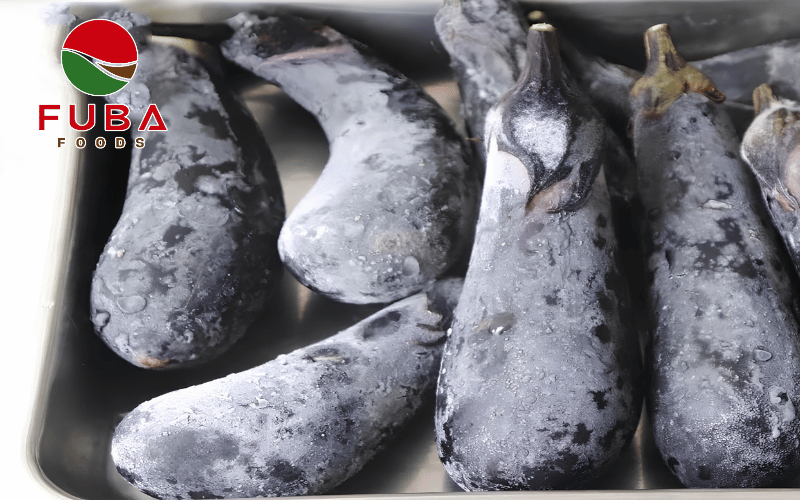
Choosing between IQF eggplant and conventional frozen eggplant is not simply a matter of selecting one freezing method over another. For food manufacturers, distributors, foodservice operators, and importers, the real question is how the freezing format will affect product quality, handling, yield, storage, and processing efficiency after the product reaches the factory or commercial kitchen.
The difference between IQF vs conventional frozen eggplant becomes particularly important when eggplant is purchased in bulk and used across multiple production batches. While both formats can provide year-round availability and reduce dependence on fresh seasonal supply, their performance during storage, portioning, thawing, and cooking can be significantly different.

Understanding these differences before placing a commercial order can help buyers select the right specification for their application, avoid unnecessary processing losses, and achieve more consistent results from batch to batch.
In this article, we will explore the typical shelf life of frozen eggplant, the recommended storage temperature, and the key factors that can affect product quality during storage and transportation. We will also cover practical cold-chain and handling practices that can help maintain the product’s texture, color, flavor, and overall quality throughout its intended storage period.
What Is the Difference Between IQF and Conventional Frozen Eggplant?
IQF, or Individually Quick Frozen, is a freezing process in which individual pieces of prepared eggplant are rapidly frozen so that they remain substantially separate after freezing. Conventional frozen eggplant is a broader term that can refer to products frozen using slower or non-IQF methods, often resulting in pieces freezing together into blocks or larger clusters.
The distinction is important because freezing does more than simply lower the temperature of the vegetable. The rate at which freezing occurs influences the size and distribution of ice crystals formed inside the plant tissue. Faster freezing generally creates smaller ice crystals, which can help reduce structural damage and support better retention of texture after storage and preparation.
However, buyers should not assume that every IQF product will automatically outperform every conventional frozen product. Raw material maturity, cutting size, pre-treatment, blanching or cooking conditions, freezing parameters, packaging, storage temperature, and cold-chain management all contribute to the final result. A well-controlled production process is therefore just as important as the freezing technology itself.

How IQF Freezing Affects Eggplant Quality
Eggplant contains a high proportion of water, making freezing control particularly important. When freezing occurs slowly, larger ice crystals can develop and damage cellular structures. After thawing or cooking, this may contribute to softer texture, greater moisture release, and more noticeable changes in appearance.
IQF freezing is designed to freeze individual pieces rapidly. Because the product passes through a controlled freezing system soon after preparation, the freezing process can better stabilize the individual pieces and reduce the tendency for them to become a single frozen mass.
For commercial users, this creates a practical advantage. A manufacturer can take the required quantity of eggplant from a carton or bag without having to defrost an entire block. This is especially useful when production lines require precise ingredient dosing or when the same raw material is used in different recipes.
IQF vs Conventional Frozen Eggplant: Key Differences for Buyers
When evaluating IQF vs conventional frozen eggplant, buyers should look beyond the label and consider how the product behaves throughout the entire supply chain. The most important differences are usually related to piece separation, handling, texture, portion control, processing efficiency, and total operating cost.
Piece Separation and Portion Control
One of the clearest advantages of IQF eggplant is individual piece separation. Properly frozen IQF pieces are designed to remain free-flowing, making it easier to take out only the quantity required for a production batch.
This matters when eggplant is used as an ingredient rather than sold as a complete retail product. A food manufacturer producing ready meals, pasta dishes, soups, stir-fries, or pizza toppings may need different quantities in each production run. With individually frozen pieces, operators can portion the ingredient more efficiently without repeatedly thawing and refreezing the remaining product.
Conventional frozen eggplant may freeze into blocks or clusters depending on the freezing process, product loading, moisture, and packaging format. Breaking apart frozen blocks adds handling time and can make automated or semi-automated dosing more difficult.

Texture and Moisture Retention
Texture is another major consideration. Eggplant naturally has a soft, porous structure, so freezing and subsequent cooking can strongly influence its final mouthfeel.
Rapid freezing can help limit the physical damage associated with large ice crystal formation. This does not mean IQF eggplant will have exactly the same texture as fresh eggplant, but it can provide a more controlled frozen-to-cooked result when the raw material and process are properly managed.
For buyers, the relevant question is not simply whether the eggplant is frozen, but whether the finished product meets the texture required by the application. A soft cooked eggplant may be desirable for sauces or prepared meals, while a manufacturer producing a more structured vegetable dish may require tighter specifications for size, preparation method, and cooking stage.
Processing Efficiency
Processing efficiency is where the difference between IQF and conventional frozen formats can become measurable at factory level.
IQF eggplant can generally be weighed, dosed, mixed, and transferred more easily because individual pieces are separated. This reduces the need for manual breaking or pre-thawing before production. For high-volume manufacturers, even small improvements in handling can become significant when multiplied across hundreds of production batches.
Conventional frozen eggplant may still be suitable where the product is destined for further processing and exact individual-piece handling is not important. If the eggplant will be blended, pureed, cooked into a sauce, or otherwise processed extensively, the operational advantage of IQF may be less critical.
When Should Buyers Choose IQF Eggplant?
IQF eggplant is particularly suitable when consistency, portion control, and ease of handling are important parts of the production process.
For ready meals, stir-fries, pasta, soups, pizza toppings, and other prepared foods, individual pieces can help manufacturers maintain a more consistent ingredient distribution throughout production. IQF formats are also useful when different quantities are required across multiple SKUs because the product can be portioned according to the production formula.
The format becomes even more valuable when a manufacturer wants to minimize unnecessary thawing. Removing only the amount required for a production run helps preserve the remaining frozen stock and supports more efficient inventory management.
This is one reason commercial frozen vegetable suppliers increasingly offer different cut formats rather than treating frozen eggplant as a single standard product. Cut size and processing style need to match the final application.

When Can Conventional Frozen Eggplant Still Make Sense?
IQF is not automatically the right answer for every purchasing situation. Conventional frozen eggplant can remain commercially practical when the product will undergo substantial downstream processing or when individual piece separation is not a major requirement.
For example, manufacturers producing purees, sauces, fillings, processed vegetable blends, or other products where the eggplant will be heavily cooked or mechanically processed may place greater importance on raw material cost and overall processing suitability than on individual-piece separation.
Buyers should therefore calculate the total cost of use rather than comparing the purchase price per kilogram alone. A lower-priced frozen product may become less economical if it requires additional labor for breaking frozen blocks, produces more processing waste, or creates inconsistent dosing on the production line.
The correct comparison is ultimately between cost per usable kilogram in the finished production process, not simply cost per kilogram on the supplier’s quotation.
What Should Buyers Check Before Purchasing IQF Eggplant?
The freezing method should be only one part of the purchasing specification. Buyers should also evaluate raw material sourcing, product preparation, cut size, cooking or pre-treatment, packaging, storage conditions, and quality control.
Raw material consistency is particularly important for eggplant. Differences in maturity, size, color, firmness, and moisture content can affect the final frozen product even when the same freezing technology is used. A reliable supply chain that works closely with growing regions can help reduce these variations.
Production controls are equally important. A capable frozen vegetable factory should have defined inspection and sorting procedures before processing, controlled preparation steps, freezing equipment appropriate to the product, food-safety inspection, and temperature-controlled storage. These controls provide a stronger foundation for consistency than the IQF label alone.
FUBA operates processing facilities equipped with six IQF freezing lines, metal detection systems, X-ray inspection systems, an in-house microbiological laboratory, and cold storage capacity of 500 MT across three units. Its quality and food-safety systems include HACCP and ISO 22000, alongside other international requirements.

Check Cut Size and Processing Format
Cut size can influence both freezing performance and cooking behavior. Dice, straight cuts, random cuts, whole eggplant, and specialty formats are not interchangeable in every application.
A manufacturer producing a sauce may prefer smaller pieces that integrate quickly into the formulation, while a ready-meal producer may require a more recognizable eggplant shape. Foodservice customers may prioritize convenience and consistent portioning, whereas industrial processors may focus more heavily on yield and downstream processing compatibility.
For this reason, buyers should specify the intended application before selecting a frozen eggplant format. The supplier should be able to discuss the relationship between cut size, preparation method, freezing process, packaging, and final use.
Evaluate Packaging and Cold-Chain Control
Even a well-produced IQF product can lose quality if storage and transportation are poorly controlled. Frozen eggplant should remain within the required frozen temperature range throughout storage and distribution.
Commercial specifications should therefore cover storage temperature, shelf life, packaging format, carton configuration, and cold-chain requirements.
FUBA’s frozen eggplant products are specified for storage at ≤ -18°C with a shelf life of up to 24 months, with retail, foodservice, and bulk export packaging formats available across its frozen product portfolio.
For international buyers, this is particularly relevant because product quality depends not only on what happens inside the factory but also on how effectively the frozen condition is maintained until arrival.

How Manufacturers Can Compare IQF and Conventional Frozen Eggplant
A practical comparison should start with the end application. If the product needs to remain separated, be portioned frequently, or move efficiently through a production line, IQF is usually the more suitable format. If the product will be extensively processed and individual-piece separation has little operational value, conventional frozen formats may still be considered.
The second consideration should be yield. Buyers should assess how much of the purchased product becomes usable material after handling, cooking, and processing. Texture, moisture release, trimming, and processing losses can affect the actual cost of the ingredient.
The third consideration is supply consistency. A supplier with strong agricultural sourcing, modern freezing equipment, quality-control systems, and established export operations can offer greater predictability than a supplier whose capability is limited to trading and redistribution.
This factory-level perspective is particularly relevant for long-term contracts. Consistent raw material sourcing and controlled production can help reduce variation between shipments, while customized specifications allow manufacturers to maintain the same ingredient characteristics across multiple production cycles.
FUBA combines agricultural sourcing networks with modern processing facilities and customized product specifications for international markets.
IQF vs Conventional Frozen Eggplant: Which One Is Better?
There is no universal answer because the better format depends on how the eggplant will be used.
IQF eggplant generally offers stronger advantages when buyers need individual-piece separation, convenient portioning, consistent handling, and efficient integration into commercial food production. It is particularly relevant for ready meals, stir-fries, pasta, soups, pizza toppings, and other applications where the physical format of the vegetable remains important.
Conventional frozen eggplant can still be appropriate when the product is destined for intensive downstream processing and individual-piece handling provides little additional value. In these cases, purchasing economics, processing yield, and raw material specifications may be more important than the freezing format itself.
The key is therefore not to ask whether IQF is simply “better” than conventional freezing. The better question is whether the freezing and processing format delivers the right combination of quality, handling efficiency, yield, consistency, and cost for the intended application.

Conclusion
The difference between IQF vs conventional frozen eggplant becomes most meaningful when viewed from the perspective of actual commercial use. IQF technology can provide better piece separation, easier portion control, and more efficient handling, while conventional frozen formats may remain suitable for applications involving extensive downstream processing.
For buyers, the freezing method should be evaluated together with raw material quality, cut specification, processing conditions, packaging, cold-chain management, food-safety controls, and supplier reliability. A strong manufacturing partner should be able to provide more than a frozen product; it should provide a specification that remains consistent from raw material sourcing through processing, storage, and shipment.
When selecting a long-term frozen eggplant supplier, evaluating the factory’s production capabilities and quality-control infrastructure can therefore be just as important as comparing the quoted price per kilogram.


