


Food safety in frozen food processing does not end when the product reaches the freezing stage. Foreign material can enter the production process during raw material handling, preparation, processing, or packaging, and conventional visual inspection cannot reliably identify every type of contamination. This is why X-ray inspection frozen food systems have become an important part of quality control in modern food manufacturing.
X-ray inspection uses X-ray technology to examine frozen food products and identify certain foreign materials or physical abnormalities that may not be visible from the outside. When integrated with other inspection and food safety controls, it provides an additional layer of protection before products leave the factory.
For frozen food manufacturers, distributors, and importers, the important question is not simply whether a supplier has an X-ray machine. The real concern is how the system is integrated into production, what risks it is designed to control, and whether the factory has a broader quality management process behind it. This article explains how X-ray inspection works in frozen food processing, what it can detect, where it fits into the production line, and what buyers should evaluate when selecting a frozen food supplier.
What Is X-Ray Inspection in Frozen Food Processing?
X-ray inspection is a non-destructive food inspection technology that uses X-rays to examine the internal characteristics of a packaged or unpackaged product. Differences in density between the food and foreign materials can create detectable variations in the X-ray image, allowing an inspection system to identify certain contaminants or product defects.
Unlike visual inspection, which primarily evaluates what can be seen on the product surface, X-ray inspection can examine the product internally. This is particularly useful when frozen foods are packed in opaque materials or when potential contaminants cannot be identified through visual checks alone.
In a commercial frozen food factory, X-ray inspection should not be treated as a replacement for good manufacturing practices. It works as part of a broader food safety system that begins with raw material inspection and continues through processing, freezing, inspection, packaging, storage, and shipment.
Why Is X-Ray Inspection Important for Frozen Food?
Frozen food production involves multiple stages in which physical contamination can potentially occur. Raw agricultural materials arrive from farms and collection areas, then pass through washing, sorting, cutting, preparation, freezing, packaging, and storage. Every additional handling stage creates another point where physical hazards need to be controlled.
Frozen fruits and vegetables can also vary naturally in size, shape, density, and moisture content. This makes consistent inspection important because a factory needs to distinguish normal product characteristics from unwanted foreign material without unnecessarily rejecting acceptable products.
X-ray inspection provides another control point within this process. It can help identify physical contaminants that may otherwise pass through production and reach the finished-product stage. For manufacturers supplying international markets, this additional inspection capability can also support stronger quality assurance and reduce the risk associated with physical contamination complaints or product rejection.
What Can X-Ray Inspection Detect in Frozen Food?
The effectiveness of an X-ray inspection system depends on the material, size, density, product composition, packaging, equipment configuration, and operating conditions. X-ray systems are particularly useful for detecting foreign materials that have a density different from the food product.
Metal and Dense Foreign Materials
One of the most important applications of X-ray inspection is the detection of dense foreign materials. Depending on the system and product conditions, X-ray technology can identify materials such as metal and other dense contaminants that may be difficult to detect visually.
This provides an additional safeguard beyond metal detection. Metal detectors and X-ray inspection are not necessarily interchangeable technologies because they operate on different principles and have different detection capabilities. A factory may therefore use multiple inspection technologies to address different physical hazards.
Other Physical Contaminants
X-ray systems can also be capable of detecting certain non-metallic dense materials, depending on the product and inspection parameters. Examples can include glass, stones, or other dense foreign objects.
However, detection should never be presented as universal. The actual capability depends on the product being inspected and the equipment configuration. A professional supplier should be able to discuss detection performance based on the actual product format rather than making broad claims that every contaminant can be detected.
How Does X-Ray Inspection Work in a Frozen Food Factory?
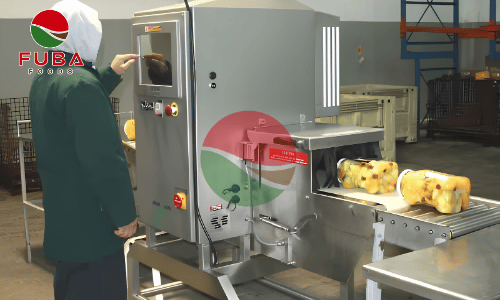
The inspection process typically involves passing the product through an X-ray inspection system after relevant processing stages. The system generates an X-ray image and analyzes density differences within the product or package.
When the system identifies an object or density pattern that falls outside the programmed acceptance criteria, the product can be identified for rejection or further inspection. The objective is to prevent potentially contaminated products from continuing into finished-product storage or shipment.
The exact position of the X-ray system depends on the factory’s process design and product format. It may be positioned after processing or at a suitable point before final shipment, depending on how the manufacturer has designed its food safety control points.
For this reason, simply having an X-ray machine does not automatically demonstrate strong food safety management. The value comes from how the equipment is integrated into the production flow, how inspection parameters are controlled, and how rejected products are managed.
X-Ray Inspection vs Metal Detection in Frozen Food Processing
X-ray inspection and metal detection are both used to control physical contamination, but they are based on different detection principles.
Metal detectors are designed primarily to identify metallic contaminants by detecting disturbances in an electromagnetic field. They are widely used in food processing because they can provide fast and reliable detection of many metallic contaminants.
X-ray inspection instead evaluates differences in density within the product. This gives it the ability to detect certain dense non-metallic foreign materials in addition to metals, depending on the application.

For frozen food manufacturers, the decision should therefore not be framed as choosing one technology and eliminating the other. A stronger approach can be to use complementary inspection technologies where the product risk assessment justifies them. The appropriate combination depends on product characteristics, packaging, production conditions, and food safety requirements.
Where Does X-Ray Inspection Fit in the Frozen Food Processing Flow?
Food safety control is most effective when it is built into the complete manufacturing process rather than concentrated at a single inspection point.
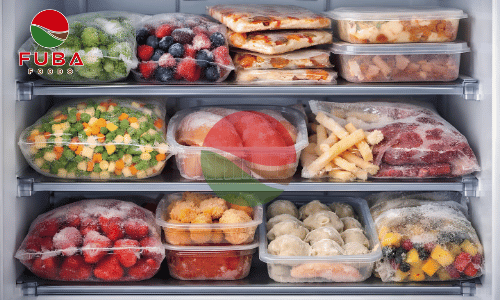
A typical frozen food process begins with farm sourcing and raw material inspection. The incoming produce is then washed and cleaned before being sorted and graded according to product requirements. Depending on the product, it may then undergo cutting or preparation before freezing, followed by foreign-material inspection, packing, cold storage, and export shipment.
This integrated approach is important because X-ray inspection is a downstream control. It can identify certain physical hazards, but it cannot correct poor raw material selection, inadequate sanitation, improper freezing, or cold-chain failures.
A factory therefore needs controls at multiple stages. FUBA’s processing flow, for example, covers raw material inspection, washing and cleaning, sorting and grading, cutting or preparation, IQF freezing, metal detection, packing, cold storage, and export shipment. Its facility also includes dedicated X-ray inspection systems as part of the broader quality-control setup.
How X-Ray Inspection Supports Quality Assurance for Exported Frozen Food
For exported frozen food, quality control needs to extend beyond the processing line. Products may remain in cold storage before shipment and then travel through international cold-chain logistics before reaching the customer.
Physical contamination discovered after shipment can create much greater commercial consequences than contamination identified inside the factory. Depending on the market and customer requirements, issues can lead to complaints, rejected shipments, recalls, or damage to long-term supplier relationships.
X-ray inspection provides an additional opportunity to identify physical contamination before products enter the finished-product supply chain. It does not eliminate risk, but it strengthens the factory’s ability to control one specific category of food safety hazard.
FUBA operates three X-ray inspection systems alongside five metal detection systems and an in-house microbiological laboratory. This combination illustrates an important principle in factory-level quality control: different inspection technologies can serve different purposes within the same production environment.
What Should Buyers Check When Evaluating X-Ray Inspection?
When evaluating a frozen food supplier, buyers should look beyond the statement that an X-ray machine is available. The first question should be where the equipment is positioned within the production process and what products pass through it.
The next consideration is whether the supplier combines X-ray inspection with other food safety controls. Raw material inspection, sorting, sanitation, metal detection, packaging controls, cold storage, and traceability all contribute to the final food safety outcome. A single piece of inspection equipment cannot replace a properly controlled manufacturing system.
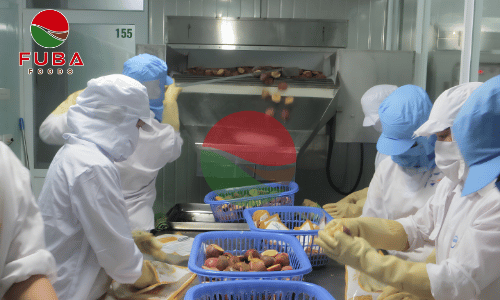
Buyers should also consider whether the factory has sufficient production and quality-control infrastructure to support consistent commercial supply. A supplier may have advanced inspection equipment but still struggle with raw material consistency, production capacity, or cold-chain management.
Most importantly, buyers should ask the supplier to evaluate the actual product rather than relying on generic equipment specifications. Product density, piece size, packaging material, moisture, and product composition can all influence inspection performance.
How X-Ray Inspection Fits Into a Modern Frozen Food Factory
Modern frozen food safety depends on multiple controls working together. X-ray inspection is most valuable when it is integrated into a factory that already has disciplined raw material sourcing, processing controls, inspection procedures, and cold-chain management.
This is particularly important for products such as frozen vegetables and fruits, where natural variation in size, shape, and density can make automated inspection more demanding. The factory needs both suitable technology and trained personnel capable of maintaining the process consistently.
The broader manufacturing environment also matters. A factory with dedicated processing lines, inspection equipment, cold storage, and established quality management systems is better positioned to control risks across the entire production cycle than a supplier that simply purchases finished products and resells them.

For buyers, this distinction is important because food safety should be traceable back to the production process. The stronger the manufacturer’s control over sourcing, preparation, freezing, inspection, packaging, and storage, the easier it is to maintain a consistent product specification across repeated shipments.
Conclusion
X-ray inspection frozen food systems provide an important layer of physical hazard control in modern frozen food processing. By examining density differences inside products or packages, X-ray technology can detect certain foreign materials that may not be visible from the outside and can complement conventional metal detection.
However, X-ray inspection should not be viewed as a standalone solution. Its effectiveness depends on the product, equipment configuration, inspection parameters, and the wider food safety system surrounding it. Raw material control, processing hygiene, metal detection, X-ray inspection, packaging, cold storage, and traceability all have a role to play.
For manufacturers and distributors evaluating frozen food suppliers, the key question is therefore not simply whether a factory has X-ray inspection. It is whether that technology is properly integrated into a controlled manufacturing process capable of delivering safe, consistent products at commercial scale.


