

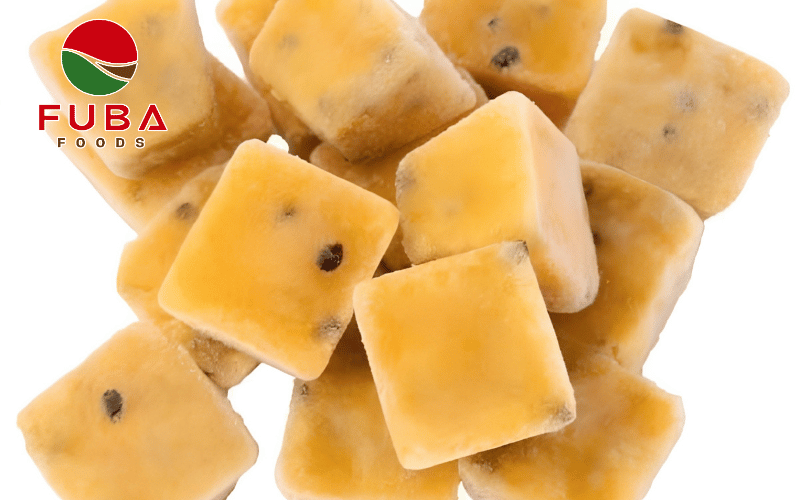
Frozen passion fruit is used across a wide range of commercial food and beverage applications, from juices and smoothies to sauces, desserts, dairy products, and fruit-based formulations. For businesses purchasing passion fruit ingredients at commercial volumes, however, finding a supplier is not simply about comparing prices or checking whether a product is available. The supplier needs to deliver consistent fruit quality, suitable product specifications, reliable supply, and controlled frozen storage throughout the order cycle.
When choosing a frozen passion fruit ingredient supplier, businesses should look beyond the product itself and evaluate the manufacturing system behind it. Raw material sourcing, processing technology, quality control, cold-chain management, documentation, production capacity, and the supplier’s ability to maintain consistent specifications can all influence the actual cost and reliability of sourcing.
This article explains the key factors to assess before selecting a frozen passion fruit supplier, from product specifications and processing controls to factory capacity, food safety, packaging, and long-term supply continuity.

What to Look for in a Frozen Passion Fruit Ingredient Supplier
The first question to ask is whether the supplier can provide a clearly defined product specification rather than offering frozen passion fruit as a generic commodity. Commercial buyers need to know exactly what they are purchasing and whether that specification matches the requirements of their own production process.
Depending on the application, this may include frozen passion fruit puree, pulp, seeds, or other customized forms. The relevant characteristics can include fruit variety, flavour intensity, Brix, colour, texture, seed content, packaging format, storage temperature, and shelf life.
A supplier should also be able to explain where the fruit comes from, how incoming raw materials are inspected, how the product is processed, and how finished goods are stored before shipment. These details provide a clearer picture of whether the supplier operates as a manufacturer with control over production or primarily sources finished goods from elsewhere.
For businesses planning regular imports, this distinction can become important. A direct processing factory has greater control over raw material selection, processing parameters, quality checks, production scheduling, and packaging specifications.
Evaluate the Passion Fruit Raw Material at the Source
Origin and Agricultural Sourcing
Passion fruit is an agricultural product, so the quality of the final frozen ingredient starts with the raw material. Fruit maturity, growing conditions, variety, harvesting practices, and seasonal changes can influence flavour, colour, acidity, and soluble solids.
A supplier with an established sourcing network can have greater visibility into these variables. Instead of purchasing raw fruit only when an order arrives, a manufacturer can build relationships with growing regions and manage raw material collection according to production requirements.
FUBA works with agricultural regions and growers across Vietnam, while passion fruit is one of the tropical fruits included in its product portfolio. Vietnam’s Central Highlands is particularly relevant to FUBA’s sourcing network, where passion fruit is among the key agricultural products associated with the region.

Raw Material Inspection and Sorting
Once passion fruit reaches the factory, incoming inspection becomes another important control point. Fruit should be assessed before processing so that unsuitable raw materials are not carried into the finished product.
A controlled processing flow normally includes raw material inspection followed by washing, cleaning, sorting, grading, and product preparation. This creates multiple points at which quality deviations can be identified before the ingredient reaches the final packaging stage.
FUBA’s processing flow follows this type of farm-to-factory approach, with incoming material inspection, washing and cleaning, sorting and grading, preparation, processing, quality checks, packing, cold storage, and export shipment integrated into the production system.
Check the Frozen Passion Fruit Processing Technology
Processing technology directly affects the quality and consistency of frozen fruit ingredients. Rapid freezing can help preserve the characteristics of fruit after processing, but the freezing system needs to be considered together with preparation, handling, packaging, and cold storage.
For whole or cut frozen fruit, IQF technology can be particularly useful because individual pieces are frozen rapidly and remain separated rather than forming a single frozen block. For puree and other processed formats, the relevant processing controls may differ, so buyers should evaluate the actual production process for the ingredient they intend to purchase.
This type of processing infrastructure matters when evaluating whether a supplier can support commercial-scale production rather than relying on outsourced or intermittent processing capacity.
Compare Supplier Quality Control and Food Safety Systems
Price can be easy to compare between suppliers, but quality control is harder to evaluate from a quotation alone. Businesses should examine how the supplier controls quality throughout the production process.
A suitable supplier should have defined procedures for raw material inspection, processing controls, foreign-material detection, microbiological testing, packaging inspection, traceability, and frozen storage. The supplier should also be able to provide relevant documentation for the product and destination market.
For an importer or food manufacturer, these systems are useful indicators of how the supplier manages risk. However, buyers should still request the specific certificates, specifications, test reports, and other documents applicable to the product and destination market rather than relying only on certification names.

Assess Supply Capacity Before You Commit to a Supplier
A supplier may be able to fulfil a sample order without necessarily having the capacity to support a long-term commercial contract. This is why production capacity should be evaluated alongside product quality.
Businesses should consider whether the supplier has sufficient processing capacity, raw material access, cold storage, workforce, and export infrastructure to support expected order volumes during peak periods.
FUBA’s manufacturing operation has an annual supply capacity of 20,000 MT, more than 600 workers, and more than 15 years of experience in frozen fruit and vegetable processing. The company exports to more than 30 countries, providing experience with international shipment requirements and different market specifications.
For buyers, these figures are most useful when considered in relation to their own purchasing requirements. A supplier should be assessed not only on total capacity but also on whether it can allocate consistent production capacity to the specific ingredient and specification required.
Examine Frozen Storage and Cold-Chain Control
Cold-chain management is an important consideration when purchasing frozen passion fruit ingredients. A product may leave the factory in good condition but still experience quality deterioration if the required temperature is not maintained during storage or transportation.
Commercial buyers should therefore confirm the required storage temperature, shelf life, packaging format, warehouse conditions, and transportation arrangements before placing an order. These factors can affect how well the product maintains its quality throughout the supply chain.
Frozen fruit products can have a shelf life of up to 24 months when stored at -18°C or below under appropriate conditions. Large-scale cold-storage capacity can also be important for export orders, as finished products may need to remain in controlled storage before shipment.
Maintaining the cold chain after the product leaves the factory is equally important. Temperature control should continue during loading, transportation, unloading, and storage at the destination warehouse. For this reason, logistics arrangements should be considered as part of the overall sourcing process rather than treated separately from product quality.
Review Packaging and Product Specifications
Packaging should be selected according to the buyer’s production volume, handling system, storage capacity, and destination-market requirements. A supplier that can only provide one standard packaging format may be less suitable for businesses with different operational requirements.
For commercial sourcing, buyers should confirm the product’s net weight, inner packaging, outer carton, labelling requirements, pallet configuration, and applicable export documentation. These details can affect warehouse handling and the total landed cost even when the ingredient price itself appears competitive.
For passion fruit ingredients, the appropriate packaging should ultimately be determined according to the product form and the buyer’s manufacturing and distribution requirements.

Consider Total Sourcing Cost, Not Only the Product Price
A lower quotation does not necessarily mean lower sourcing cost. The actual cost of a frozen fruit ingredient can be affected by yield, consistency, packaging, rejected shipments, storage requirements, freight efficiency, documentation, and production interruptions.
Direct manufacturing can provide advantages at the source because procurement, processing, quality control, packaging, and storage are managed within the same production system. FUBA’s sourcing and production model is built around agricultural supply networks, processing facilities, quality controls, cold storage, and export operations, allowing these stages to be managed as part of an integrated supply chain.
For long-term purchasing, evaluating this complete cost structure can provide a more realistic comparison than looking only at the quoted price per kilogram.
Ask About Customization and Long-Term Production Support
Commercial food manufacturers rarely have identical requirements. One customer may need a particular passion fruit format, while another may require a specific packaging configuration, processing specification, or private-label solution.
This makes manufacturing flexibility an important supplier-selection criterion. Before placing a large order, buyers should determine whether the supplier can adjust specifications while maintaining appropriate quality controls and production consistency.
FUBA offers OEM and private-label manufacturing with customized specifications and packaging formats. This capability can be useful when a business needs an ingredient developed around an existing formulation or supply-chain requirement rather than simply purchasing a standard product.
The key is to establish the specification clearly before production begins and ensure that any agreed requirements are reflected in the product documentation and quality controls.
How to Choose the Right Frozen Passion Fruit Ingredient Supplier
Choosing the right frozen passion fruit ingredient supplier requires evaluating the entire supply chain rather than comparing product prices alone. The most relevant supplier should be able to demonstrate control over raw material sourcing, processing, quality assurance, cold storage, packaging, and export logistics.
Start by defining the exact ingredient specification required for your application. Then assess the supplier’s raw material sources, manufacturing process, certifications, production capacity, cold-chain infrastructure, packaging options, and ability to provide consistent documentation.
Sample approval should also be treated as part of the qualification process rather than the final decision. The sample should be tested under the same conditions used in commercial production so that flavour, texture, colour, processing performance, and overall suitability can be evaluated before scaling up.
For ongoing supply, buyers should also discuss production lead times, minimum order quantities, shipment planning, quality documentation, and procedures for handling products that do not meet the agreed specification. These details establish clearer expectations between the manufacturer and buyer before commercial orders begin.

Conclusion
Selecting a frozen passion fruit supplier is ultimately a decision about product consistency, manufacturing capability, and supply reliability, not simply the lowest quoted price. Businesses should evaluate the fruit source, processing technology, quality-control systems, production capacity, frozen storage, packaging, documentation, and ability to support customized requirements.
For businesses evaluating a frozen passion fruit ingredient supplier, the strongest starting point is a clearly defined product specification followed by sample testing, factory capability assessment, documentation review, and confirmation of long-term supply conditions. This approach helps ensure that the supplier selected can support not only the first shipment, but the consistency and production requirements that follow.


