

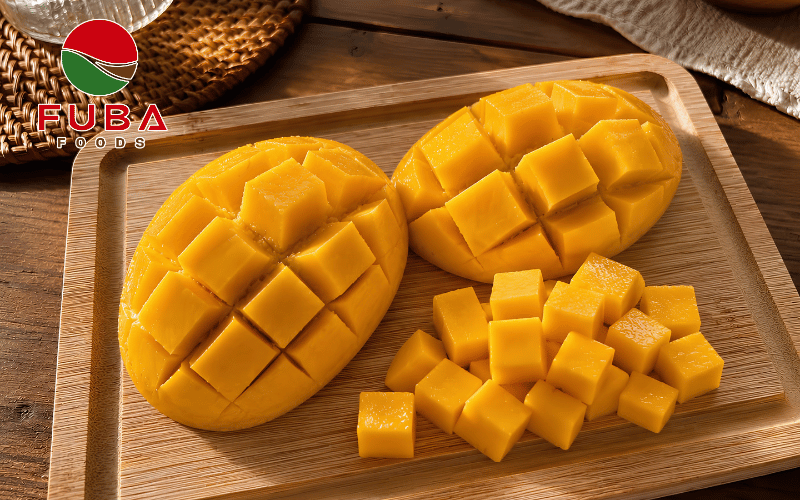
Finding a suitable frozen mango ingredient supplier is not simply about comparing product prices. For food manufacturers, distributors, foodservice suppliers, and importers, the more important question is whether a supplier can consistently provide the right mango format, specification, quality, packaging, and volume required for commercial operations.
A reliable supplier should be able to demonstrate control over the entire supply chain, from raw mango sourcing and inspection to processing, IQF freezing, packaging, cold storage, and export shipment. This is particularly important for businesses that need the same product specification across repeated orders, rather than a different quality profile from one shipment to the next.
The right supplier should also offer enough product flexibility to match different applications. Cubes, half cuts, and puree serve different manufacturing needs, while retail, foodservice, and bulk packaging require different handling and logistics. This article explains the key factors businesses should evaluate when choosing a frozen mango ingredient supplier, with a focus on factory capability, product consistency, customization, and long-term supply reliability.

What Frozen Mango Formats Does the Supplier Offer?
The first step is to check whether the supplier’s product range actually matches the way mango will be used in your operation. A supplier offering only one standard format may not be suitable if your business serves multiple applications or requires different ingredient specifications.
Frozen Mango Cubes
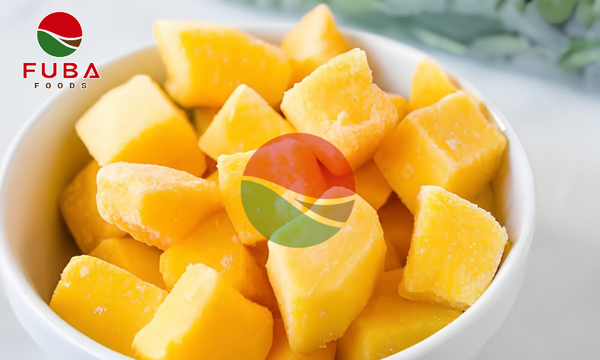
IQF mango cubes are suitable for applications where manufacturers need visible fruit pieces with relatively consistent dimensions. They can be incorporated into beverages, yoghurt, ice cream, bakery products, fruit mixes, desserts, and other processed foods.
The important point is to look beyond the term “mango cubes.” Buyers should ask about mango variety, Brix, cut dimensions, size tolerance, colour, texture, and individual piece separation after freezing. These details can directly affect portioning and processing performance.
Frozen Mango Half Cut
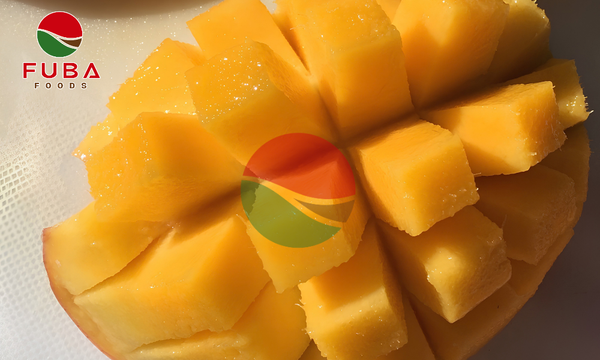
Half-cut mango is a different proposition from diced fruit. It retains more of the natural mango shape and can be suitable when appearance and larger fruit pieces are important.
When evaluating this format, buyers should confirm the expected fruit size, consistency between pieces, shape, flesh quality, and handling requirements. A supplier should be able to define what “consistent size” means rather than relying only on general quality descriptions.
Frozen Mango Puree
Puree is generally more suitable when mango becomes part of the formulation rather than remaining as a visible fruit piece. It can be used in beverages, dairy products, ice cream, bakery, desserts, sauces, and other food-processing applications.
For puree, Brix and texture become particularly important. Brix affects sweetness and formulation calculations, while texture influences how easily the puree integrates into the production process.
Can the Supplier Provide the Packaging Your Business Needs?
Packaging should be evaluated at the beginning of the sourcing process rather than after the product has already been selected. The appropriate format depends on how the mango will be distributed, stored, portioned, and used.
A supplier serving several commercial channels should ideally be able to support different packaging requirements. Smaller packs may be appropriate for retail, while foodservice and industrial customers usually require larger quantities that reduce handling and repacking costs.
For importers and distributors, packaging specifications should also be discussed together with carton configuration, labelling, net weight, palletisation, and market-specific requirements. This helps prevent additional repacking or relabelling work after arrival.
Does the Supplier Offer OEM, Private Label, or Customized Specifications?
A supplier’s ability to produce a standard catalogue item is different from its ability to manufacture according to a customer’s specification.
This distinction becomes important when a manufacturer has an existing recipe or production line with specific requirements for cut size, Brix, packaging, product weight, or other technical parameters. In such cases, the supplier should be able to discuss the specification at factory level and determine whether it can be reproduced consistently.
For buyers, customization should not be viewed only as a commercial service. It should be evaluated through the supplier’s actual production capability. A factory needs appropriate preparation, freezing, packaging, quality-control, and storage systems to manufacture a customized specification consistently at commercial volume.

Where Does the Supplier Source Its Mango?
The quality of a frozen mango product starts before the mango reaches the processing line. Raw material maturity, variety, growing conditions, harvesting practices, and incoming quality can all influence the final product.
A supplier with direct access to agricultural sourcing networks can have greater control over raw material availability than a company purchasing finished frozen products from multiple third parties.
Vietnam has several major agricultural regions, and mango is strongly associated with the Mekong Delta. FUBA’s sourcing network extends across Vietnam’s key agricultural regions, while its company profile identifies the Mekong Delta as an important sourcing area for mango and other tropical fruits.
How Does the Supplier Control Raw Materials?
Agricultural ingredients naturally vary, so supplier reliability depends on how that variation is managed.
A professional frozen mango processor should have defined controls before production begins. Incoming fruit should be inspected and sorted according to agreed quality parameters before moving into washing, preparation, and freezing.
This type of controlled process matters because consistency cannot be created at the packaging stage. If raw mango entering the factory varies significantly, the finished product can also vary in colour, texture, sweetness, and usable yield.
What IQF Technology Should a Frozen Mango Supplier Have?
For mango cubes and other individual frozen pieces, IQF technology is an important part of the evaluation.
Individual Quick Freezing rapidly freezes separate pieces, helping maintain their individual form while supporting the preservation of natural colour, texture, flavour, and nutritional characteristics. More importantly from an operational perspective, properly frozen pieces should remain easier to portion and handle than products that freeze into large blocks.
However, buyers should not evaluate IQF technology in isolation. Freezing performance depends on the preparation process, product dimensions, freezing conditions, equipment, and cold-chain management.
For a buyer, this provides more useful information than simply seeing “IQF” on a product specification. The question is whether the supplier has sufficient processing infrastructure to maintain the required product quality at commercial volume.

How Important Is Cold Storage?
Freezing the mango correctly is only one part of maintaining product quality. The product must remain under appropriate frozen conditions after processing and throughout storage before shipment.
Temperature-controlled storage helps protect the frozen product from unnecessary quality deterioration and supports a stable cold chain from production through to export.
For commercially frozen mango, storage at -18°C or below is generally required to maintain the product in its frozen state and preserve its quality throughout the intended shelf life. Storage capacity, temperature monitoring, and proper handling are therefore important parts of the overall cold-chain process.
When assessing a supplier, buyers should ask about storage temperature, cold-storage capacity, monitoring systems, shelf-life specifications, and how the product is transferred from storage to shipment. A strong freezing process has limited value if the cold chain is poorly managed afterwards.
Can the Supplier Provide the Quality and Export Documentation You Need?
Food manufacturers and importers often need more than a product specification. Depending on the destination market and application, documentation may include certificates of analysis, certificates of origin, food-safety documentation, traceability records, and other export-related documents.
The supplier should also be able to explain its quality-control system and identify where critical checks occur during production.
FUBA’s factory operates with internationally recognised food-safety and quality systems including HACCP, ISO 22000, HALAL, BRCGS, FDA compliance, and product traceability. Its processing flow includes metal detection and X-ray inspection before finished products move through packing, cold storage, and export shipment.
For international buyers, this type of documentation and process visibility can be particularly important because the supplier must meet not only the buyer’s commercial specification but also the requirements of the destination market.
Does the Supplier Have Enough Capacity for Long-Term Supply?
A supplier may have a suitable product sample but still be unable to support the volume required for a long-term commercial relationship. Capacity should therefore be evaluated separately from product quality.
FUBA has an annual supply capacity of 20,000 MT, more than 600 workers, and over 15 years of experience in frozen fruit and vegetable processing and export. The company exports to more than 30 countries and serves international markets including Japan, Korea, the European Union, and the Middle East.
For buyers, capacity is relevant not simply because a large number looks impressive. It indicates whether the supplier has an established production system capable of handling recurring orders, raw material sourcing, processing, storage, and export operations at commercial scale.
The more important question is whether the supplier can maintain the agreed mango specification from one shipment to the next while meeting the required order volume.
What Should You Confirm Before Choosing a Frozen Mango Ingredient Supplier?
Product Specification and Commercial Requirements
Before finalising a supplier, the product specification and commercial requirements should be clear on both sides. Buyers should confirm the mango variety, format, Brix where applicable, cut size, texture, colour expectations, storage temperature, shelf life, packaging format, and order volume.
Evaluating Manufacturing Capability
The supplier’s manufacturing capability should then be evaluated against those requirements. Raw material sourcing, processing flow, IQF technology, quality-control systems, cold storage, documentation, and export experience all contribute to the reliability of the finished ingredient.
What a Suitable Supplier Should Provide
A suitable frozen mango ingredient supplier should ultimately provide more than frozen fruit. The supplier should provide a controlled production system capable of delivering the required ingredient specification repeatedly, at the required volume and under appropriate food-safety and cold-chain conditions.
Conclusion
Choosing a frozen mango ingredient supplier requires a broader assessment than comparing price per kilogram. The right supplier needs to match your product format, technical specification, packaging requirements, production volume, and destination-market standards.
Start by confirming whether the supplier offers the appropriate mango formats, such as IQF cubes, half cuts, or puree. Then evaluate how the mango is sourced, how raw materials are inspected, how IQF freezing is controlled, and how products are stored and shipped.
For long-term sourcing, factory capability becomes equally important. Production capacity, cold-storage infrastructure, quality systems, traceability, customization capability, OEM or private-label support, and export experience all influence whether a supplier can support consistent commercial production.
A manufacturer such as FUBA, with established agricultural sourcing, dedicated processing facilities, IQF freezing technology, quality-control systems, cold storage, and international export experience, provides a useful example of what buyers should examine when evaluating a Vietnamese frozen mango supplier.


