


How is frozen eggplant made? At an industrial processing facility, frozen eggplant is produced through a controlled sequence that starts with fresh eggplant and ends with individually frozen pieces ready for storage, transportation, and food manufacturing. The process is more than simply placing fresh eggplant into a freezer. Raw material selection, washing, sorting, cutting, pre-processing, rapid freezing, inspection, packaging, and cold storage all influence the quality of the finished product.
For food manufacturers, understanding how is frozen eggplant made is useful when evaluating suppliers because processing decisions directly affect the ingredient’s color, texture, flavor, piece consistency, and performance in cooking applications. A supplier with a controlled production process can provide much greater consistency than a product that is simply frozen without standardized preparation.
This article explains each major stage of industrial frozen eggplant production and shows why IQF technology is widely used when manufacturers need convenient, consistent, and easy-to-handle frozen vegetable ingredients.
How Is Frozen Eggplant Made in an Industrial Factory?
The basic process can be described as fresh eggplant sourcing, raw-material inspection, washing and cleaning, sorting and grading, cutting or preparation, optional value-added processing, IQF freezing, foreign-material inspection, packaging, cold storage, and frozen shipment.
Each stage has a specific purpose. The objective is to control variation before freezing rather than trying to correct quality problems afterward. This is especially important for eggplant because its soft structure and relatively high moisture content make it sensitive to handling, cutting, heat, and freezing conditions.
A well-designed processing line therefore connects agricultural sourcing with food-processing technology. The quality of the finished frozen eggplant depends not only on the freezing equipment but also on what happens before the product reaches the freezer.
Selecting and Inspecting Fresh Eggplant
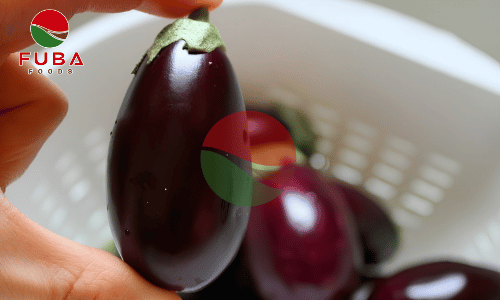
The production process begins with the raw material. Fresh eggplants are sourced from suitable growing areas and delivered to the processing facility for inspection before entering production.
Why Raw Material Quality Matters
Eggplant maturity, size, color, physical condition, and freshness can influence the final frozen product. Over-mature eggplant may have a different texture and seed development, while damaged or unsuitable vegetables can create quality problems during cutting and subsequent processing.
Industrial manufacturers therefore need defined raw-material specifications. Incoming eggplant is checked before processing so that unsuitable material can be removed rather than carried through the entire production line.
This step also helps manufacturers achieve greater batch-to-batch consistency. If raw materials vary significantly, even advanced freezing equipment cannot completely eliminate the resulting differences in texture or appearance.
A controlled sourcing system is particularly valuable when supplying international food manufacturers that require stable specifications throughout repeated orders.
FUBA works with farming regions and growers across Vietnam and incorporates raw-material inspection into its processing flow before washing, sorting, preparation, and freezing.
Washing and Cleaning the Eggplant
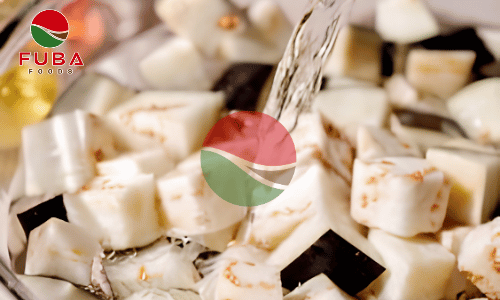
After inspection, suitable eggplants are washed and cleaned to remove soil, agricultural residues, and other physical impurities from the raw material.
Cleaning is a fundamental food-safety step, but it also prepares the vegetables for subsequent processing. Any cutting, frying, grilling, or freezing operation should be performed on properly cleaned raw materials under controlled hygienic conditions.
In an industrial facility, washing should be integrated into a broader sanitation system rather than treated as an isolated operation. Equipment surfaces, water management, personnel practices, and processing conditions all contribute to maintaining product hygiene.
Sorting and Grading Before Cutting
The cleaned eggplant is then sorted according to relevant quality and size specifications. Sorting is important because different raw-material sizes can behave differently during cutting and cooking.
Why Uniformity Matters for Frozen Eggplant
For commercial food production, uniformity is not simply an aesthetic requirement. It affects processing performance.
If eggplant pieces have significantly different dimensions, smaller pieces may cook or soften faster than larger pieces. This can create inconsistent texture within the same batch of finished food.
Sorting before cutting helps create a more predictable starting point. The manufacturer can then establish appropriate cutting and processing parameters for the selected raw material.
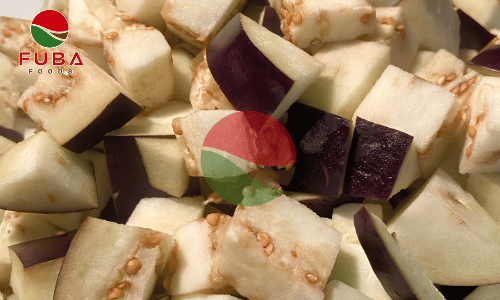
This is particularly important for products such as frozen eggplant dice, straight cuts, coin cuts, and other defined formats where the final piece size forms part of the product specification.
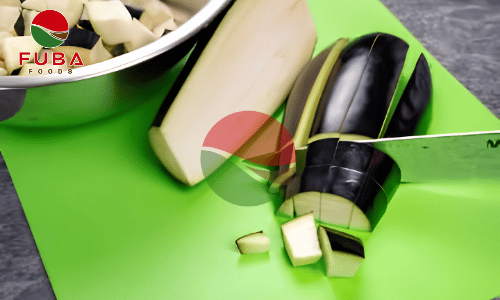
Cutting and Preparing the Eggplant
Once sorted, the eggplant is prepared according to the required product format. Unlike frozen vegetables sold only as generic pieces, industrial eggplant can be processed into different shapes depending on the final application.
Different Cuts for Different Food Applications
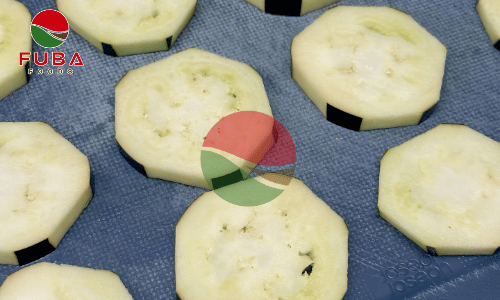
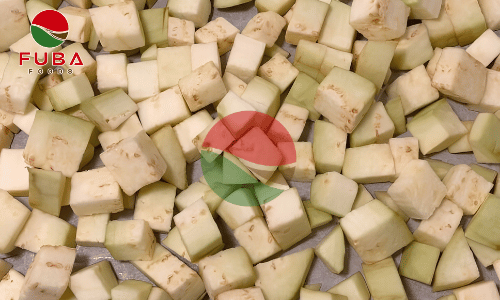
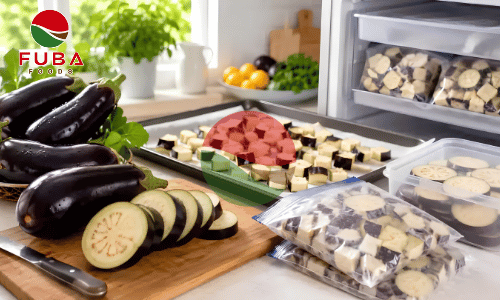
Diced eggplant is suitable when the ingredient needs to be distributed throughout sauces, pasta, vegetable mixes, or prepared meals. Straight-cut pieces provide a more defined shape, while coin-cut eggplant can create a more recognizable presentation in finished dishes.
Whole or mini eggplant formats may be used when retaining the vegetable’s original form is important. The appropriate format depends on the recipe, portioning system, cooking process, and appearance requirements of the finished product.
This is why manufacturers should define the product specification before production rather than selecting frozen eggplant solely according to price. Cut dimensions, tolerance, processing method, and expected cooking performance can all affect production efficiency.
Pre-Processing Such as Frying or Grilling
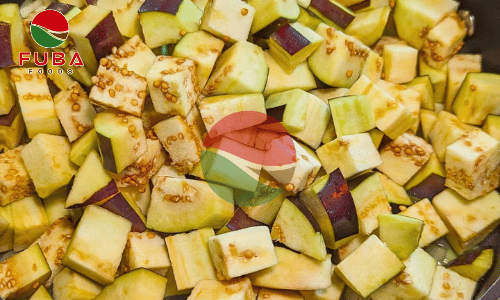
Not every frozen eggplant product goes directly from cutting to IQF freezing. Some varieties receive additional processing before freezing, particularly when the finished ingredient needs a specific cooked characteristic.
Frying and grilling are two examples. Pre-processing can develop flavor, modify texture, and reduce the amount of preparation required at the customer’s facility.
For ready meals and other prepared foods, this can be particularly useful because the manufacturer receives an ingredient that has already undergone part of the cooking process. However, the thermal treatment must be controlled carefully. Excessive cooking can make eggplant too soft, while insufficient processing may not provide the intended texture or flavor.
Rapid IQF Freezing
After preparation, the eggplant enters the freezing stage. This is where IQF technology becomes particularly important.
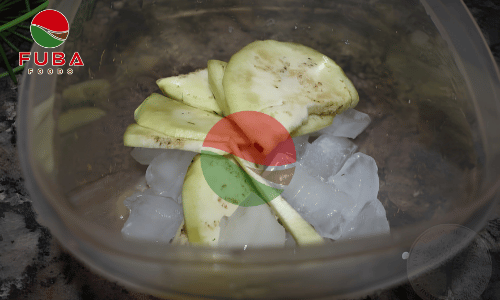
What Is IQF Freezing?
IQF stands for Individually Quick Frozen. Instead of freezing the entire quantity into one solid mass, the process rapidly freezes individual pieces so they remain separated from one another.
This format is highly practical for industrial food production. Manufacturers can take the quantity required for a recipe without having to thaw and break apart an entire frozen block.
Rapid freezing also helps limit the time during which the product passes through the temperature range where ice crystals develop. Smaller ice crystals generally cause less mechanical damage to plant tissues than larger crystals, which can help the product retain more of its intended structure after thawing and cooking.
The purpose of IQF is therefore not simply to make the product frozen. It is to create a frozen ingredient that remains practical to handle while helping preserve important quality characteristics such as color, texture, flavor, and nutritional value.
Industrial IQF lines are designed to control freezing conditions consistently across production batches.
FUBA’s processing infrastructure includes multiple IQF freezing lines, supported by additional freezing systems and dedicated vegetable-processing equipment.
Foreign-Material Detection and Quality Inspection
Freezing does not represent the final quality-control stage. After processing, frozen eggplant needs to pass through appropriate inspection systems before packaging and storage.
Why Inspection Is Essential
Food manufacturers purchasing frozen ingredients need confidence that the product meets defined food-safety and quality requirements. Foreign-material detection is therefore an important part of industrial processing.
Depending on the facility and product, inspection systems may include metal detection and X-ray inspection. Microbiological controls and documented quality procedures provide additional layers of food-safety management.
FUBA’s production facility includes metal detection systems, X-ray inspection systems, and an in-house microbiological laboratory, alongside food-safety systems including HACCP and ISO 22000.
These controls are particularly relevant for export-oriented manufacturers because international buyers often require documented food-safety systems and traceability throughout the supply chain.
Packaging Frozen Eggplant
Once the product has passed the required inspections, it is packed according to the intended market and application.
Packaging is more than a container for the product. It needs to protect frozen eggplant during handling, transportation, and storage while fitting the buyer’s operational requirements.
Choosing the Right Pack Size
Industrial buyers may require larger bulk formats because the ingredient is consumed rapidly within a production facility. Foodservice customers may prefer different pack sizes based on their kitchen operations and storage capacity.
For export, packaging also needs to withstand frozen transportation and maintain product integrity throughout the cold chain.
The right packaging specification should therefore be discussed together with order volume, warehouse conditions, handling practices, and intended application.
Cold Storage at Controlled Temperatures
After packaging, frozen eggplant is transferred to cold storage. Maintaining a stable frozen environment is essential because the production process does not end when the product leaves the IQF freezer.
Repeated temperature fluctuations can negatively affect frozen-food quality. If partial thawing and refreezing occur, ice crystals may grow and cause additional structural damage to the vegetable.
For this reason, industrial frozen-food facilities use temperature-controlled storage and cold-chain transportation. Frozen eggplant should remain under the specified storage conditions until it reaches the customer’s facility.
Frozen eggplant is generally stored at ≤ -18°C to help maintain product quality throughout its intended shelf life. Maintaining consistent storage conditions is particularly important during long-term storage, transportation, and distribution, as temperature fluctuations can negatively affect texture and overall product quality.
From Fresh Eggplant to IQF: Why the Complete Process Matters
Understanding how frozen eggplant is made reveals an important point: IQF freezing is only one part of the production system.
The final quality of frozen eggplant is determined by the combination of raw-material sourcing, inspection, cleaning, sorting, preparation, thermal processing where required, rapid freezing, quality inspection, packaging, and cold-chain management.
For buyers, this means evaluating the factory rather than focusing only on the product name. A supplier may offer “IQF frozen eggplant,” but the actual production process behind that label determines whether the ingredient can deliver consistent performance.
This becomes even more important for long-term commercial supply. When a food manufacturer uses the same eggplant ingredient across multiple production runs, consistency in cut size, processing level, packaging, and frozen storage conditions can reduce variation and make production planning easier.
How to Evaluate a Frozen Eggplant Manufacturer
When selecting a supplier, buyers should ask how the eggplant is sourced, what inspections are performed before processing, which formats are available, whether value-added processing is performed in-house, and how IQF freezing conditions are controlled.
It is also important to verify food-safety certifications, traceability procedures, foreign-material inspection, storage conditions, packaging specifications, and export experience. These factors provide a more realistic picture of the supplier’s ability to support consistent commercial production.
A direct manufacturer can offer an additional advantage when specifications need to be adjusted. Instead of purchasing a fixed product from an intermediary, buyers can communicate requirements closer to the production process, including cut format, processing method, packaging, and order planning.
For manufacturers serving international markets, this factory-level control can contribute to more predictable quality and cost management throughout the supply chain.
Conclusion
So, how is frozen eggplant made? In a professional industrial facility, the process starts long before the eggplant enters the freezer. Fresh eggplant is selected and inspected, washed, sorted, cut or otherwise prepared, and sometimes fried or grilled before undergoing rapid IQF freezing. The frozen product is then inspected, packaged, stored under controlled temperatures, and transported through the cold chain.
The value of IQF lies in creating individually frozen pieces that are easier to portion and handle while helping maintain the product’s intended quality characteristics. But reliable frozen eggplant ultimately depends on the entire production system behind the freezing process.
For food manufacturers, the best supplier is therefore not simply the one offering frozen eggplant at a competitive price. It is the processor capable of controlling raw materials, processing conditions, food safety, freezing technology, packaging, and cold-chain management consistently from factory to final delivery.


