

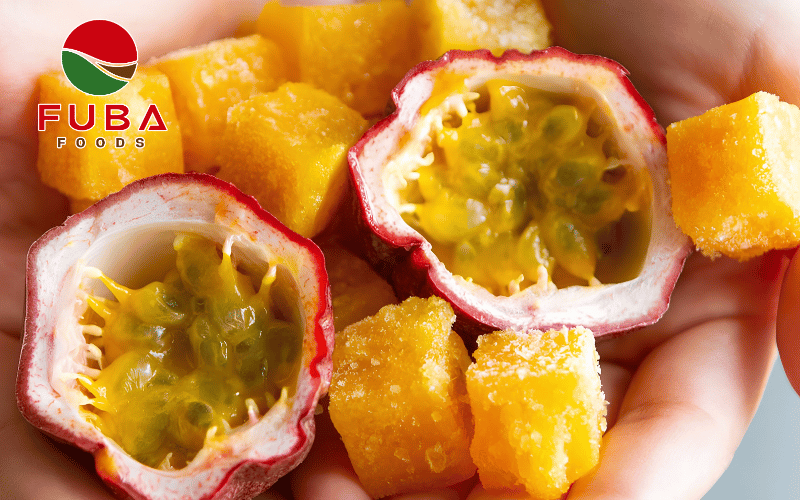
Passion fruit is widely used in food manufacturing because of its distinctive aroma, naturally acidic taste, vibrant color, and ability to add a recognizable tropical fruit profile to commercial products. It can be incorporated into beverages, fruit preparations, sauces, desserts, dairy products, bakery applications, and other processed foods. For manufacturers working with regular production volumes, however, sourcing passion fruit is not simply a matter of finding a supplier with an attractive price.
Frozen passion fruit for food manufacturing should be evaluated based on product format, raw material consistency, processing controls, quality specifications, storage conditions, and the supplier’s ability to maintain stable supply. A product that looks suitable at the quotation stage may create production challenges if its fruit quality, acidity, texture, yield, packaging, or cold-chain conditions do not match the intended application.
This article explains the main factors manufacturers, importers, distributors, and foodservice suppliers should consider before sourcing frozen passion fruit, from product specifications and processing technology to factory capacity, quality assurance, packaging, and long-term supply reliability.

Start With the Frozen Passion Fruit Specification
Before comparing suppliers, manufacturers should define exactly what they need from the frozen passion fruit. The appropriate specification depends heavily on how the ingredient will be processed after arrival.
Passion fruit may be required in different forms depending on the application, including frozen fruit portions, pulp or puree, seeds-containing preparations, or customized formats. A beverage manufacturer, for example, may prioritize aroma, juice yield, acidity, and consistency, while a dessert or bakery producer may place greater importance on texture and visual characteristics.
The specification should therefore cover more than the product name. Buyers should clarify the fruit form, variety or origin, processing method, particle or texture requirements where applicable, taste and aroma profile, color, foreign-material limits, packaging format, storage temperature, shelf life, and documentation requirements.
This becomes particularly important when the frozen ingredient will be incorporated directly into a standardized recipe. Even relatively small differences in raw material characteristics can affect the finished product’s flavor balance, formulation ratio, and processing performance.
Evaluate Raw Material Sourcing and Fruit Consistency
Sourcing Region Matters
The quality of frozen passion fruit begins before the fruit reaches the processing line. Growing conditions, harvest timing, fruit maturity, agricultural practices, and transportation from farm to factory can all influence the characteristics of the final ingredient.
For manufacturers, a supplier with access to established growing regions can provide greater control over raw material availability than a supplier that relies only on spot-market purchases. Consistent sourcing also makes it easier to establish product specifications and maintain them across different production batches.
FUBA works with farming regions and growers across Vietnam, with passion fruit among the key products sourced from the country’s Central Highlands. This sourcing network is integrated with the company’s processing operation, helping connect agricultural raw materials with controlled factory production rather than treating sourcing and manufacturing as separate activities.
Consistency Is More Important Than a Single Good Batch
One shipment of high-quality passion fruit does not necessarily indicate that a supplier can support continuous commercial production. Buyers should consider whether the supplier can maintain comparable raw material characteristics across multiple orders and different harvest periods.
For long-term manufacturing, consistency in flavor, color, maturity, and usable yield can be more valuable than simply obtaining the lowest initial quotation. A stable specification reduces the need for repeated recipe adjustments and makes production planning more predictable.
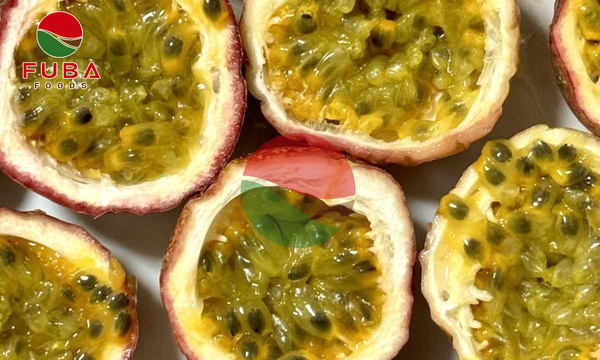
Look Closely at the Processing Technology
Frozen fruit quality depends heavily on what happens between raw material reception and final packing. A professional processing system should include inspection, cleaning, sorting, preparation, freezing, food-safety controls, packaging, and cold storage.
At a factory level, these stages should work as one controlled process. Incoming passion fruit needs to be inspected before entering production, while sorting and preparation help remove unsuitable materials and maintain the required product specification.
FUBA’s production flow covers farm sourcing, raw material inspection, washing and cleaning, sorting and grading, cutting or preparation, IQF freezing, metal detection, packing, cold storage, and export shipment. The factory’s freezing and storage systems are designed to maintain controlled frozen conditions throughout the production and post-production stages.
Why IQF Capability Can Matter
Where the required passion fruit format is suitable for IQF processing, rapid individual freezing can help preserve the natural characteristics of the fruit while making the frozen ingredient easier to handle during subsequent processing.
The key point for buyers is not simply whether a supplier uses the term “IQF.” They should understand what freezing equipment is available, how the product moves through the freezing process, and how temperature is controlled after freezing.
Check Quality Control Beyond the Final Product
A reliable frozen passion fruit supplier should be able to demonstrate how quality is controlled throughout production, rather than relying only on final-product inspection.
Raw material inspection, sorting, processing controls, foreign-material detection, microbiological testing, packaging inspection, and traceability all contribute to finished-product consistency. These controls become particularly important for manufacturers supplying regulated markets or producing foods under strict internal quality systems.
FUBA’s factory uses five metal detection systems, three X-ray inspection systems, and an in-house microbiological laboratory. Its quality-management framework includes HACCP, ISO 22000, HALAL, BRCGS, traceability, and food-safety compliance systems.
For buyers, certifications should not be viewed as a substitute for product specifications. Instead, they should be considered together: the certification framework demonstrates how food safety is managed, while the product specification defines what the buyer is actually purchasing.

Assess Factory Capacity and Supply Continuity
A supplier may provide a suitable sample but still be unable to support larger or recurring orders. This is why manufacturing capacity should be evaluated before entering a long-term supply arrangement.
Buyers should consider the supplier’s annual capacity, processing-line configuration, raw material network, cold-storage capacity, export experience, and ability to handle multiple orders without compromising specifications.
The supplier’s cold-storage capability also matters because production capacity alone does not determine supply reliability. Finished frozen products need to remain under controlled conditions after processing until shipment.
Compare Packaging With Your Logistics and Production Needs
Packaging should be discussed before the purchase order is finalized, particularly for frozen ingredients that may travel internationally and remain in storage before entering production.
The right packaging needs to protect the product from contamination, moisture loss, physical damage, and temperature-related quality deterioration. It should also fit the buyer’s warehouse handling system and intended production volume.
For manufacturers purchasing frozen passion fruit in bulk, larger foodservice or export-oriented formats may be more practical than retail packaging. At the same time, some buyers may require customized packaging, labeling, or private-label solutions according to their market.
FUBA provides customized product specifications and packaging formats, including OEM and private-label manufacturing. Products are packed according to customer and market requirements, allowing packaging to be considered as part of the overall supply specification rather than an afterthought.
Consider Total Sourcing Cost, Not Just the Quoted Price
Price is naturally an important part of frozen fruit sourcing, but the lowest quoted unit price does not always represent the lowest overall procurement cost.
Manufacturers should consider usable yield, product consistency, packaging efficiency, storage requirements, shipment conditions, rejected quantities, specification deviations, and the cost of adjusting production when raw material characteristics change.
A direct manufacturing model can also improve cost control because sourcing, processing, quality control, storage, and export preparation are coordinated within the same supply chain. Efficient agricultural sourcing and production systems can reduce unnecessary intermediary costs while giving buyers greater visibility into how the product is produced.
This is particularly relevant for recurring commercial orders, where even small differences in yield or product consistency can accumulate into significant production costs over time.

Ask About Customization Before Choosing a Supplier
Not every manufacturer needs exactly the same frozen passion fruit specification. Some may require a specific fruit format, packaging weight, labeling configuration, or processing specification based on their finished product.
A capable factory should therefore be able to discuss customization at the specification stage rather than offering only a fixed catalogue item.
Verify Cold-Chain and Export Readiness
Frozen passion fruit is only as reliable as the cold chain supporting it. Even a well-processed product can lose quality if temperature control is poorly managed during storage or transportation.
Buyers should therefore verify the supplier’s frozen-storage conditions, shipment procedures, documentation capabilities, and experience with international logistics. This is especially important for importers purchasing from overseas factories, where the product may pass through several logistics stages before reaching the final warehouse.
A factory with integrated processing, cold storage, export documentation, and established international logistics processes can reduce the number of handoffs between production and delivery.
For international sourcing, it is also useful to confirm required commercial and quality documents before placing an order. The exact documentation will depend on the destination market, buyer requirements, product specification, and applicable import regulations.

Conclusion
Choosing frozen passion fruit for food manufacturing requires more than comparing product prices. Buyers need to evaluate the ingredient itself, the consistency of the raw material, processing and freezing technology, food-safety controls, factory capacity, cold-chain management, packaging, customization, and long-term supply capability.
A direct factory perspective is particularly useful because the quality of a frozen ingredient is determined by the entire chain from agricultural sourcing to processing, storage, and shipment. When these stages are managed within an integrated production system, manufacturers have a clearer basis for assessing product consistency, supply reliability, and total sourcing value.
Ultimately, the right supplier is not simply the one offering frozen passion fruit at the right price. It is the supplier whose product specification, manufacturing capability, quality controls, and supply system can consistently support the requirements of your production operation.


