

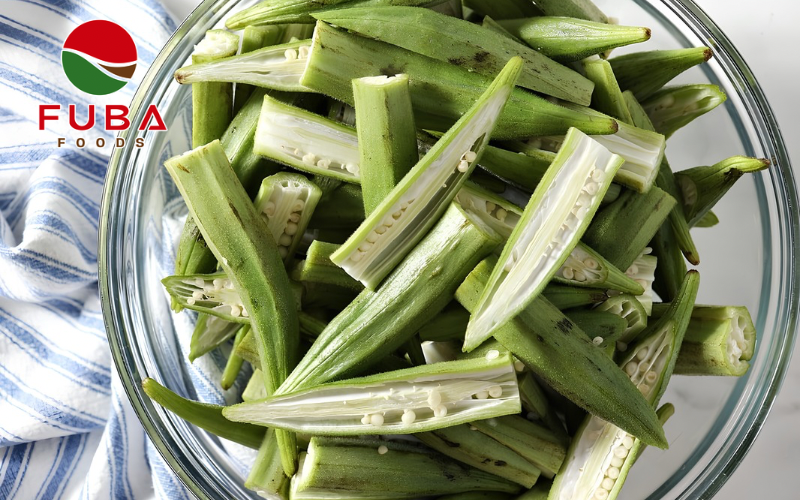
Frozen okra slices are pre-cut okra pieces that are processed and individually quick frozen to provide food manufacturers with a convenient, consistent ingredient for year-round production. By removing much of the washing, trimming, and cutting work required when using fresh okra, frozen okra slices can help commercial kitchens and food factories improve preparation efficiency while maintaining a more consistent ingredient specification.

For food manufacturers, however, convenience alone is not enough. Slice thickness, raw material maturity, colour, texture, freezing performance, packaging, and cold-chain stability all affect how frozen okra slices perform during cooking and further processing. A dependable product therefore starts with controlled processing at the factory level, from agricultural sourcing and raw material inspection through cutting, blanching, IQF freezing, inspection, and cold storage.
This article looks at what makes frozen okra slices suitable for commercial food production, how they are processed, where they can be used, and what importers, distributors, and manufacturers should evaluate before establishing a long-term supply.
What Are Frozen Okra Slices?
Frozen okra slices are fresh okra that has been cleaned, prepared, cut into slices, and rapidly frozen using IQF technology. Unlike whole okra, which is supplied as an intact pod, the sliced format is designed to be incorporated directly into recipes and food formulations with minimal additional preparation.
The cutting specification is one of the most important characteristics of the product. Consistent slices help manufacturers achieve more predictable cooking times and distribute okra more evenly throughout a finished product. This is particularly relevant when the ingredient is used in ready meals, soups, sauces, vegetable mixes, or other processed foods.
Because the product is individually frozen, the slices can generally be portioned according to production requirements instead of requiring an entire frozen block to be thawed. This makes the format practical for both industrial processing and high-volume foodservice operations.
Why Use Frozen Okra Slices in Food Manufacturing?
The main advantage of frozen okra slices is the preparation time they remove from the production process. Fresh okra requires receiving, inspection, washing, trimming, and cutting before it can enter a recipe. With a properly processed frozen product, much of this preparation has already been completed at the manufacturing facility.

This can make production planning more predictable. The manufacturer receives an ingredient with a defined cut specification rather than relying on variable fresh raw material and manual preparation. Reduced preparation requirements can also help lower labour requirements, particularly in operations processing large volumes of vegetables.
Frozen okra slices can also help maintain a stable supply throughout the year. Instead of adjusting production around short-term fresh availability, manufacturers can maintain frozen inventory and use the ingredient according to their production schedule.
How Are Frozen Okra Slices Processed?
The quality of frozen okra slices is closely connected to the control maintained at each processing stage. Cutting the vegetable correctly is only one part of the process; the raw material must first be suitable for freezing, and the finished slices must be rapidly frozen and protected throughout storage.
Fresh Okra Selection and Inspection
Processing starts with the selection of fresh okra that meets defined quality requirements. Incoming raw materials are inspected for freshness, maturity, colour, physical damage, and other characteristics that could affect the finished product.
At FUBA, raw material sourcing is connected with the factory’s processing system, allowing fresh okra to be inspected before entering washing, sorting, cutting, and further processing. This early-stage control helps ensure that the raw material used for frozen okra slices meets the required specifications before freezing.
This step is particularly important for sliced okra because cutting does not eliminate raw material defects. Over-mature okra, for example, may produce an undesirable texture even when the final pieces have an otherwise uniform appearance.

Washing, Sorting, and Cutting
After inspection, the okra is washed and sorted before being prepared for cutting. Proper cleaning removes soil and surface impurities, while sorting helps separate unsuitable material before it enters the cutting line.
The okra is then cut according to the agreed slice specification. Uniform cutting is critical because pieces that differ substantially in thickness may cook at different rates. For industrial applications, this can affect texture, appearance, and the consistency of the finished product.
A controlled factory cutting process provides greater consistency than relying on manual preparation, particularly when the same specification needs to be reproduced across repeated commercial orders.
Blanching and Cooling
Blanching may be used before freezing to help stabilize the vegetable and control enzyme activity during frozen storage. The temperature and treatment time need to be carefully controlled because excessive blanching can negatively affect firmness, while insufficient treatment may not provide the desired processing effect.
Following blanching, the sliced okra is cooled before entering the freezing stage. Managing the transition between thermal treatment and freezing helps prepare the product for rapid freezing while limiting unnecessary exposure to heat.

IQF Freezing
The prepared okra slices are rapidly frozen using Individual Quick Freezing technology. Instead of freezing the slices together as a single mass, IQF technology allows individual pieces to freeze separately.
For manufacturers, this is an important operational advantage. The required quantity can be removed from the package without thawing the entire batch, making portion control easier and reducing unnecessary product handling.
Rapid freezing also helps preserve the characteristics established during processing. When the freezing process and cold chain are properly controlled, IQF can help maintain the natural colour, flavour, texture, and nutritional characteristics of the okra.
What Makes High-Quality Frozen Okra Slices?
A commercially reliable frozen okra slice should be evaluated beyond its appearance in the package. Manufacturers need consistency that continues through cooking and further processing.
Consistent Slice Size and Thickness
Uniformity is one of the most important specifications for sliced okra. When slice dimensions are reasonably consistent, heat can penetrate the pieces more predictably during cooking.
This is particularly important for ready meals and industrial formulations where multiple ingredients are cooked together. Significant variation in slice thickness can result in some pieces becoming too soft while others remain insufficiently cooked.
Consistent cutting therefore contributes directly to production control rather than simply improving visual appearance.

Colour and Texture
Okra should retain an appropriate natural appearance after freezing and cooking. Colour can be influenced by raw material maturity, blanching conditions, freezing speed, storage temperature, and temperature fluctuations during distribution.
Texture is equally important. Poor raw material selection or excessive thermal treatment can lead to an overly soft product. For this reason, quality control needs to begin before the freezing stage rather than relying on IQF technology alone.
Free-Flowing IQF Pieces
Another practical consideration is whether the slices remain sufficiently separated after freezing. Free-flowing pieces are easier to weigh, portion, and transfer into production lines, particularly when ingredients need to be dosed repeatedly during large-scale production.
At FUBA, controlled IQF processing is designed to keep individual slant-cut okra pieces sufficiently separated for easier handling after freezing. This supports more consistent portioning and reduces the need to manually break apart frozen pieces before use.
This becomes increasingly important in large-scale manufacturing, where small handling inefficiencies can become significant when multiplied across hundreds of production batches.
Applications of Frozen Okra Slices
The sliced format is particularly useful when okra needs to be distributed throughout a recipe rather than presented as a whole vegetable. Its smaller size allows it to integrate more easily with other ingredients and sauces.

Ready Meals and Frozen Foods
Frozen okra slices can be incorporated into prepared meals, frozen vegetable combinations, and other convenience foods. Because the vegetable arrives cleaned, cut, and frozen, manufacturers can reduce preparation steps before formulation.
The consistent cut also supports more predictable distribution within a finished meal, helping manufacturers maintain a similar appearance and ingredient ratio across production batches.
Soups, Stews, and Sauces
Sliced okra works well in soups, stews, and other cooked preparations where the vegetable is incorporated directly into the dish. The smaller pieces can release their characteristic texture and flavour while becoming part of the overall recipe.
For industrial production, frozen slices provide a practical alternative to preparing fresh okra immediately before cooking. The ingredient can remain in frozen inventory and be added according to the planned production volume.
Foodservice and Central Kitchens
Restaurants, catering operations, and central kitchens can also benefit from the preparation already completed at the factory. Frozen okra slices reduce the need for staff to wash and manually cut fresh pods before cooking.
This can be particularly useful for operations that need consistent portions across multiple locations or production shifts.

Frozen Okra Slices Storage and Packaging
Proper frozen storage helps preserve the quality of frozen okra slices throughout their shelf life. The product should be maintained at -18°C or below, with stable temperature control during storage and transportation. Minimising temperature fluctuations helps protect the texture and condition of the okra during distribution.
Under the specified storage conditions, frozen okra slices can have a shelf life of up to 24 months. This allows manufacturers and distributors to plan inventory around their production or sales requirements rather than relying on frequent replenishment.
Packaging can be selected according to the intended market and handling requirements. Available formats include 500 g to 2 kg retail packs, 5 kg foodservice packaging, and 10 kg cartons with PE inner liners for bulk export. These options allow the product to be handled appropriately across different distribution channels.
For importers and distributors, packaging should be considered as part of the overall cold-chain process. Suitable packaging helps protect the frozen okra from moisture, physical damage, and handling during loading, transportation, warehouse storage, and delivery.
Choosing a Frozen Okra Slices Supplier
Choosing a frozen okra slices supplier should start with the product requirements rather than price alone. Buyers need to know whether the supplier can consistently deliver the agreed slice size, quality, packaging, and quantity across regular commercial orders.

The supplier’s production capabilities are an important part of this assessment. Raw material sourcing, preparation, cutting, blanching where required, IQF freezing, inspection, packaging, and cold storage all contribute to the consistency of the finished product. A supplier with sufficient production and storage capacity is also better positioned to support repeat orders as demand increases.
At FUBA, the factory production flow integrates raw material sourcing and inspection with washing, sorting, preparation, IQF freezing, metal detection, packing, cold storage, and export shipment. The facility has six IQF freezing lines with a listed capacity of 500 kg/hour each, supported by X-ray inspection systems, metal detectors, cold-storage facilities, and an in-house microbiological laboratory. This integrated setup provides the infrastructure to manage frozen vegetable production at commercial scale.
Direct factory production can provide greater visibility throughout the process. At the manufacturing level, the production flow covers raw material sourcing and inspection, washing, sorting, preparation, IQF freezing, metal detection, packing, cold storage, and export shipment. Managing these stages within one operation allows specifications to be monitored from the beginning of production through to the finished product.
Flexibility is also worth considering when the frozen okra slices are intended for different products or markets. Buyers may have specific requirements for slice dimensions, packaging, labelling, or private-label production. Working directly with a manufacturer can make it easier to discuss these requirements and coordinate production according to the agreed specification.

Conclusion
Frozen okra slices offer food manufacturers a practical IQF ingredient that reduces preparation work while providing a consistent format for industrial cooking and foodservice applications. Their pre-cut form is particularly suitable for ready meals, soups, stews, sauces, frozen vegetable mixes, and other recipes where okra needs to be distributed evenly throughout the finished product.
The quality of frozen okra slices depends on much more than the freezing stage. Raw material selection, washing, sorting, cutting accuracy, blanching, IQF technology, inspection, packaging, and cold-chain management all contribute to consistent performance.
For commercial sourcing, the manufacturing system behind the product is therefore a key consideration. A factory with controlled sourcing, modern processing and freezing equipment, recognized food-safety systems, traceability, and sufficient production capacity can provide the consistency required for long-term frozen okra supply.


