

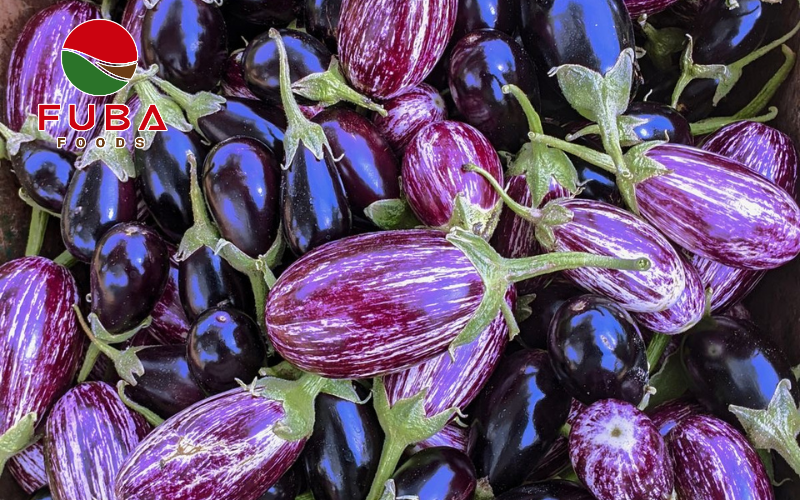
Frozen mini eggplant, particularly the small-sized Hisui variety, is a practical vegetable ingredient for food manufacturers, foodservice operators, and distributors looking for consistent portions, convenient preparation, and reliable year-round supply. Unlike standard-sized eggplant, mini eggplant offers a compact shape that can be used whole or incorporated into prepared dishes with minimal cutting and preparation.
For commercial food production, however, choosing frozen mini eggplant is not simply about selecting a smaller vegetable. Buyers need to consider the product’s size, preparation method, freezing technology, texture, packaging, storage conditions, and suitability for the intended application. These factors determine whether the ingredient can perform consistently in a restaurant kitchen, ready-meal line, foodservice operation, or further-processing facility.

This article explains what frozen mini eggplant is, how the Hisui format is used, which food applications are most suitable, and what manufacturers and distributors should evaluate when sourcing the product from a frozen vegetable supplier.
What Is Frozen Mini Eggplant?
Frozen mini eggplant is a small-sized eggplant that is prepared and frozen for commercial storage and use. Its compact size makes it different from conventional eggplant formats because the product can retain a more complete and recognizable shape after processing.
The term “Hisui” is commonly used to identify a small Japanese-style eggplant format. For commercial buyers, the most important consideration is not the name alone but the actual product specification supplied by the factory. Size range, appearance, processing method, freezing condition, and packaging should be clearly defined before purchase, particularly when the mini eggplant will be used as a standardized ingredient.
A frozen mini eggplant product is especially useful when manufacturers want to reduce preparation work while retaining flexibility in cooking. Instead of purchasing fresh eggplant and carrying out sorting, trimming, and preparation internally, buyers can source a ready-to-process frozen format that has already passed through controlled production stages.
FUBA includes frozen fried mini eggplant (Hisui) within its eggplant range, alongside several other processed formats. The product is made from Vietnamese eggplant and processed using IQF technology, giving buyers access to a standardized frozen format rather than having to prepare fresh mini eggplant themselves.

Why Choose Frozen Mini Eggplant for Food Production?
The main advantage of frozen mini eggplant is convenience without sacrificing the flexibility required in commercial cooking. Fresh eggplant requires purchasing, receiving, inspection, storage, washing, preparation, and processing before it can enter a recipe. Each additional step creates labor requirements and another opportunity for variation.
A frozen format moves much of this work upstream to the processing facility. The manufacturer receives a product that has already been selected, prepared, and frozen according to an established specification. This can simplify production planning and make ingredient handling easier, particularly for businesses producing prepared foods at regular volume.
Mini eggplant also has a natural advantage in portion control. Its smaller size can make it suitable for individual servings, side dishes, vegetable-based meals, and recipes where the shape of the vegetable contributes to the presentation. Instead of cutting a large eggplant into multiple pieces, manufacturers can work with smaller units that are easier to portion according to the recipe.
Another consideration is supply continuity. Food manufacturers and distributors may need a consistent eggplant ingredient beyond the availability and quality fluctuations of the fresh market. Frozen processing allows the product to be stored and supplied under controlled conditions, helping manufacturers plan production around a defined specification rather than relying entirely on fresh seasonal purchasing.
Frozen Mini Eggplant Product Uses and Applications
The versatility of frozen mini eggplant comes from its compact size and ability to work across different preparation styles. The most suitable application depends on whether the buyer prioritizes whole-piece presentation, a cooked texture, convenience, or integration into a larger prepared-food recipe.

Frozen Mini Eggplant for Ready Meals
Ready meals are one of the strongest applications for frozen mini eggplant because manufacturers need ingredients that can be portioned consistently and integrated into a repeatable production process.
Mini eggplant can be used in vegetable-based ready meals, mixed vegetable dishes, rice meals, pasta dishes, and other prepared-food formulations. Its compact size provides a recognizable vegetable component without requiring the manufacturer to carry out extensive cutting during assembly.
For industrial production, consistency is particularly important. If eggplant pieces vary significantly in size or condition, cooking time and portion distribution can also vary. A factory-produced frozen specification helps reduce this variation and makes it easier to establish repeatable production parameters.
Frozen Mini Eggplant for Stir-Fry and Savory Dishes
Mini eggplant can also be incorporated into stir-fried and other savory dishes where the vegetable needs to retain its identity within the finished recipe.
The compact format works particularly well when the dish calls for visible vegetable pieces rather than finely diced ingredients. Depending on the recipe and processing specification, the eggplant can be combined with sauces, seasonings, other vegetables, or protein ingredients.
For food manufacturers, the key is to select a processing method that matches the final cooking process. A fried mini eggplant, for example, already has a different texture and flavor profile from a raw frozen mini eggplant. The supplier specification therefore needs to reflect how the ingredient will be used after delivery.

Frozen Mini Eggplant for Foodservice
Foodservice kitchens benefit from frozen mini eggplant because preparation can be simplified while maintaining a consistent ingredient supply. Restaurants, central kitchens, catering operations, and foodservice distributors can use the product in dishes where a small whole or recognizable eggplant format adds visual and culinary value.
The frozen format can also reduce dependence on daily fresh preparation. Instead of purchasing fresh eggplant and processing it according to each kitchen’s workflow, operators can portion the required quantity from frozen inventory according to production needs.
For distributors, this makes product specification particularly important. The buyer should be able to communicate the actual format, processing method, packaging, storage requirement, and intended application clearly to downstream customers.
IQF Technology and Frozen Mini Eggplant Quality
Freezing technology has a direct effect on how a frozen vegetable performs after storage and cooking. IQF, or Individually Quick Frozen technology, rapidly freezes individual pieces so they remain separate rather than becoming one solid frozen block.
For mini eggplant, individual freezing can make handling and portioning more convenient. Users can take the required quantity from a package without needing to thaw the entire product. This is especially useful for foodservice operations and manufacturing lines where ingredients are consumed in controlled quantities throughout production.
IQF processing also forms part of a broader quality-control system. It cannot compensate for poor raw materials or uncontrolled processing, so the freezing stage needs to work together with raw-material inspection, sorting, preparation, food safety controls, and cold storage.
FUBA uses an integrated production flow covering farm sourcing, raw material inspection, washing and cleaning, sorting and grading, cutting or preparation, IQF freezing, metal detection, packing, cold storage, and export shipment. This type of controlled process is important when buyers require consistent frozen vegetable specifications for repeated commercial production.

What Should Buyers Check When Sourcing Frozen Mini Eggplant?
Before placing a commercial order, buyers should establish the exact product specification rather than relying only on the term “mini eggplant.” Size consistency is important because the physical dimensions of the product influence portioning, cooking time, packaging efficiency, and finished-product appearance.
The processing method should also be confirmed. A buyer looking for fried mini eggplant should not assume that every frozen mini eggplant has undergone the same preparation. The supplier should clearly identify whether the product is fried, blanched, raw, grilled, or processed in another way.
Texture and appearance should be assessed through product samples and, where possible, application testing. This is particularly important when the mini eggplant will be reheated, incorporated into a ready meal, or subjected to another cooking process. A sample that performs well in its frozen state may behave differently after thawing and cooking, so testing the actual application provides a more reliable evaluation.
Packaging and storage conditions also matter for commercial supply. Frozen eggplant products should remain under controlled frozen storage throughout distribution.

Choosing a Frozen Mini Eggplant Supplier
Supplier selection should focus on manufacturing consistency rather than price alone. For a product that becomes part of a regular food-production process, inconsistent raw materials, changing cut specifications, or unstable supply can create greater costs downstream through production adjustments and rejected batches.
A reliable supplier should have control over raw-material sourcing and processing. Strong relationships with growing regions and growers can help support a more stable supply of suitable eggplant, while systematic inspection and grading help control variation before the product reaches the freezing stage.
Manufacturing infrastructure is another important consideration. A factory with dedicated freezing, inspection, cold-storage, and value-added processing equipment has greater control over the product than a company that simply sources finished frozen vegetables from another producer.
FUBA operates a factory in Vietnam with an annual supply capacity of 20,000 MT and more than 600 workers. Its processing infrastructure includes six IQF freezing lines with a capacity of 500 kg per hour each, three contact freezing lines, two air-blast freezing systems, X-ray inspection, metal detection, cold storage, and value-added processing equipment. This production base supports the kind of volume, processing control, and customization that can be relevant when frozen mini eggplant is required for ongoing commercial supply.
Food safety and traceability should also be verified before establishing a long-term supply relationship. FUBA’s quality assurance system includes FDA, HACCP, ISO 22000, HALAL, and BRCGS, together with temperature-controlled storage below -18°C and product traceability.

Frozen Mini Eggplant for Commercial Food Applications
Frozen mini eggplant (Hisui) is more than a smaller version of conventional eggplant. Its compact format gives manufacturers and foodservice operators another way to control portioning, presentation, preparation time, and ingredient consistency.
The most suitable applications include ready meals, stir-fried dishes, savory vegetable recipes, foodservice preparations, and other processed foods where a recognizable mini eggplant format adds value. Fried mini eggplant can provide a pre-processed ingredient with a different texture and flavor profile, while the right specification can also support more efficient large-scale preparation.
For buyers, the most important decision is therefore to match the product specification with the finished application. Size, processing method, IQF technology, texture, packaging, storage, food safety controls, and supplier production capacity should all be evaluated together.
When these factors are properly controlled, frozen mini eggplant can provide manufacturers and distributors with a convenient, consistent, and commercially practical vegetable ingredient for year-round food production.

Conclusion
Frozen mini eggplant (Hisui) offers a compact, versatile format for manufacturers, distributors, and foodservice operators that need greater consistency and convenience than fresh eggplant preparation can provide. Its applications extend across ready meals, stir-fried dishes, savory recipes, and foodservice preparations, with the exact product specification determining how effectively it performs in each application.
IQF freezing, controlled processing, reliable raw-material sourcing, appropriate packaging, and a maintained cold chain are essential to product consistency. For commercial buyers, evaluating the supplier’s actual manufacturing capabilities is just as important as evaluating the frozen mini eggplant itself.


