

Mango is widely used in food manufacturing because of its naturally sweet flavour, attractive colour, and versatility across beverages, dairy products, bakery items, fruit mixes, and processed foods. For manufacturers working with consistent production volumes, however, sourcing mango is not simply about finding fruit at a competitive price. Raw material consistency, usable yield, product format, Brix, texture, packaging, and supply continuity can all affect the efficiency of the final production process.
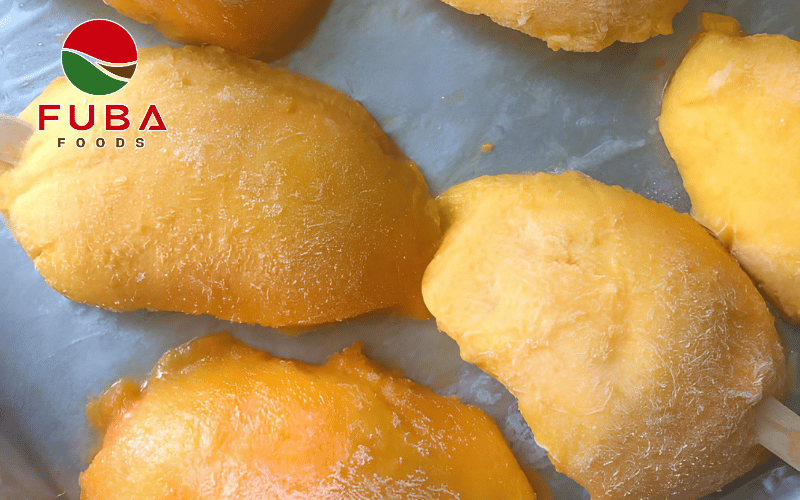
Frozen mango for food manufacturing provides a practical way to standardise mango ingredients while reducing the preparation work associated with fresh fruit. Depending on the application, manufacturers can source IQF mango cubes, half-cut mango, or frozen mango puree, with each format serving a different production requirement.
For buyers, the important question is not simply whether frozen mango is suitable, but whether the product specification and supplier’s processing capabilities match the actual requirements of the production line. This article looks at the main factors to consider before sourcing frozen mango, including product formats, technical specifications, processing, packaging, supply continuity, and factory capabilities. It also explains what buyers should clarify with a supplier before moving from samples and quotations to regular commercial orders.
Why Food Manufacturers Use Frozen Mango
Using fresh mango at an industrial scale can involve a considerable amount of preparation. Depending on the final application, the fruit may need to be washed, peeled, trimmed, cut, sorted, or processed before it reaches the production line.
Frozen mango moves much of this preparation to the processing stage. The fruit arrives in a defined format and can be stored under controlled frozen conditions until it is needed.
This can make production easier to plan, particularly for manufacturers that use mango regularly rather than only during a specific harvest period.
Easier Ingredient Preparation
Pre-processed mango reduces the amount of preparation required at the customer’s facility. Instead of starting with whole fresh fruit, manufacturers can work with cubes, half-cut pieces, or puree according to their formulation.
For high-volume production, this can reduce preparation labour and make ingredient handling more predictable.
More Consistent Ingredient Specifications
Fresh mango can naturally vary in size, maturity, colour, and texture. A commercial frozen product is processed according to an agreed specification, giving manufacturers clearer parameters for the ingredient entering their production line.
This does not mean every piece will be identical. Rather, the supplier can work within defined requirements for characteristics such as cut size, Brix, colour, texture, and product format.
More Flexible Production Planning
Frozen storage allows processed mango to be held and released according to production requirements. This can reduce dependence on the immediate availability of fresh fruit and make it easier to plan production throughout the year.
The benefit depends on proper storage and cold-chain management. Freezing can extend the usable period of prepared mango, but the product still needs to be kept under the required conditions from the factory to the final destination.
Fresh Mango vs Frozen Mango From a Production Perspective
Fresh and frozen mango can both be suitable for food manufacturing, but they create different requirements within the production process.
Fresh mango gives manufacturers direct control over preparation, which can be useful when a particular product requires fruit to be handled in-house. At the same time, this means the manufacturer takes responsibility for receiving, inspection, preparation, yield management, and waste generated during processing.
Frozen mango is already prepared according to a defined specification. The manufacturer can therefore focus more directly on incorporating the ingredient into the final formulation rather than carrying out all of the preliminary fruit preparation internally.
For repeated production, this difference can become more significant. A frozen ingredient can be stored and used according to the production schedule, while fresh mango needs to be managed around its condition and availability at the time of purchase.
However, freezing does not solve problems created by poor raw material selection. The quality of the frozen product still depends on the mango entering the processing line. Variety, maturity, colour, texture, and Brix should therefore be considered before the freezing stage rather than judged only after the finished product has been produced.
Which Frozen Mango Format Fits Your Production Process?
The most suitable format depends on what happens to the mango after it reaches the factory. A product that needs visible fruit pieces will have different requirements from one in which mango is blended directly into the formulation.
IQF Mango Cubes for Fruit Pieces
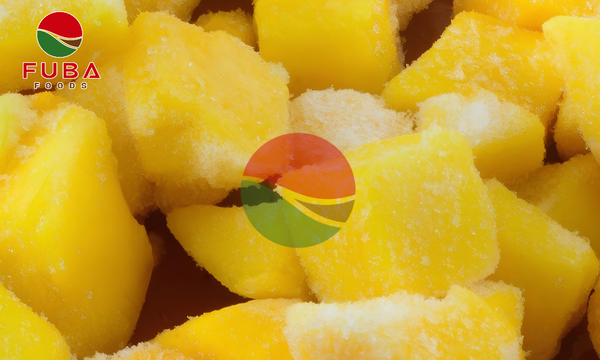
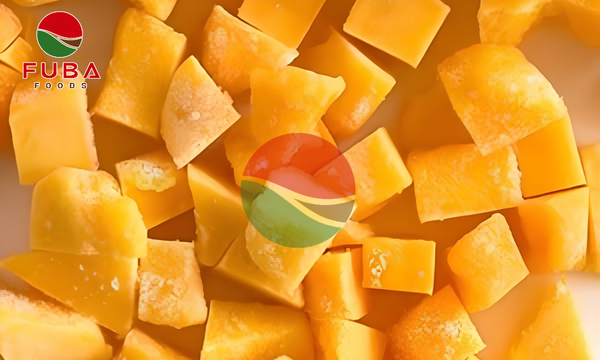
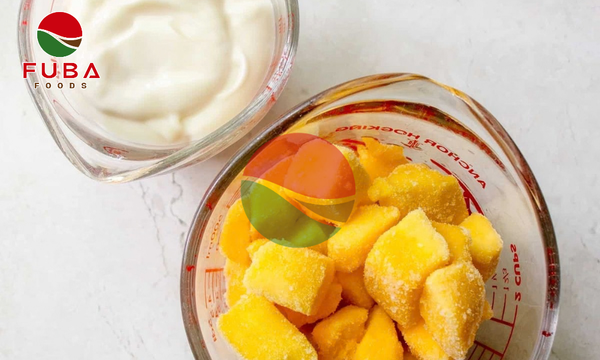
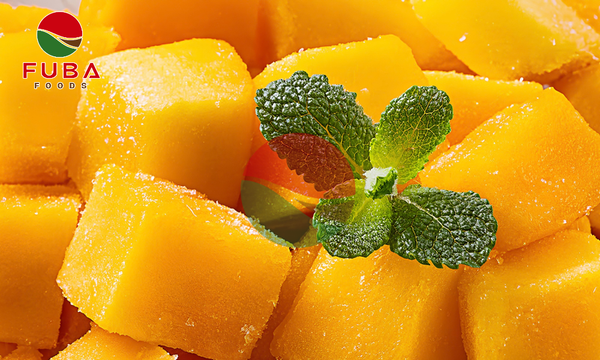
IQF mango cubes are suitable for applications where recognizable pieces of mango are part of the finished product. They can be used in fruit mixes, yoghurt products, desserts, bakery products, and prepared foods.
The main consideration is the required cube size. Smaller pieces may work better in some formulations, while larger pieces may be preferred where mango needs to remain visually prominent.
Buyers should therefore specify the required dimensions or size range instead of relying only on a general description such as “IQF mango cubes.”
IQF Mango Half Cut for Larger Fruit Pieces
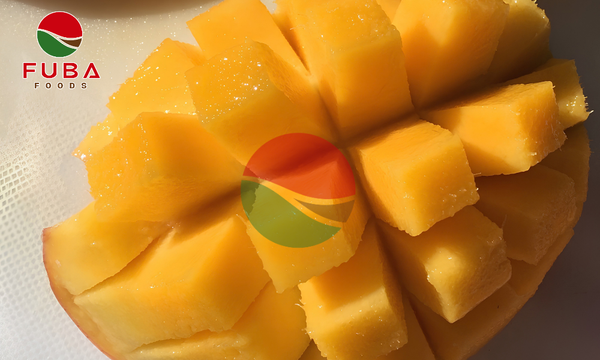
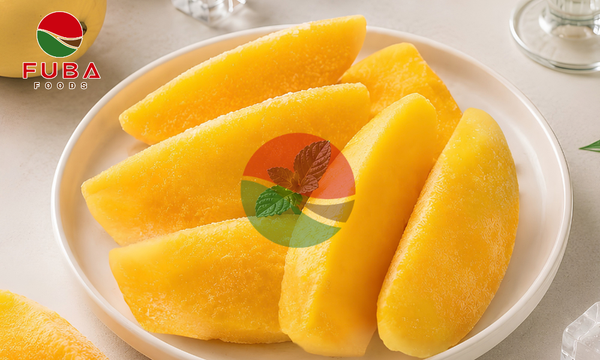
Half-cut mango retains more of the fruit’s original shape and can be suitable for products where appearance and presentation are important.
Because the pieces are larger, buyers should also consider how they will be handled during production, packaging, and storage. Product weight, size range, appearance, and freezing performance should be agreed before commercial supply begins.
Frozen Mango Puree for Formulation-Based Products
Frozen mango puree is better suited to products where mango becomes part of the formulation rather than remaining as a visible piece.
It can be used in beverages, yoghurt, ice cream, bakery products, desserts, sauces, and other applications requiring a smooth mango base.
For puree, Brix is an important specification. It indicates the level of soluble solids in the product and can influence sweetness and formulation. Buyers should establish the target Brix range according to their recipe rather than treating mango puree as a standard product with one fixed specification.
What Specifications Should Buyers Ask a Frozen Mango Supplier For?
Mango Variety and Raw Material
Mango variety can influence flavour, colour, texture, and processing characteristics. Buyers should therefore identify the variety used rather than evaluating the product only by the general term “frozen mango.”
FUBA’s mango range includes Cat Chu and Kaew varieties. Defining the variety at the sourcing stage gives manufacturers a clearer reference when comparing samples and setting a commercial specification.
Raw material maturity is another consideration. Mango that is too firm or too mature can behave differently during cutting, freezing, and further processing.
Brix
Brix is particularly relevant for mango puree and other formulation-based applications. A difference in soluble solids can affect sweetness and the balance of other ingredients in the recipe.
For commercial sourcing, buyers should agree on a target range and acceptable tolerance so that the ingredient can be incorporated consistently into the formulation.
Cut Size and Uniformity
For IQF mango cubes, cut size affects portioning, appearance, and processing behaviour. Significant variation between pieces can make it harder to achieve consistent results across production batches.
The same principle applies to half-cut mango. Buyers should define the expected size and acceptable variation clearly rather than depending on broad descriptions such as “large” or “premium” pieces.
Colour, Texture, and IQF Separation
Colour and texture are important quality characteristics for frozen mango, particularly when the fruit remains visible in the finished product.
IQF freezing helps keep individual mango pieces separated after freezing, making them easier to portion and handle. Buyers should still check the actual performance of the product after freezing, including whether pieces remain sufficiently free-flowing and whether the texture meets the intended application.
Packaging and Order Volume Matter More Than They Seem
Packaging needs to work for the entire supply chain, not just the factory. The product may be loaded, transported internationally, stored in a warehouse, moved several times, and eventually transferred into production.
For this reason, buyers should clarify the pack size, inner packaging, carton configuration, labelling, palletisation, and any market-specific requirements before confirming an order.
Order volume should also be discussed early. A supplier may have the right product but not the production or storage capacity required for recurring commercial volumes.
The expected order quantity should therefore be considered together with processing capacity, freezing capacity, raw material availability, and cold-storage space.
Supply Continuity Starts With Raw Material Sourcing
Mango is an agricultural product, so supply is naturally connected to growing regions and harvest periods. A supplier’s ability to maintain production depends partly on how effectively it manages raw material sourcing.
Working with established agricultural supply relationships can give a manufacturer greater visibility over the incoming fruit and allow raw material requirements to be defined before the harvest reaches the processing line.
FUBA sources agricultural raw materials from growing regions across Vietnam, with mango among the products associated with its sourcing network. This sourcing structure supports the coordination between incoming fruit and the factory’s processing requirements.
What to Ask a Vietnamese Frozen Mango Supplier
Before moving from a quotation to a regular order, buyers should request a clear product specification. At minimum, this should cover the mango variety, format, Brix where applicable, cut size, colour and texture requirements, storage temperature, shelf life, packaging, and available documentation.
The supplier should also be able to explain how the product moves through the factory. Raw material inspection, washing and cleaning, sorting, preparation, cutting, freezing, inspection, packing, and storage should follow a defined process.
At FUBA, the production flow covers raw material inspection, washing and cleaning, sorting and grading, cutting or preparation, IQF freezing, metal detection, packing, cold storage, and export shipment.
Food-safety and traceability systems are another part of supplier qualification. FUBA operates systems including HACCP, ISO 22000, HALAL, and BRCGS, with traceability and inspection equipment including metal detection and X-ray systems. The factory also has an in-house microbiological laboratory.
Documentation requirements should be discussed before the order is confirmed. Depending on the destination market, buyers may need product specifications, certificates of analysis, certificates of origin, traceability information, food-safety documentation, and export paperwork.
Commercial procedures should also be clear. Claims, replacement arrangements, product discrepancies, and other quality-related issues are easier to manage when the requirements have been agreed before shipment.
Why Factory Sourcing Can Improve Frozen Mango Cost Control
The cost of frozen mango is not determined by the price of fresh fruit alone. Yield, preparation, labour, freezing, packaging, cold storage, and logistics all contribute to the final product cost.
Working directly with a manufacturer can give buyers a clearer view of these stages. It also allows product specifications and production requirements to be discussed closer to the processing source rather than through several intermediaries.
FUBA operates a frozen fruit and vegetable factory in Ca Mau Province with a listed annual capacity of 20,000 MT, more than 600 workers, and over 15 years of experience in the industry. Its production infrastructure includes IQF freezing lines, contact freezing lines, air-blast freezing systems, inspection equipment, and dedicated cold-storage facilities.
For mango buyers, the value of this infrastructure is connected to consistency. Raw material sourcing, preparation, freezing, inspection, storage, and export operations need to work together if the same product specification is to be maintained across recurring orders.
FUBA’s Frozen Mango Formats
FUBA supplies frozen mango in three main formats: IQF mango cubes, IQF mango half cut, and frozen mango puree.
The cube and puree specifications include Brix ranges of 12–14° and 14–18°, respectively, while Cat Chu and Kaew are among the mango varieties used across the range. The products are made from Vietnamese mango and processed for frozen storage and export applications.
The formats serve different production needs. Cubes are suited to applications requiring identifiable fruit pieces, half cut provides a larger and more recognizable mango format, while puree is intended for formulations where mango is incorporated as a smooth ingredient.
For manufacturers, having several formats available from one factory can make sourcing more straightforward when different products require different forms of mango.
Conclusion
Sourcing frozen mango for food manufacturing involves more than comparing prices between suppliers. The product needs to match the production process in terms of format, mango variety, Brix, cut size, colour, texture, packaging, and storage requirements.
IQF mango cubes are suitable for applications that require visible fruit pieces, half cut can support products where larger pieces and presentation are important, while frozen mango puree provides a practical option for beverages, dairy, bakery, desserts, and other formulation-based products.
Beyond the product itself, buyers should also examine raw material sourcing, processing controls, IQF freezing, food-safety systems, traceability, cold storage, production capacity, documentation, and supply continuity.
A direct manufacturing relationship can give buyers greater visibility across these stages and make it easier to establish a clear product specification before regular orders begin. For long-term sourcing, that consistency between the agreed specification and the product delivered from one shipment to the next is an important part of evaluating a frozen mango supplier.


