

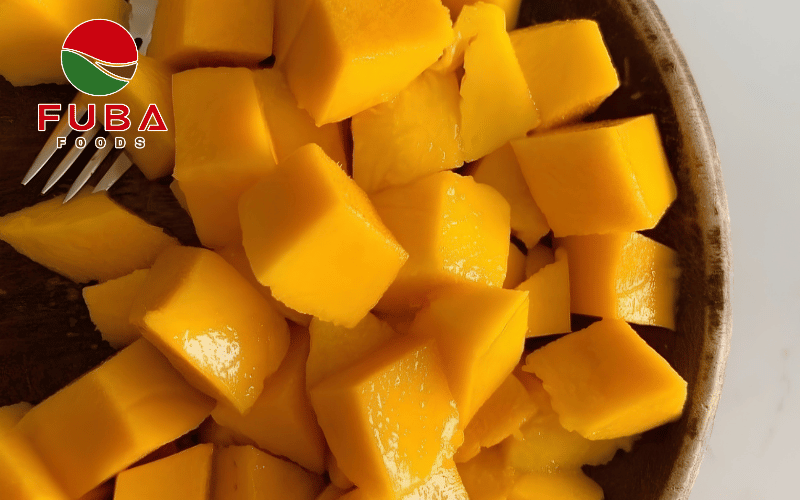
Mango cubes are widely used in commercial food production because they offer a convenient way to incorporate real mango while keeping the fruit in a defined format. They can be blended into beverages, added to fruit mixes, used in desserts, incorporated into bakery products, or processed further into sauces and other formulations. However, not every mango cube specification will perform equally well across different production lines.
For food manufacturers and distributors, choosing the right frozen mango cubes for food manufacturing involves more than looking at the word “IQF” or comparing the price per kilogram. Cube size, mango variety, Brix, firmness, colour, freezing performance, packaging, and raw material consistency can all affect how the ingredient performs during production.
The right cut should fit both the final application and the way the factory handles, thaws, blends, cooks, or portions the mango. A cube that works well as a visible fruit topping, for example, may not be the most practical choice for a beverage base or industrial puree production.
This article explains how to select frozen mango cubes based on production requirements, which specifications manufacturers should evaluate, and how processing and factory controls can influence the consistency of the finished ingredient.

What Are Frozen Mango Cubes for Food Manufacturing?
Frozen mango cubes are mangoes that have been prepared and cut into defined cube-shaped pieces before freezing, typically using Individual Quick Freezing (IQF) technology. The individual pieces are frozen rapidly so that they remain separate rather than forming a single solid block.
This format gives manufacturers greater control over portioning and processing compared with whole frozen mango or irregular fruit pieces. The cubes can be weighed, mixed, processed, or added to recipes according to the requirements of the finished product.
For commercial production, however, the cube shape is only one part of the specification. Actual size, size tolerance, mango variety, maturity, Brix, texture, colour, and freezing conditions all influence how consistently the product performs on the production line.
A reliable supplier should therefore provide a clearly defined product specification rather than treating all frozen mango cubes as the same ingredient.
How Should Manufacturers Choose the Right Mango Cube Size?
The most suitable cube size depends largely on what happens to the mango after it reaches the factory.
Smaller Mango Cubes for Blending and Further Processing
Smaller cubes can be practical when mango will be blended, pulped, homogenised, or incorporated into another formulation. A smaller cut may reduce the amount of mechanical processing needed to break down the fruit before it becomes part of the final product.
This can be useful for beverage bases, smoothies, sauces, fruit preparations, and other applications where the mango does not need to remain visibly cubed.
The manufacturer should still consider how the cube size interacts with the processing equipment. Smaller pieces may thaw and process differently from larger ones, so the specification should ideally be tested under actual production conditions rather than selected based solely on nominal dimensions.
Larger Mango Cubes for Visible Fruit Applications
Larger cubes can be more suitable when the finished product needs to retain a visible mango appearance. Fruit mixes, dessert toppings, yoghurt preparations, bakery products, and certain ready-to-eat applications may benefit from a more defined fruit shape.
In these applications, the cubes need to retain their shape and acceptable firmness after thawing or further processing. A specification that looks suitable while frozen may perform differently after temperature changes, mixing, cooking, or storage.
The right cube size is therefore not necessarily the largest or smallest available. It is the size that provides the required appearance and processing performance for the finished product.

Why Does Mango Variety Matter When Buying Frozen Mango Cubes?
Cube size often receives considerable attention during purchasing, but mango variety can be just as important. Different varieties can vary in flavour, aroma, colour, sweetness, texture, and fruit structure.
For example, FUBA’s frozen mango cube products use Cat Chu and Kaew mango varieties, with a stated Brix specification of 12–14°. The products are intended for applications including beverages, ice cream, yoghurt, bakery products, fruit mixes, and other food-processing uses.
For manufacturers, knowing the mango variety provides more useful information than simply purchasing “Vietnamese frozen mango.” It allows the technical team to assess whether the fruit characteristics are suitable for the formulation and whether the same specification can be maintained across future orders.
Raw material sourcing is also important for long-term supply. A factory with an established agricultural sourcing network can coordinate raw material availability with processing requirements instead of relying entirely on spot-market purchasing.
What Brix Should Frozen Mango Cubes Have?
Brix is an important specification when frozen mango is used as a formulation ingredient because it indicates the level of soluble solids in the fruit and can influence sweetness and recipe calculations.
A range of 12–14° Brix can be suitable for various commercial frozen mango cube applications, although the appropriate range ultimately depends on the finished product and its formulation.
For example, a beverage manufacturer may need to balance mango solids with water, sugar, other fruit ingredients, or concentrates. A yoghurt or dessert manufacturer may have different requirements because the mango is combined with dairy or other ingredients.
Brix should therefore be considered as part of the overall ingredient specification rather than as a standalone measure of quality. Manufacturers should evaluate it together with flavour, maturity, colour, texture, and consistency.
How Important Is Cube Uniformity in Food Production?
Uniformity becomes increasingly important as production volume increases. When cubes vary significantly in size, they may behave differently during thawing, cooking, blending, or portioning.
For products that require visible mango pieces, inconsistent cuts can also affect the appearance of the finished product. A mixture containing very large and very small pieces may result in an uneven visual appearance and inconsistent bite.
For automated or semi-automated production, consistent cube dimensions can also make weighing, dosing, and handling more predictable.
This is why buyers should ask about cut dimensions and size tolerance rather than relying on general descriptions such as “diced mango” or “mango cubes.” The supplier should be able to define the intended cut and explain how it is controlled during processing.
Why Does IQF Freezing Matter for Mango Cubes?
IQF technology is particularly relevant to frozen mango cubes because the individual pieces need to remain separate and manageable after freezing.
Rapid individual freezing helps preserve the natural characteristics of the mango while preventing the cubes from freezing together into one large block. This allows manufacturers to take only the quantity they need from a larger package without having to thaw the entire batch.
For commercial operations, IQF performance also affects handling efficiency. Individual pieces can be weighed, portioned, mixed with other ingredients, or transferred into production equipment more easily than frozen blocks.
At FUBA, IQF freezing is integrated into a broader factory processing flow that includes raw material inspection, washing and cleaning, sorting and grading, preparation, freezing, metal detection, packing, cold storage, and export shipment. The factory operates multiple IQF freezing lines as part of its frozen food production system.
This integrated approach is important because freezing performance is closely connected to the processes before and after the freezing stage.

How Does Raw Material Control Affect Frozen Mango Cube Quality?
Consistent frozen mango cubes start with consistent raw material. Fruit maturity, physical condition, variety, and sourcing region can all influence the finished product.
When raw mango arrives at different maturity stages, the resulting cubes may vary in firmness, sweetness, colour, and flavour. This can create challenges for manufacturers that need the same ingredient specification across multiple production batches.
Factory-level raw material inspection and sorting help reduce this variation before the fruit enters cutting and freezing.
FUBA sources mango through Vietnam’s agricultural supply network and combines sourcing with factory processing and quality control. This creates a closer connection between the agricultural raw material and the finished frozen product, which can be useful when manufacturers require consistent supply over an extended purchasing cycle.
What Processing Controls Should a Frozen Mango Cube Supplier Have?
Cutting mango into cubes is only one stage of commercial production. The factory needs to manage multiple steps between receiving the raw fruit and shipping the finished product.
A controlled process typically includes raw material inspection, washing, sorting, grading, cutting, freezing, foreign-material detection, packing, and frozen storage. Each stage can influence the final product specification as well as food safety.
Quality systems are also important when frozen mango is supplied internationally. FUBA’s factory operates under food-safety and quality systems including HACCP, ISO 22000, HALAL, BRCGS, FDA compliance, and traceability controls. Its inspection equipment includes metal detection and X-ray systems, supported by an in-house microbiological laboratory.
For manufacturers, these systems represent more than certification credentials. They show that product control extends beyond the physical appearance of the mango cubes to areas such as food safety, traceability, and process management.
How Should Frozen Mango Cubes Be Stored and Packaged?
Frozen mango cubes require continuous temperature control after processing. Commercial frozen mango products are stored at ≤ -18°C, with a shelf life of up to 24 months under appropriate storage conditions.
Packaging should also reflect the intended purchasing volume. Manufacturers using large quantities may require bulk formats that reduce handling and repacking, while foodservice or smaller operations may need more manageable pack sizes.
For importers and distributors, packaging should be considered alongside pallet configuration, storage capacity, shipment volume, and expected inventory turnover. The most suitable pack is the one that fits the actual handling system rather than simply being the smallest or largest option available.
How Does Production Capacity Affect Frozen Mango Cube Supply?
A technically suitable mango cube is only useful if the supplier can maintain supply as demand increases.
Manufacturers should therefore consider annual production capacity, freezing capacity, raw material sourcing, cold-storage capacity, and export experience when evaluating a supplier. These factors become particularly relevant when moving from a sample order to recurring commercial shipments.
FUBA has a stated annual capacity of 20,000 MT, more than 15 years of experience, and exports to over 30 markets. Its factory also has three cold-storage facilities, each with a stated capacity of 500 MT.
These capabilities are relevant when customers require repeated shipments rather than a one-time purchase. Production scale also allows the manufacturer to coordinate sourcing, processing, freezing, storage, and export preparation within a connected supply chain.

What Should Buyers Confirm Before Ordering Frozen Mango Cubes?
Cut Size and Tolerance
Before placing a commercial order, buyers should make sure the mango cube specification fits the actual production process.
The first consideration is cut size and tolerance. A cube suitable for a beverage or puree application may not be the same as one required for a visible fruit topping.
Mango Variety and Brix
The second is mango variety and Brix. These specifications influence flavour, sweetness, colour, and formulation performance and should be confirmed against the requirements of the finished product.
Texture After Thawing and Processing
The third is texture after thawing or processing. A frozen sample may look acceptable, but a more useful test is to see how the cubes perform under the manufacturer’s actual production conditions.
IQF and Foreign-Material Control
The fourth is IQF performance and foreign-material control. Individual separation, freezing consistency, metal detection, X-ray inspection, and traceability are all relevant when the ingredient is supplied at commercial scale.
Packaging, Storage, Capacity, and Documentation
Finally, packaging, storage temperature, shelf life, production capacity, and documentation should be evaluated together. The supplier should be able to provide clear product specifications and the quality documents required for the intended market.

Conclusion
Choosing frozen mango cubes for food manufacturing is not simply a matter of selecting a convenient diced fruit product. The right cube needs to fit the finished application, processing equipment, formulation, handling system, and expected production volume.
Cube size and uniformity are particularly important when mango needs to retain its physical form, while smaller or more process-oriented cuts may be more practical when the fruit will be blended or processed further. Mango variety, Brix, raw material maturity, IQF freezing, food-safety controls, packaging, and cold-chain management also influence the consistency of the ingredient.
For commercial sourcing, a factory-direct supplier can provide greater visibility across the supply chain because raw material sourcing, processing, quality control, freezing, storage, and export preparation are connected within the same production system. The objective is not simply to purchase frozen mango cubes at the lowest initial price, but to secure a specification that performs consistently and remains commercially practical across repeated production cycles.


