

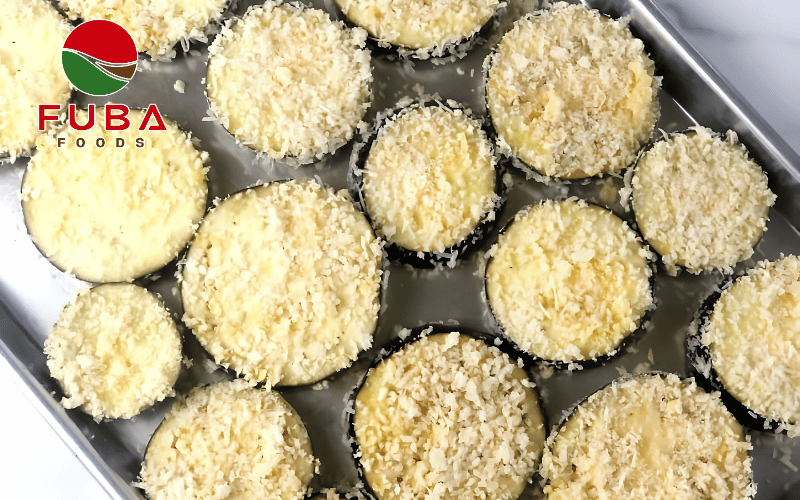
Frozen grilled eggplant is a practical ingredient for food manufacturers looking to achieve a grilled flavor and tender texture without adding extensive preparation steps to their production process. Compared with fresh eggplant, a frozen format can simplify handling, reduce preparation labor, and provide more consistent portioning for repeated production.
For manufacturers developing ready meals, frozen grilled eggplant in coin-cut format offers a balance between convenience, visual consistency, texture, and production efficiency. The key is not simply finding frozen eggplant, but selecting a product with a suitable cut, controlled grilling process, reliable freezing technology, and specifications that can perform consistently at commercial scale.

This article explains what makes grilled eggplant coin cut suitable for food manufacturing, how the processing and IQF freezing stages affect the finished ingredient, where it can be used, and what manufacturers should evaluate before choosing a long-term supplier.
Why Frozen Grilled Eggplant Coin Cut Works for Food Manufacturing
Fresh eggplant requires several preparation stages before it can be incorporated into a finished food product. Depending on the recipe, manufacturers may need to wash, trim, slice, grill or cook, portion, and process the eggplant within a limited time frame. These additional operations require labor, equipment, production space, and tighter control over raw-material variation.
Frozen grilled eggplant removes much of this preparation burden. The eggplant is already cut and grilled before freezing, allowing manufacturers to use the ingredient directly according to their production process. This is particularly useful when the recipe requires a recognizable eggplant shape and grilled characteristics rather than a puree or heavily processed vegetable ingredient.
The coin-cut format also provides a practical balance between appearance and portion control. Round slices can be distributed across pizzas, ready meals, pasta dishes, vegetable mixes, and prepared foods while maintaining a recognizable vegetable appearance. For products manufactured repeatedly, a standardized cut can also make ingredient dosing and product presentation easier to control.
Another important consideration is storage. Frozen grilled eggplant can be held under controlled frozen conditions and supplied according to production schedules rather than requiring manufacturers to process fresh eggplant immediately after delivery. Properly frozen products can therefore support more predictable production planning and reduce dependence on short fresh-produce windows.

How Grilled Eggplant Is Processed for Consistent Industrial Use
The performance of frozen grilled eggplant depends heavily on what happens before freezing. A good finished product starts with suitable raw materials and controlled preparation rather than relying on freezing technology alone.
Raw Material Selection and Preparation
Eggplant intended for grilling needs to be selected according to characteristics such as maturity, size, appearance, firmness, and internal structure. Excessively mature eggplant may have a softer structure or more prominent seeds, while immature fruit may not provide the desired texture and flavor after grilling.
After receiving, raw materials should undergo inspection and cleaning before processing. Sorting helps remove unsuitable pieces and creates greater consistency in the material entering the cutting and grilling stages. The eggplant is then prepared into the required coin-cut format before thermal processing.
For manufacturers, this stage matters because variation in raw-material quality can become more noticeable after grilling and freezing. A supplier with an established sourcing and quality-control system can therefore provide greater consistency than a supply chain that relies only on spot purchasing.
Controlled Grilling for Flavor and Texture
The defining characteristic of this product is the grilling stage. Unlike plain frozen eggplant, grilled eggplant is processed to develop a distinct grilled flavor while maintaining a tender structure that remains suitable for subsequent cooking or reheating.
The grilling process needs to be controlled carefully. Excessive heat or processing time can make the eggplant too soft, dry, or heavily browned, while insufficient grilling may produce a weak grilled profile. The objective is to achieve repeatable characteristics across production batches so manufacturers can formulate recipes around a predictable ingredient.
This is particularly important for prepared foods where the eggplant contributes both flavor and visible appearance. In a pizza topping, for example, excessive moisture can affect the surrounding ingredients, while overly soft slices may lose their structure during subsequent heating. The supplier therefore needs to control not only the grilling process but also the raw-material condition and freezing stage that follows.

IQF Freezing Helps Maintain Individual Pieces
After preparation and grilling, rapid freezing is important for maintaining the usability of the finished product. IQF, or Individually Quick Frozen, technology freezes individual pieces separately rather than creating one solid frozen block.
For coin-cut eggplant, this provides a practical advantage during manufacturing. Individual pieces can be taken from the package and portioned according to production requirements without having to thaw or separate a large frozen mass.
Rapid freezing also helps maintain the product’s physical characteristics during storage when the cold chain is properly maintained. The processing objective is to preserve the grilled eggplant’s color, flavor, and texture as effectively as possible while creating a convenient ingredient for downstream production.
FUBA’s frozen eggplant range includes grilled coin cut as well as fried dice cut, straight cut, mini eggplant, whole eggplant, and random cut. These formats are processed using IQF technology to provide different options for food manufacturing applications.
What Manufacturers Should Check Before Buying Frozen Grilled Eggplant
Not every frozen grilled eggplant product will perform the same way in an industrial recipe. Before selecting a supplier, manufacturers should evaluate the product against their actual production requirements rather than comparing price alone.
Cut Size and Shape Consistency
Coin-cut eggplant should have a reasonably consistent diameter and thickness according to the agreed product specification. Consistent pieces help manufacturers control portioning, cooking behavior, and visual presentation.
The required dimensions should be established before commercial production. Depending on the application, a manufacturer may prioritize a particular slice thickness, diameter, piece weight, or tolerance range. These details should be included in the product specification rather than left to interpretation between batches.
Grilled Characteristics and Texture
The product should provide a clear grilled profile without compromising its usability after reheating or further processing. Manufacturers should assess the appearance, aroma, texture, moisture behavior, and degree of grilling under the actual conditions in which the ingredient will be used.
A sample evaluation is especially valuable for products such as ready meals and pizza toppings because the ingredient may undergo additional baking, frying, steaming, or reheating after arrival. A product that performs well immediately after thawing may behave differently after another thermal-processing stage.

Food Safety and Quality Control
Food manufacturers need more than a visually attractive product. Raw-material inspection, washing and cleaning, sorting, processing controls, metal detection, packaging, cold storage, and traceability all contribute to finished-product safety.
A structured processing flow gives manufacturers greater confidence that quality is controlled throughout production rather than inspected only at the final stage. FUBA’s production system includes raw-material inspection, washing and cleaning, sorting and grading, cutting and preparation, IQF freezing, metal detection, packing, cold storage, and export shipment.
Quality systems and certifications should also be evaluated according to the destination market and customer’s requirements. Depending on the supplier and market, documentation may include HACCP, ISO 22000, BRCGS, HALAL, FDA-related compliance, certificates of analysis, certificates of origin, or other relevant export documentation. FUBA’s stated quality-assurance framework includes FDA, HACCP, ISO 22000, HALAL, and BRCGS, alongside temperature-controlled storage and product traceability.
Applications of Frozen Grilled Eggplant Coin Cut
The coin-cut format is suitable for applications where eggplant needs to remain visible as an ingredient rather than being completely incorporated into a sauce or puree.
Ready Meals and Prepared Foods
Frozen grilled eggplant can be incorporated into ready meals alongside rice, pasta, meat, seafood, or other vegetables. Its pre-grilled condition can reduce preparation requirements while contributing a cooked vegetable component to the final product.
Because the ingredient is already portioned into slices, manufacturers can also control distribution across individual meal units more easily than when processing whole fresh eggplant.

Pizza, Pasta, and Vegetable Mixes
Grilled eggplant is particularly suitable for pizzas, pasta dishes, vegetable mixes, and recipes where a roasted or grilled vegetable profile is desirable. The coin shape provides a recognizable visual element that can improve the appearance of the finished product.
For pizza production, manufacturers should pay particular attention to moisture release during baking. Product specifications and application trials should therefore be established around the manufacturer’s actual baking temperature and processing time.
Foodservice and Further Food Processing
Foodservice operators and industrial kitchens can also use frozen grilled eggplant as a ready-to-use ingredient. The frozen format reduces the need for on-site cutting and grilling while making inventory management easier.
For large-scale food processing, the ability to order different pack formats can also influence operational efficiency. Depending on the supplier, products may be available in retail, foodservice, or bulk export packaging.

Choosing a Frozen Grilled Eggplant Supplier for Long-Term Supply
For commercial production, supplier selection should go beyond product samples. A supplier needs to demonstrate that the same specifications can be maintained across repeated orders and that production capacity can support the manufacturer’s forecast.
Raw-material sourcing is one of the first factors to examine. Eggplant quality can vary by growing region, harvest period, maturity, and weather conditions. A supplier with relationships across multiple agricultural regions can have more flexibility in maintaining supply when local availability changes.
Processing capacity is equally important. Manufacturers should understand whether the supplier operates its own processing facility, what freezing technology is available, how quality inspection is performed, and whether production can accommodate customized specifications.
FUBA is one example of a Vietnamese frozen food manufacturer operating an integrated processing and export system. Its facility is equipped with multiple IQF freezing lines, metal detection and X-ray inspection systems, cold-storage capacity, and value-added processing equipment including grilling machinery. The factory reports an annual supply capacity of 20,000 MT and exports to more than 30 countries.
For buyers developing a long-term supply program, these capabilities can be more significant than a low initial quotation. Consistent specifications, reliable production capacity, appropriate packaging, export documentation, and stable cold-chain handling all contribute to the actual landed cost and operational reliability of the ingredient.

Conclusion
Frozen grilled eggplant coin cut is not simply a substitute for fresh eggplant. It is a processed ingredient designed to reduce preparation requirements while providing a more standardized format for commercial food production.
The most important factors are the quality of the raw eggplant, consistency of the coin cut, control of the grilling process, IQF freezing performance, food-safety controls, packaging, storage conditions, and the supplier’s ability to maintain the same specification over time.
For manufacturers evaluating suppliers, product samples should be tested under the actual application conditions rather than assessed only after thawing. The right product is the one that delivers the required grilled flavor, tender texture, piece consistency, and processing convenience while fitting the manufacturer’s food-safety and supply requirements.
With the right processing partner and clearly defined specifications, frozen grilled eggplant can become a reliable component for ready meals, pizzas, pasta, foodservice products, and other value-added foods requiring a convenient grilled vegetable ingredient.


