

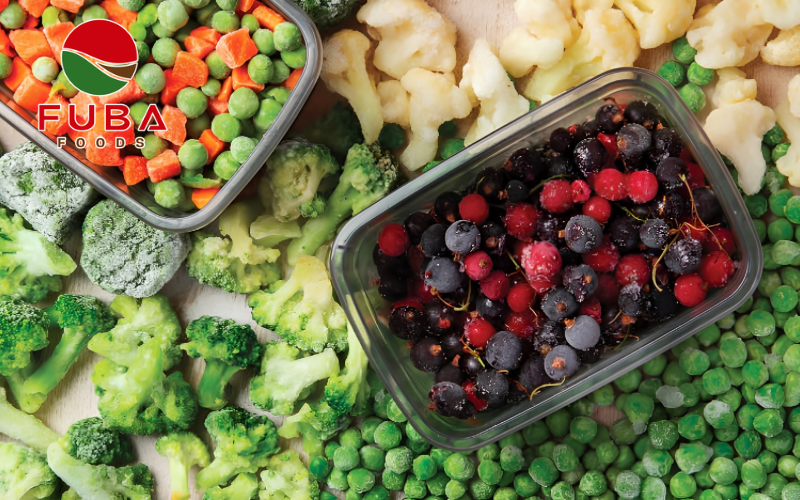
Vietnam has become an increasingly relevant sourcing market for frozen fruits and vegetables because of its diverse agricultural regions, tropical climate, and established food-processing capabilities. However, sourcing frozen products from Vietnam is not simply a matter of finding a supplier with the right product list. Global buyers also need to evaluate raw material availability, processing technology, quality control, product specifications, cold-chain management, and the manufacturer’s ability to maintain consistent supply.

For importers, distributors, food manufacturers, and foodservice companies, the best frozen fruits and vegetables from Vietnam are those that combine reliable agricultural sourcing with controlled factory processing and dependable export operations. A capable manufacturer should be able to turn seasonal agricultural raw materials into standardized frozen products while maintaining the required quality and specifications throughout production and storage.
This article explains what global buyers should know before sourcing frozen fruits and vegetables from Vietnam, including available products, processing methods, quality considerations, packaging, supply capacity, and the key factors to evaluate when choosing a Vietnamese frozen food manufacturer.
Why Source Frozen Fruits and Vegetables from Vietnam?
Vietnam has a broad agricultural base covering the Central Highlands, Mekong Delta, Southeast Vietnam, and other growing regions. This geographical diversity supports the production of tropical fruits as well as a wide range of vegetables, giving processors access to different raw material sources and harvest periods.
For frozen food production, this agricultural diversity becomes particularly valuable when supported by an organized sourcing network. Strong relationships with farming regions and growers can help manufacturers manage seasonal fluctuations and maintain access to suitable raw materials throughout the year. Vietnam’s harvest calendar includes products such as mango, dragon fruit, passion fruit, avocado, durian, jackfruit, eggplant, zucchini, okra, sweet corn, sweet pepper, edamame, sweet potato, and pumpkin.
The advantage for global buyers is not simply product variety. A broader agricultural base gives manufacturers more opportunities to plan production around raw material availability and develop different frozen formats for retail, foodservice, and industrial applications.

What Frozen Fruits and Vegetables Are Available from Vietnam?
Vietnamese frozen food manufacturers can supply both fruit and vegetable ingredients in formats adapted to different commercial applications. Common formats include IQF cubes, slices, chunks, halves, whole products, puree, and customized cuts.
Frozen fruit products can include mango, passion fruit, avocado, dragon fruit, jackfruit, and durian. Depending on the product, buyers may require different specifications such as cube dimensions, puree consistency, Brix, dry matter, seed content, or fruit variety. For example, frozen mango may be supplied as IQF cubes, half cuts, or puree, while passion fruit can be processed into pulp with seeds, seedless cubes, or puree.
Vegetable options can include eggplant, zucchini, okra, corn, edamame, sweet potato, pumpkin, and sweet pepper. These products can be prepared according to their intended applications, such as ready meals, pizza toppings, soups, stir-fries, food processing, or foodservice.
For buyers, this means the product specification should be defined before sourcing rather than selecting a supplier based only on the name of the fruit or vegetable. The correct cut, size, processing method, packaging, and storage requirements can be just as important as the raw material itself.

How Are Frozen Fruits and Vegetables from Vietnam Processed?
The quality of a frozen product depends heavily on what happens between raw material collection and freezing. A professional factory should have a controlled processing flow that connects raw material inspection with preparation, freezing, inspection, packaging, storage, and shipment.
A typical factory-level process begins with farm sourcing and incoming raw material inspection. Materials are then washed and cleaned, sorted and graded according to quality requirements, and prepared through cutting or other processing steps. After preparation, products are frozen, inspected for foreign materials, packed, placed into controlled cold storage, and prepared for export shipment.
This integrated flow is important because frozen food quality cannot be corrected after the product has already been processed. If raw materials are inconsistent or preparation is poorly controlled, freezing alone cannot create a standardized finished product.
Why Is IQF Important for Commercial Frozen Food?
IQF, or Individually Quick Frozen technology, is widely used for fruits and vegetables because individual pieces are frozen separately rather than forming one solid block. This is particularly useful for commercial applications where ingredients need to be portioned, measured, and processed efficiently.
The freezing process also affects product quality. Properly controlled IQF processing can help maintain natural color, texture, flavor, and nutritional characteristics. The technology is therefore not simply about making a product cold; it is part of the manufacturing system used to preserve the characteristics of the prepared raw material.

A large-scale factory may also use different freezing technologies depending on the product and processing requirements. One Vietnamese manufacturer, for example, operates six IQF freezing lines with a capacity of 500 kg/hour per line, together with contact and air-blast freezing systems.
What Quality Standards Should Global Buyers Check?
When sourcing frozen fruits and vegetables from Vietnam, buyers should look beyond a supplier’s product catalogue. Quality assurance needs to cover the complete production process, from raw material selection to final shipment.
Incoming materials should be inspected before entering production, while sorting and grading help control characteristics such as size, color, and quality. During later stages, appropriate foreign-material detection and product inspection systems provide additional control. Finished products also need to remain within the required frozen storage conditions until shipment.
For example, a factory-level quality system may combine metal detection, X-ray inspection, microbiological testing, traceability, and temperature-controlled cold storage. The facility referenced above has five metal detection systems, three X-ray inspection systems, and an in-house microbiological laboratory, with finished products stored below -18°C. Its listed food-safety systems include FDA, HACCP, ISO 22000, HALAL, and BRCGS.
Global buyers should also distinguish between having a certification and actually having a controlled production system. Certifications are important, but they should be considered alongside factory processes, inspection procedures, traceability, storage conditions, and the manufacturer’s ability to maintain specifications consistently across shipments.

How Can Buyers Evaluate Supply Capacity?
Supply capacity is one of the most important factors when sourcing frozen fruits and vegetables for commercial distribution or food manufacturing. A supplier may be able to provide samples or small quantities but struggle when order volumes increase.
Buyers should therefore assess annual production capacity together with freezing capacity, cold storage, workforce, and processing infrastructure. These factors provide a better indication of whether a manufacturer can support recurring commercial orders.
FUBA’s factory in Ca Mau has an annual capacity of 20,000 MT, more than 600 workers, and over 15 years of experience in frozen fruit and vegetable processing and export. The company has also supplied international markets across more than 30 countries.
The practical lesson is that capacity should be evaluated as a complete system. Production volume alone does not guarantee supply reliability if the factory lacks sufficient freezing or storage infrastructure. A stronger evaluation looks at the entire path from raw material intake to finished goods and export shipment.
What Packaging and Specifications Should Buyers Discuss?
Frozen food packaging needs to match the destination market and the way the product will be used. Retail products, foodservice ingredients, and bulk industrial products often require different pack sizes and formats.
Vietnamese manufacturers can provide different packaging options depending on the product and market. Typical formats may include smaller retail packs, foodservice packs, and bulk export cartons with an inner PE liner. Some products in the catalogue are available in retail sizes of 500 g–2 kg, 5 kg foodservice packs, and 10 kg bulk export cartons.

Buyers should define packaging requirements together with product specifications rather than treating packaging as a final-stage decision. Important considerations can include net weight, inner liner, carton construction, labelling requirements, palletization, storage temperature, and destination-market regulations.
For customized projects, manufacturers may also need to adjust cut size, product form, packaging format, or private-label requirements. This flexibility can be particularly valuable for distributors developing their own product range or food manufacturers with established production specifications.
How Does Cold-Chain Management Affect Frozen Food Quality?
Freezing the product correctly is only one part of maintaining frozen food quality. The product must remain within appropriate temperature conditions after processing, during storage, and throughout transportation.
A reliable cold chain should therefore connect factory cold storage with export logistics. Finished products need controlled storage before shipment, while transportation must be managed to prevent temperature fluctuations that could compromise product condition.
Factory infrastructure provides an important indication of this capability. The facility described in the catalogue has three cold-storage units with a capacity of 500 MT each, with finished products maintained below -18°C.
For global buyers, this is particularly important when sourcing products for long-distance international shipments. The supplier should be able to explain how products are stored after production, how shipments are prepared, and how cold-chain conditions are maintained until export.

How Should Global Buyers Choose a Frozen Food Manufacturer in Vietnam?
The right manufacturer should be evaluated based on more than price. A low factory price does not necessarily result in lower total sourcing costs if inconsistent specifications, production delays, poor packaging, or quality problems create additional expenses later.
Raw material sourcing should be one of the first considerations. Buyers should understand where the manufacturer obtains its fruits and vegetables and how it manages seasonal availability. Production capability should then be assessed through processing lines, freezing technology, storage capacity, quality-control systems, and annual supply capacity.
Product flexibility is another important consideration. Buyers should confirm whether the manufacturer can provide the required cut, size, puree specification, packaging format, and private-label requirements. Export experience should also be considered, particularly when products are being shipped to markets with strict documentation and food-safety requirements.
Finally, buyers should evaluate whether the manufacturer can support a long-term relationship rather than simply fulfill a single order. Consistency across repeated shipments is often a stronger indicator of supplier reliability than the quality of one initial sample.
Conclusion
Sourcing frozen fruits and vegetables from Vietnam can give global buyers access to a broad agricultural base, diverse tropical products, competitive manufacturing capabilities, and flexible processing formats. However, successful sourcing depends on choosing a manufacturer that can convert these agricultural advantages into consistent commercial supply.

The strongest suppliers combine reliable raw material sourcing with controlled factory processing, IQF technology, food-safety systems, cold storage, suitable packaging, and export capabilities. Buyers should evaluate these elements together rather than judging a Vietnamese supplier solely by product range or quotation.
For distributors, importers, food manufacturers, and foodservice companies, a factory with the right combination of agricultural access, production infrastructure, quality control, and export experience can provide a more dependable foundation for long-term sourcing from Vietnam.


