

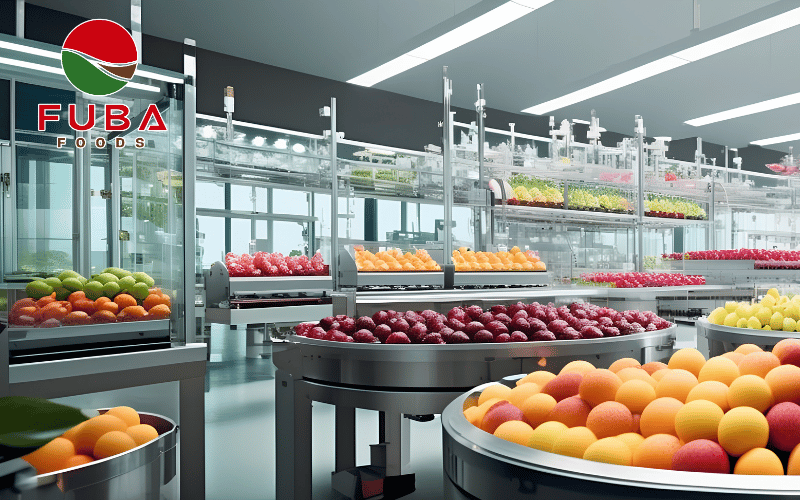
Frozen fruit OEM manufacturing enables importers, distributors, food brands, and food manufacturers to develop customized frozen fruit products without the need to invest in their own processing facilities. Instead of relying solely on standard offerings, buyers can collaborate directly with manufacturers to define fruit varieties, processing formats, product specifications, packaging, and other requirements tailored to their brand and market needs.

In Vietnam, frozen fruit OEM manufacturing has become an increasingly attractive option for businesses seeking access to tropical fruit ingredients, flexible processing capabilities, and competitive production costs. However, successful cooperation depends on more than simply finding a factory that can freeze fruit. Buyers must evaluate how customization is managed, how quality is controlled throughout production, and whether the supplier has the sourcing network, processing capacity, storage systems, and export infrastructure required to support consistent, long-term supply.
This article explains how frozen fruit OEM manufacturing works in Vietnam, outlining key customization options, production processes, quality control standards, and the critical factors buyers should consider when selecting a reliable OEM partner.
What Is Frozen Fruit OEM Manufacturing?
Frozen fruit OEM manufacturing is a production model in which a manufacturer processes frozen fruit based on specifications provided or agreed upon with a buyer. Instead of selling only a fixed product range, the factory works with the customer to develop a product that matches a specific application, market, packaging requirement, or brand.
The level of customization can vary. A buyer may only need a different cut size or packaging format, while another may require a completely customized product specification. Depending on the factory’s capabilities, OEM production can involve raw material selection, processing format, freezing method, packaging, labeling, and production requirements.
This makes OEM particularly useful for distributors and food brands that want differentiated products without investing in their own processing lines. The factory provides the manufacturing infrastructure, while the buyer can focus on product positioning, distribution, branding, and market development.
How Does Frozen Fruit OEM Manufacturing Work?
The OEM process normally begins long before production starts. A professional factory first needs to understand exactly what the buyer wants to purchase and how the finished product will be used.
Product Requirements and Technical Specifications
The first stage is to define the product specification. This may include the fruit variety, origin, maturity, size, cut format, color, texture, moisture requirements, sweetness or Brix level where applicable, freezing method, packaging weight, carton configuration, and storage conditions.
For example, a beverage manufacturer may require passion fruit pulp, while a food manufacturer may need uniform mango or dragon fruit cubes. A smoothie producer could require avocado cubes or puree, while a distributor may need several pack sizes for different market channels.
Clear specifications are essential because “frozen mango” or “frozen passion fruit” alone is not a complete OEM specification. Two factories can supply products under the same general name while producing significantly different results in terms of cut size, maturity, texture, yield, and packaging.

Sample Development and Approval
Once the requirements are established, the factory prepares samples for evaluation. This stage allows the buyer to determine whether the proposed product performs as expected before committing to larger production volumes.
Sample approval should not focus only on appearance. Buyers should evaluate the product after thawing and, where relevant, after it has been incorporated into the intended application. Texture, flavor, color, consistency, and processing performance can all affect the final product.
The approved sample and technical specification should then become the reference point for commercial production. This reduces the risk of misunderstandings between the buyer and manufacturer when larger orders are placed.
What Can Be Customized in Frozen Fruit OEM Manufacturing?
One of the main advantages of OEM manufacturing is flexibility. However, customization depends on the factory’s equipment and processing capabilities, so buyers should discuss technical requirements before assuming that every specification can be accommodated.
Fruit Format and Processing Method
Frozen fruit can be processed into different formats depending on the application. Common options include slices, cubes, chunks, halves, and puree. IQF processing is also widely used when individual pieces and convenient portioning are important.
The processing method should be selected based on how the product will be used. A food manufacturer may prioritize uniform pieces for consistent processing, while a beverage producer may prioritize puree or pulp with specific fruit characteristics.

A factory with multiple processing and freezing systems can provide greater flexibility when handling different fruit formats. FUBA combines fruit processing capabilities with IQF freezing and customized product specifications, while its product range includes formats such as slices, chunks, halves, and puree.
Packaging and Private Label Requirements
Packaging is another major part of OEM production. Buyers may require retail packaging, foodservice packs, or bulk export cartons depending on their distribution model.
Private label manufacturing can also involve customized labels, packaging formats, carton configurations, and market-specific requirements. These details should be confirmed early because packaging materials, printing, minimum order quantities, and production schedules can affect both cost and lead time.
For international shipments, packaging must also provide sufficient protection during frozen storage and transportation. The final packaging specification should therefore be considered together with the product’s storage conditions and shipping method rather than treated as a separate branding decision.

How Does a Factory Control Quality During OEM Production?
Quality control in OEM manufacturing cannot depend only on inspecting the finished carton. By that stage, a quality problem may already have affected a large production batch.
A reliable factory should control quality throughout the production process, starting with incoming raw materials. Fruits should be inspected before processing, then washed, sorted, graded, prepared, frozen, inspected, packed, and stored under controlled conditions.
For frozen fruit, freezing technology is particularly important. IQF freezing rapidly freezes individual pieces, helping maintain separation and supporting consistent handling after freezing. The process can also help preserve characteristics such as natural color, texture, flavor, and nutritional value when properly controlled.
Quality assurance should also include physical and food safety controls. Depending on the factory, these may include metal detection, X-ray inspection, microbiological testing, traceability systems, and documented food safety procedures.
What Should Buyers Check About the OEM Factory?
Choosing the right factory is one of the most important decisions in the OEM process. A factory may offer an attractive quotation but still be unsuitable if it lacks raw material stability, production capacity, quality systems, or export experience.
Raw Material Sourcing and Production Capacity
The factory should have a reliable system for sourcing the required fruits and managing seasonal availability. This becomes particularly important when the buyer expects regular shipments throughout the year.
Production capacity should also be evaluated against expected order volumes. A factory capable of handling trial orders may not necessarily have enough capacity to support a growing distribution network or large food manufacturing program.
FUBA is one example of a Vietnamese manufacturer operating at commercial scale, with more than 15 years of frozen fruit and vegetable processing experience, an annual supply capacity of 20,000 MT, more than 600 workers, and export markets covering more than 30 countries.
These indicators do not automatically make a factory suitable for every OEM project, but they demonstrate why production capacity, workforce, sourcing network, and export experience should be evaluated together rather than judged from a product catalogue alone.

Food Safety and Certification
International buyers should verify the factory’s food safety management systems and relevant certifications before starting commercial production. The certification should be applicable to the actual production facility and relevant product scope.
A well-controlled manufacturing environment should also provide traceability from raw materials through finished products. This becomes increasingly important when products are being supplied to regulated markets or incorporated into another manufactured food product.
FUBA’s factory operates with food safety systems and certifications including HACCP, ISO 22000, FDA, HALAL, and BRCGS, together with product traceability and controlled cold storage below -18°C. Buyers should still request and verify current certification documents and their applicable scope during supplier qualification.
How Much Does Frozen Fruit OEM Manufacturing Cost?
There is no single OEM price because the final cost depends on the complete product specification rather than simply the fruit itself.
Raw material availability is one major factor. Fruit variety, seasonality, quality grade, processing yield, and sourcing location can all influence the production cost. Processing requirements also matter. A simple frozen fruit format may require less processing than a customized puree, precisely cut IQF product, or value-added product.
Packaging can create another significant difference. Retail packaging, foodservice packaging, and bulk export cartons have different material and production requirements. Printing, customized labels, special packaging structures, and smaller production runs can also increase the cost per unit.
For this reason, buyers should request a quotation based on a complete technical specification. Comparing two suppliers only by their quoted price per kilogram can produce a misleading result if the products are not actually equivalent.
What Is the MOQ for Frozen Fruit OEM Manufacturing?
Minimum order quantity depends on the factory, product, packaging, and degree of customization. Standard bulk products may be easier to produce in smaller commercial quantities than highly customized private-label products.
Customized packaging often requires minimum printing or packaging-material volumes. At the production level, the factory also needs to allocate raw materials, processing time, freezing capacity, packaging resources, and cold storage space.
Buyers should therefore discuss MOQ during the early development stage. If the initial order is relatively small, it may be more practical to begin with an existing product format and move toward more extensive customization as sales volume grows.

How Long Does Frozen Fruit OEM Production Take?
OEM lead time is influenced by more than the manufacturing process itself. New packaging materials, label approval, raw material availability, sample development, production scheduling, and shipping arrangements can all affect the timeline.
For repeat orders using an approved specification and existing packaging, production can generally be planned more efficiently because the factory already has an established product reference. New OEM projects require more coordination because specifications and packaging need to be finalized before production can proceed.
This is why buyers should agree on lead times at the beginning of the project and distinguish between sample-development time, production time, and export logistics time.
What Happens After Frozen Fruit Is Produced?
OEM manufacturing does not end when the fruit leaves the freezing line. Finished products need to be packed, inspected, stored, and prepared for shipment under controlled conditions.
Cold storage is particularly important for maintaining product quality after production. The factory should have sufficient frozen storage capacity and procedures for temperature control, inventory management, and loading.
Export execution is another critical part of the process for international buyers. Documentation, logistics coordination, container loading, and cold-chain transportation all need to work together. A manufacturer with established export operations can reduce the coordination burden for buyers importing frozen products across international markets.

Is Frozen Fruit OEM Manufacturing in Vietnam Right for Your Business?
Vietnam can be a practical manufacturing base for frozen tropical fruit OEM projects because buyers can access a wide range of locally grown fruits while working directly with processing factories. The country’s different agricultural regions also provide opportunities for sourcing multiple fruit categories across different growing seasons.
However, the key consideration should not simply be whether a factory is located in Vietnam. Buyers should evaluate whether that factory can consistently meet their specifications, maintain food safety standards, secure suitable raw materials, handle the required production volume, and support international export requirements.
For businesses planning private-label or customized frozen fruit products, the strongest OEM relationship is built around clear specifications and transparent production controls. When the buyer and factory agree on the product requirements from the beginning, it becomes much easier to maintain consistency as order volumes increase.
How to Choose the Right Frozen Fruit OEM Manufacturer
The right manufacturer should be able to demonstrate control over the complete production chain rather than relying heavily on external processors. Raw material sourcing, processing, freezing, quality inspection, packaging, cold storage, and export coordination should form a connected manufacturing system.
Buyers should also look at the factory’s ability to scale. A successful OEM relationship may start with one product and gradually expand into multiple fruit formats, packaging sizes, or markets. The supplier therefore needs sufficient production infrastructure and technical flexibility to support that growth.
Most importantly, do not select an OEM manufacturer based solely on a sample or the lowest quotation. Evaluate the factory behind the product. Its sourcing network, equipment, quality systems, storage infrastructure, production capacity, and export experience will ultimately determine whether it can deliver consistent products over the long term.

Conclusion
Frozen fruit OEM manufacturing gives international buyers a flexible way to develop customized frozen fruit products without investing in their own processing infrastructure. The process typically moves from product specifications and sample development to customized processing, quality control, packaging, cold storage, and international shipment.
For importers, distributors, food manufacturers, and private-label brands, the most important decision is choosing a factory that can control these stages consistently. A strong OEM manufacturer should combine reliable raw material sourcing, appropriate processing and freezing technology, rigorous quality systems, sufficient production capacity, and proven export capability.
When these elements are properly evaluated before the first commercial order, OEM manufacturing becomes more than a way to outsource production. It becomes a scalable supply model that allows businesses to develop differentiated frozen fruit products while maintaining greater control over quality, specifications, and long-term supply.


