

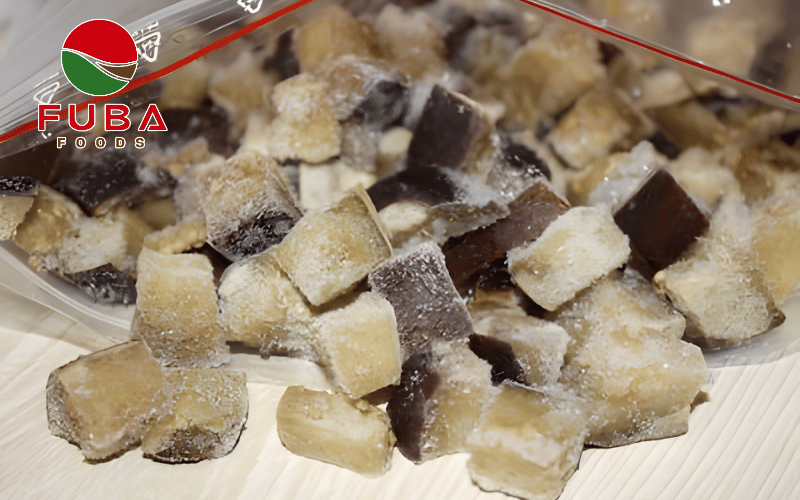
Frozen eggplant is widely used in ready meals, food processing, foodservice, pasta, soups, stir-fries, salads, and pizza toppings. Compared with fresh eggplant, freezing provides longer storage, more consistent availability, and greater preparation convenience. However, freezing alone does not determine how long the product can maintain its quality. Storage life depends on several factors, including processing methods, freezing conditions, packaging, storage temperature, transportation, and handling throughout the cold chain.

Under controlled commercial processing and continuous storage at ≤ -18°C, frozen eggplant can achieve a shelf life of up to 24 months while maintaining its intended quality. For manufacturers, importers, distributors, and foodservice operators, understanding these storage requirements is essential for effective inventory planning and for protecting the product’s texture, color, flavor, food safety, and processing performance.
This article explains how long frozen eggplant can typically be stored, why temperature control is important, what factors may shorten its storage life, and which storage and supply-chain practices can help preserve quality from production through final use.
How Long Is the Shelf Life of Frozen Eggplant?
The typical commercial shelf life of frozen eggplant can reach up to 24 months when stored at or below -18°C, provided that the product remains properly packaged and the cold chain is maintained. However, shelf life should not be interpreted as a guarantee that the product will remain identical to freshly processed eggplant for the entire period. Shelf life is established around the product’s formulation, processing method, packaging, freezing conditions, storage temperature, and validated quality and safety requirements.
This distinction is particularly important for food manufacturers. Frozen eggplant may remain safe and within its declared shelf life while its sensory quality gradually changes if storage conditions are poor. Color may become less attractive, texture may deteriorate, and excessive ice formation can affect the product’s appearance and cooking performance. Therefore, the declared shelf life only delivers its intended value when the complete storage system is properly controlled.
Why Does Temperature Matter for Frozen Eggplant Shelf Life?
Temperature is one of the most important factors determining frozen eggplant shelf life. At sufficiently low temperatures, microbial growth is effectively inhibited and chemical and enzymatic reactions occur much more slowly. This allows the frozen product to retain its quality for a significantly longer period than fresh eggplant.
However, -18°C should be treated as a continuous storage requirement rather than a temperature that only needs to be reached once. Repeated temperature fluctuations can cause partial thawing and refreezing. When this happens, ice crystals can grow and damage the cellular structure of eggplant, particularly when the product contains significant moisture.
Large ice crystals can lead to softer or more watery texture after thawing or cooking. They can also cause pieces to stick together, creating problems during portioning and processing. For industrial users purchasing large quantities, this can directly affect production efficiency because the product may no longer separate as easily or perform consistently on the production line.
A stable freezer environment therefore matters just as much as the nominal storage temperature. Commercial frozen products should remain under controlled frozen conditions from the factory’s cold storage through transportation, distribution, and the customer’s warehouse.

How IQF Freezing Helps Preserve Frozen Eggplant Quality
IQF, or Individually Quick Frozen technology, plays an important role in maintaining the quality of frozen eggplant during its shelf life. Instead of freezing a large quantity of product into one solid block, IQF rapidly freezes individual pieces. Faster freezing generally creates smaller ice crystals, which helps reduce structural damage to the vegetable tissue.
This is particularly useful for processed eggplant because texture is an important quality attribute. Depending on the product format, manufacturers may need eggplant pieces to retain their shape and cooking characteristics after storage and subsequent preparation.
IQF also provides operational advantages. Individual pieces are easier to portion, weigh, and process because they remain relatively free-flowing rather than forming large frozen blocks. This is valuable for industrial production where frozen ingredients are automatically or manually dosed into different formulations.
At FUBA, IQF freezing is integrated into the wider processing flow, following raw-material inspection, washing, sorting, grading, and preparation. The factory combines IQF freezing with metal detection, controlled cold storage, and export cold-chain logistics to maintain product quality after processing.
Does IQF Make Frozen Eggplant Last Longer?
IQF technology contributes to quality preservation, but it does not automatically create an unlimited shelf life. Shelf life is the result of several controls working together, including raw-material quality, processing hygiene, freezing speed, packaging, storage temperature, and cold-chain stability.
A product that is properly IQF frozen but exposed to repeated temperature fluctuations may still experience quality deterioration. Conversely, a well-controlled cold chain cannot fully compensate for poor raw materials or inadequate processing before freezing.
For this reason, manufacturers should evaluate the entire production system rather than looking at the freezing machine alone when assessing the expected shelf life of frozen eggplant.

What Factors Can Shorten Frozen Eggplant Shelf Life?
Storage Temperature Fluctuations
Temperature abuse is one of the most common risks. If frozen eggplant is repeatedly exposed to temperatures above the recommended storage condition, partial thawing can occur. When the product freezes again, larger ice crystals may form and damage texture. Frequent fluctuations can therefore reduce the practical quality of the product even when the nominal expiration date has not been reached.
Packaging Damage and Freezer Burn
Packaging also has a direct impact. Frozen eggplant needs packaging that protects the product against moisture loss, contamination, physical damage, and excessive exposure to air. Poorly sealed packaging can contribute to freezer burn, which appears as dry, discolored, or dehydrated areas on the product surface.
Raw Material Quality
The quality of the raw eggplant is another important factor. Freezing preserves the condition of the product at the time of processing; it does not reverse deterioration that has already occurred. Fresh eggplant must therefore be properly selected, inspected, sorted, and processed before freezing. Differences in maturity, size, color, and physical condition can affect the final frozen product.
Processing Conditions
Processing conditions also matter. Washing, cutting, frying, grilling, or other preparation steps must be performed under controlled hygienic and process conditions. If these stages are poorly managed, the resulting product may have inconsistent quality regardless of how effectively it is frozen afterward.

Best Storage Practices for Frozen Eggplant
Maintaining a stable temperature of ≤ -18°C is the foundation of frozen eggplant storage. Warehouses should minimize unnecessary door opening, avoid placing products near areas with significant temperature variation, and use appropriate freezer management practices to maintain consistent conditions.
Inventory rotation is equally important. Commercial operators should apply a clear stock-management system such as FIFO or FEFO, depending on their internal requirements and product labeling. This prevents older batches from remaining in storage while newer shipments are consumed first.
The packaging should also remain intact throughout storage. Cartons, inner liners, and bags should be protected from tearing, puncturing, compression damage, and excessive moisture. In bulk export operations, appropriate secondary packaging helps protect the frozen product during handling and transportation.
FUBA provides frozen eggplant in different packaging formats, including retail packs, foodservice packs, and bulk export cartons with PE inner liners. This flexibility allows packaging to be matched to different distribution and processing requirements while supporting product protection throughout the frozen supply chain.
How Cold Chain Management Protects Frozen Eggplant Shelf Life
Cold chain management begins immediately after freezing and continues until the product reaches the customer’s facility. A product can leave the factory in excellent condition but lose quality if it experiences temperature abuse during transportation, port handling, customs clearance, or warehouse storage.
For international shipments, this makes cold-chain reliability an important part of supplier evaluation. Exporters should have appropriate frozen storage capacity, documented handling procedures, traceability systems, and logistics partners capable of maintaining frozen conditions throughout transportation.
A direct manufacturing setup can provide greater control over these stages because processing, quality inspection, cold storage, and shipment preparation are managed within an integrated system.
FUBA’s factory in Ca Mau has controlled cold storage below -18°C, product traceability, and export-oriented processing infrastructure. Its production system includes multiple IQF freezing lines, metal detection and X-ray inspection systems, and dedicated cold-storage capacity.
This type of infrastructure is particularly relevant when buyers are planning regular container shipments or long-term supply contracts. The objective is not simply to achieve a long shelf life on paper, but to maintain consistent product quality throughout the time the product is actually in the supply chain.

What Should Buyers Check When Evaluating Frozen Eggplant Shelf Life?
A reliable frozen eggplant supplier should be able to clearly specify the product’s storage temperature, declared shelf life, packaging configuration, product format, and relevant quality requirements. These specifications should be consistent across commercial documents and physical shipments.
Buyers should also examine how the supplier controls raw materials. A stable sourcing network helps reduce variation between production batches, particularly for products requiring consistent size, maturity, color, and processing characteristics. Vietnam’s diverse growing regions and year-round agricultural production can support continuous sourcing when raw-material collection is properly managed. FUBA works with farming regions and growers across Vietnam to maintain a stable supply of raw materials for its processing operations.
The factory’s quality-management system is another important consideration. Certifications such as HACCP, ISO 22000, BRCGS, FDA-related compliance, and HALAL can provide evidence of structured food-safety and quality-management practices, although buyers should always verify which certifications and approvals apply specifically to the product, facility, and destination market.
Finally, buyers should evaluate whether the manufacturer can provide consistent production capacity, traceability, customized specifications, and appropriate packaging for the intended market. These factors become increasingly important when frozen eggplant is used as a regular industrial ingredient rather than an occasional purchase.

Conclusion
The key point is simple: frozen eggplant can have a shelf life of up to 24 months when stored at ≤ -18°C under properly controlled conditions, but achieving that shelf life consistently depends on much more than freezing the vegetable.
Raw-material quality, hygienic processing, preparation, rapid IQF freezing, packaging integrity, stable cold storage, temperature-controlled transportation, and inventory management all contribute to the final result. If any stage of the chain is poorly controlled, product quality can decline before the declared shelf life is reached.
For food manufacturers and distributors, the best approach is therefore to evaluate frozen eggplant as a complete supply-chain product. A capable factory should be able to demonstrate not only a stated shelf life, but also the processing technology, quality controls, cold-storage infrastructure, traceability, packaging options, and export systems that support that specification in practice.


