


Frozen blanched okra is a convenient vegetable ingredient for foodservice operators and food manufacturers that need consistent quality, easier preparation, and year-round availability. By blanching fresh okra before IQF freezing, the product is prepared for further cooking while its natural green colour, texture, and characteristic flavour are maintained under controlled frozen conditions.
For commercial buyers, however, choosing frozen blanched okra is not simply about finding a convenient frozen vegetable. Product format, cut uniformity, raw material quality, blanching control, freezing technology, packaging, and cold-chain management all affect how the okra performs in kitchens and industrial production. This article explains what frozen blanched okra offers, how it is processed, which formats are suitable for different applications, and what to consider when sourcing it from a direct manufacturer.
What Is Frozen Blanched Okra?
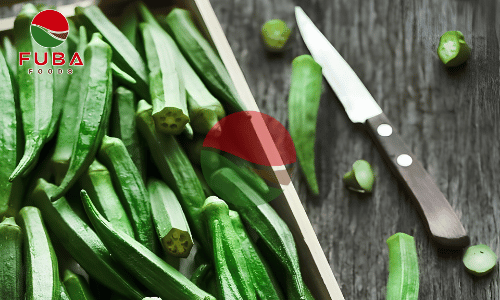
Frozen blanched okra is fresh okra that has been cleaned, prepared, heat-treated through controlled blanching, and then rapidly frozen, commonly using IQF technology. The blanching stage helps control enzyme activity before freezing, while rapid freezing stabilizes the prepared vegetable for storage and distribution.
Unlike raw frozen okra, blanched okra is partially processed before freezing. This makes it particularly practical for commercial kitchens and food manufacturers because the product can move more directly into cooking or formulation without requiring the same level of raw vegetable preparation.
The finished product can be supplied in different formats depending on the application. Whole okra is suitable when the natural shape of the vegetable is important, while slices or slant cuts provide greater convenience for soups, stir-fries, prepared meals, and other products where portioning and cooking consistency matter.
Why Use Frozen Blanched Okra for Foodservice and Manufacturing?
The main advantage of frozen blanched okra is process convenience. Foodservice operators and manufacturers do not need to start with fresh okra and carry out every preparation stage themselves. The product arrives cleaned, prepared, blanched, and frozen, reducing handling requirements before cooking.
For commercial kitchens, this can simplify preparation and improve consistency between batches. Frozen okra can be portioned according to operational requirements and used when needed without depending entirely on daily fresh vegetable deliveries.
For food manufacturers, the benefit extends to production planning. A stable frozen ingredient can be incorporated into soups, ready meals, vegetable mixes, sauces, and other formulations throughout the year. This can help manufacturers manage production schedules without being as dependent on the immediate availability of fresh okra.
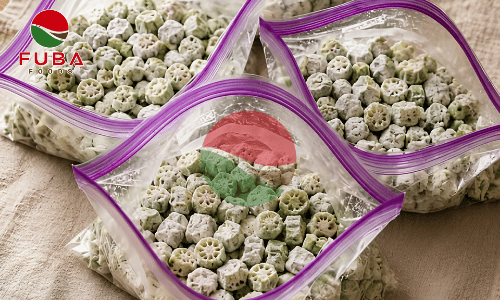
The individual freezing characteristics of IQF products are also valuable in commercial operations. Pieces remain separated rather than forming one large frozen block, making it easier to take the required quantity from a bulk package and return the remainder to frozen storage.
How Is Frozen Blanched Okra Processed?
Producing consistent frozen blanched okra requires control from raw material sourcing through final cold storage. The objective is not simply to freeze the vegetable but to establish the right quality before freezing and preserve it throughout the subsequent supply chain.
Fresh Okra Selection and Inspection
The process begins with the selection of suitable fresh okra from agricultural sources. Raw materials are inspected for freshness, colour, maturity, physical damage, foreign materials, and other specifications before entering the processing line.
Raw material quality is particularly important because freezing cannot correct poor-quality vegetables. Consistent sourcing and incoming inspection help ensure that only suitable okra enters subsequent processing stages.
A direct manufacturing operation can integrate agricultural sourcing with factory quality control, allowing specifications to be established before production rather than relying only on finished-product inspection.
At FUBA, agricultural sourcing and factory quality control are connected as part of the production process. This allows raw material requirements to be established before processing and gives the factory greater control over the quality of vegetables entering the production line.
Washing, Sorting, and Preparation
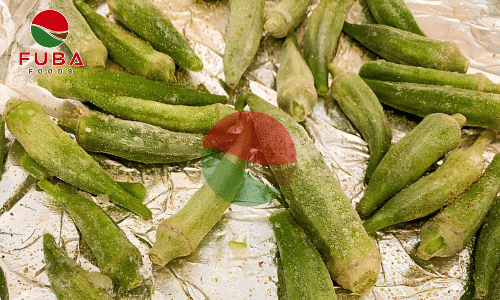
After inspection, the okra is washed and cleaned to remove soil and other surface impurities. It is then sorted according to the required quality and size specifications.
The vegetables may subsequently be prepared as whole pods, slices, or slant cuts. Cut uniformity is important because pieces of significantly different sizes can behave differently during blanching, freezing, and cooking.
For food manufacturers, consistent dimensions also make portion control and formulation easier. For foodservice applications, standardized cuts reduce preparation work and support more predictable cooking results.
Controlled Blanching
Blanching is one of the defining stages of frozen blanched okra production. The vegetable is exposed to controlled heat for a specified period before being cooled and frozen.
The purpose of blanching is to control enzyme activity that can contribute to changes in colour, flavour, and quality during frozen storage. The process must be carefully controlled because excessive heat treatment can negatively affect texture, while insufficient treatment may not provide the intended effect.
After blanching, the product is cooled and prepared for rapid freezing. Maintaining consistent processing conditions between batches is essential for commercial applications where customers expect the same product performance from one shipment to the next.
IQF Freezing
After preparation, the blanched okra is rapidly frozen using IQF technology. Individual Quick Freezing freezes pieces separately, helping prevent them from becoming one solid mass.
Rapid freezing can help maintain the product’s natural colour, texture, flavour, and nutritional characteristics by limiting the formation of larger ice crystals associated with slower freezing. The result is a frozen ingredient that is easier to portion, handle, store, and process.
For industrial buyers, the combination of blanching and IQF freezing is particularly useful because it provides a prepared ingredient while retaining the operational advantages of individually frozen pieces.
Which Frozen Blanched Okra Formats Are Available?
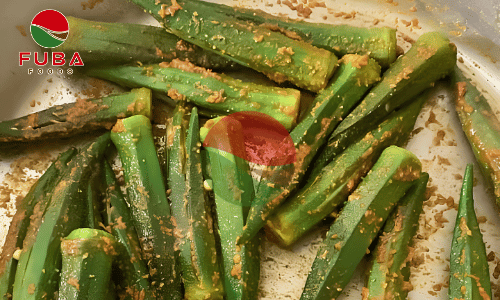
Product format should be selected according to how the okra will be used rather than treated as a purely cosmetic specification. Different cuts provide different advantages during preparation, cooking, portioning, and presentation.
Frozen Blanched Whole Okra
Frozen blanched whole okra retains the natural shape of the vegetable and is suitable for applications where the pod itself contributes to product presentation. It can be used in prepared meals, soups, stews, and foodservice dishes where a whole vegetable format is preferred.
The consistency of pod size becomes particularly important in this format because significant variation can lead to different cooking times and inconsistent portions.
Frozen Blanched Okra Slices
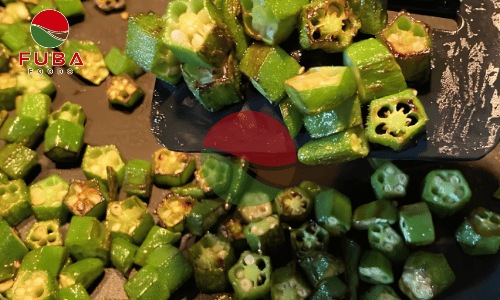
Frozen blanched okra slices provide a more convenient format for applications where whole pods are not required. Uniform slicing can help improve portion control and distribute okra more consistently throughout a finished product.
This format is practical for soups, stir-fries, prepared meals, and food-processing applications where the vegetable needs to be incorporated into a larger formulation.
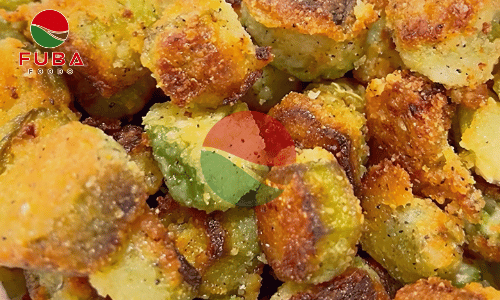
Frozen Blanched Okra Slant Cut
Slant-cut okra combines preparation convenience with a visually distinctive shape. Uniform slant cuts can be incorporated into cooked dishes while reducing the cutting work required at the foodservice or manufacturing stage.
The appropriate cut specification should be agreed with the manufacturer according to target product requirements, including dimensions, tolerance, packaging, and intended application.
Frozen Blanched Okra Storage and Shelf Life
Frozen blanched okra should be maintained at -18°C or below throughout storage and distribution. Stable frozen conditions are essential for preserving the quality established during processing and reducing the risk of deterioration caused by temperature fluctuations.
The shelf life can vary according to the product specification and manufacturer’s validated conditions. For the frozen blanched okra range specified in the company catalogue, the stated shelf life is up to 24 months when stored at ≤ -18°C.
Cold-chain management should continue from factory storage through transportation and the buyer’s warehouse. Even a well-processed IQF product can experience quality deterioration if it is repeatedly exposed to inappropriate temperatures.
For this reason, commercial buyers should evaluate both the stated shelf life and the supplier’s ability to maintain the required storage and logistics conditions.
Packaging Frozen Blanched Okra for Commercial Use
Packaging requirements depend on the distribution channel and intended application. Foodservice customers may require larger packs designed for frequent kitchen use, while industrial buyers often need bulk formats that integrate efficiently with their production and warehouse systems.
For manufacturers, packaging should also be considered alongside shipment conditions, storage capacity, product turnover, and the amount required per production batch. The right format can reduce unnecessary repacking and simplify inventory handling after the product arrives at the customer’s facility.
What Should Buyers Look for in a Frozen Blanched Okra Supplier?
A reliable supplier should be able to demonstrate control over more than the finished product. Buyers should examine how raw materials are sourced, how incoming vegetables are inspected, how blanching and IQF freezing are controlled, and how finished products are stored and shipped.
Factory infrastructure provides useful evidence of this capability. An integrated production system can connect farm sourcing, raw material inspection, washing, sorting, preparation, IQF freezing, metal detection, packaging, cold storage, and export logistics within one controlled workflow. This creates greater visibility across the production chain and can help reduce inconsistencies between batches.
At FUBA, this factory-level approach is supported by an integrated processing and quality-control system. The factory infrastructure includes six IQF freezing lines with a capacity of 500 kg/hour each, three contact freezing lines, two air-blast freezing systems, three 500 MT cold-storage units, five metal detection systems, three X-ray inspection systems, and an in-house microbiological laboratory.
The manufacturing operation has an annual capacity of 20,000 MT, more than 600 workers, over 15 years of experience, and export activity across more than 30 markets. Its quality and food-safety systems include HACCP, ISO 22000, HALAL, and BRCGS, alongside traceability and controlled frozen storage.
These capabilities are relevant when sourcing frozen blanched okra because consistent product quality depends on the entire system rather than one piece of equipment. Strong sourcing relationships, controlled processing, inspection systems, adequate cold storage, and export experience can all contribute to a more reliable supply program.
Frozen Blanched Okra for OEM and Private Label Production
For companies selling frozen vegetables under their own brands, product specifications and packaging flexibility can be as important as the vegetable itself. A manufacturer should be able to discuss requirements such as cut format, size, packaging weight, labelling, and destination-market documentation before production begins.
A factory with OEM and private-label capabilities can adapt production and packaging to the buyer’s commercial requirements while keeping the manufacturing process under direct control. This is particularly useful for distributors and food brands that need a consistent frozen okra specification across repeated orders.
FUBA supports customized product specifications, packaging formats, OEM, and private-label solutions, allowing frozen vegetable products to be developed around customer and market requirements rather than relying only on standard stock formats.
Conclusion
Frozen blanched okra provides foodservice operators and food manufacturers with a prepared, convenient, and consistently frozen vegetable ingredient. Through controlled blanching and IQF freezing, fresh okra can be converted into whole, sliced, or slant-cut formats that are easier to store, portion, transport, and incorporate into commercial food production.
For buyers, product quality ultimately depends on the complete manufacturing system. Raw material sourcing, inspection, washing, blanching, cutting, IQF freezing, packaging, food-safety controls, cold storage, and export logistics all need to work together to deliver consistent frozen blanched okra.
Working directly with a capable manufacturer also gives buyers greater visibility into production conditions and greater flexibility when defining specifications, packaging, and supply requirements. For foodservice and food manufacturing applications, that factory-level control can make frozen blanched okra a practical ingredient for reliable year-round production.


