

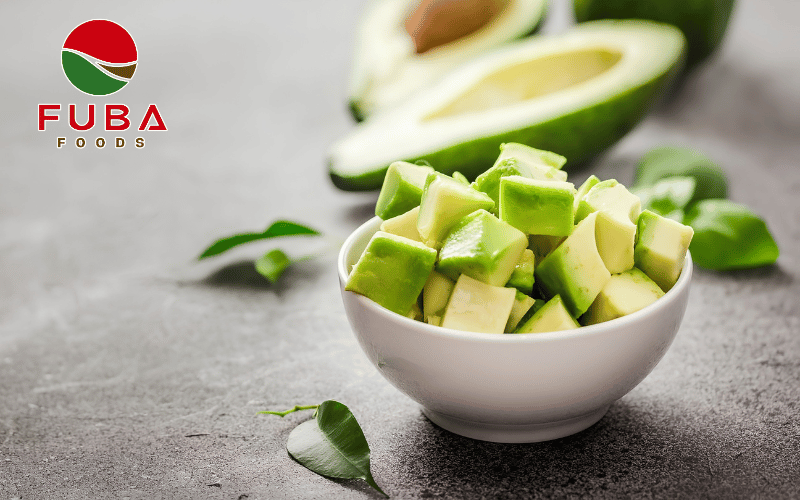
Avocado has become a versatile ingredient in commercial food production, particularly in smoothies, beverages, ice cream, yogurt, bakery products, desserts, and processed foods. Yet sourcing avocado for a production line is different from buying fresh fruit for immediate consumption. Manufacturers need an ingredient that can provide consistent texture, suitable specifications, reliable supply, and predictable performance after processing.
Frozen avocado for food manufacturing can offer a practical way to incorporate avocado into commercial formulations while reducing the need for fresh-fruit preparation at the production site. However, the right product depends on the intended application, avocado variety, dry matter, processing method, freezing technology, packaging, and cold-chain conditions.
This article looks at the main factors manufacturers should evaluate before sourcing frozen avocado, with a focus on product suitability, factory processing, quality control, supply reliability, and the total sourcing requirements behind a consistent ingredient.

Choose the Right Frozen Avocado Format for the Application
The first sourcing decision is the physical form of the avocado. Frozen avocado is not a single standardized ingredient, and different formats serve different production purposes.
Frozen Avocado Puree
Puree is suitable when avocado needs to be incorporated directly into a formulation. It can be used in smoothies, beverages, ice cream, yogurt, desserts, sauces, and other processed foods where a smooth fruit base is preferred.
For industrial production, puree can reduce preparation work because the fruit has already been processed into a usable ingredient. The main considerations then shift toward texture, dry matter, flavour, colour, and consistency between batches.
IQF Avocado Cubes and Slices
Cubes and slices are more appropriate when the avocado needs to retain a recognizable fruit format. They can be incorporated into food preparations, desserts, bakery products, foodservice recipes, or further processed into other formulations.
The cut specification becomes particularly important in these applications. Size consistency affects portioning, processing efficiency, appearance, and the amount of usable material after handling.
Selecting the format before contacting suppliers helps prevent a common sourcing problem: comparing products that appear similar but are actually designed for different production processes.
Evaluate Avocado Variety and Raw Material Quality
The finished frozen product can only be as consistent as the raw avocado entering the factory. Variety, maturity, growing conditions, and raw-material selection all influence texture, dry matter, colour, and flavour.
For manufacturers, the relevant question is therefore not simply whether a supplier offers frozen avocado, but whether the supplier has sufficient control over the agricultural supply chain behind the product.
FUBA sources agricultural raw materials through farming regions and grower partnerships across Vietnam. Avocado is one of the company’s key products associated with the Central Highlands, a major agricultural area represented in its sourcing network.
This type of sourcing structure can be important for commercial production because seasonal availability and raw-material consistency can affect both production planning and finished-product uniformity.

Pay Attention to Dry Matter and Texture
Dry matter is an important specification when evaluating frozen avocado for food manufacturing. It can influence the body of the ingredient, formulation yield, and the texture of the final product.
A higher or more consistent dry-matter level can be particularly relevant when avocado is used as a substantial component of a formulation. However, the ideal specification depends on the finished product rather than simply choosing the highest available number.
FUBA specifies dry matter ≥23% across its listed avocado products. This provides a clear technical parameter that can be compared during supplier evaluation, while application testing remains necessary to confirm performance in a specific recipe.
Understand the Factory Processing Flow
A consistent frozen avocado ingredient depends on more than freezing technology. Raw material inspection, cleaning, sorting, preparation, freezing, foreign-material control, packaging, and storage all contribute to the finished product.
A factory with an integrated processing flow can maintain greater control over these stages. It also gives customers greater visibility into how raw fruit becomes a finished ingredient.
FUBA’s production flow covers farm sourcing, raw-material inspection, washing and cleaning, sorting and grading, cutting or preparation, IQF freezing, metal detection, packing, cold storage, and export shipment.
For avocado, this controlled sequence matters because the fruit’s texture and appearance can be affected at several stages before it reaches the freezer. Consistency therefore needs to be managed throughout production rather than treated as a final inspection issue.
Consider IQF Technology and Freezing Capacity
Freezing technology directly influences how processed avocado is handled and stored. Rapid freezing can help preserve the intended characteristics of prepared fruit while making the ingredient easier to manage within a frozen supply chain.
For cubed or sliced avocado, IQF processing can also provide practical handling advantages because individual pieces can be separated and portioned more easily during production.
However, freezing equipment should never be evaluated in isolation. The quality of frozen avocado also depends on raw-material preparation, freezing conditions, packaging, storage, and temperature control throughout transportation.

Verify Food Safety and Quality-Control Systems
Food manufacturers need to consider the supplier’s food-safety system as part of ingredient qualification. A frozen avocado ingredient will eventually become part of another finished product, making traceability and process control important throughout the supply chain.
Quality control should begin with incoming raw materials and continue through processing and shipment. Inspection and sorting can help manage raw-material variation, while foreign-material detection and laboratory controls provide additional safeguards.
FUBA’s factory includes five metal detectors, three X-ray inspection systems, and an in-house microbiological laboratory. Its quality and food-safety systems include HACCP, ISO 22000, HALAL, BRCGS, and product traceability.
For manufacturers supplying international markets, these systems can also simplify supplier qualification by providing a documented framework for food safety and traceability rather than relying only on visual product inspection.
Check Frozen Storage and Cold-Chain Management
Frozen avocado needs to remain under controlled temperature conditions after processing. A supplier may produce a technically acceptable ingredient, but poor storage or transportation conditions can compromise product quality before it reaches the customer.
Storage temperature, packaging integrity, shipment handling, and cold-chain continuity should therefore be considered as one system rather than separate factors.
Frozen avocado products can have a shelf life of up to 24 months when stored at -18°C or below under appropriate conditions. For foodservice and bulk-export applications, packaging formats such as a 10 kg carton with a PE inner liner can also be used to support handling and transportation in commercial quantities.
For importers and manufacturers, this information should be evaluated alongside the expected transit time and receiving conditions. The relevant question is not simply how long the product can be stored at the factory, but whether the required frozen conditions can be maintained throughout the complete shipment process.
Assess Production Capacity Before Scaling Up
A supplier may be able to provide a successful sample but still lack the capacity required for regular commercial orders. This can become a serious issue when a product moves from development into full-scale manufacturing.
Production capacity should therefore be considered early in the sourcing process. The supplier should have sufficient raw-material access, processing infrastructure, labour, storage, and export capability to support recurring demand.
FUBA has an annual supply capacity of 20,000 MT, more than 600 workers, over 15 years of frozen fruit and vegetable processing and export experience, and exports to more than 30 countries.
These figures are relevant not because larger capacity automatically means better product quality, but because commercial sourcing requires a supplier capable of maintaining supply as order volumes increase.

Consider Packaging and Specification Customization
Different manufacturing operations may require different pack sizes and product specifications. A foodservice customer may need a manageable bulk format, while an industrial processor may require larger quantities designed around its production schedule.
Customization can become particularly valuable when the avocado ingredient is integrated into an established production system. The supplier should be able to discuss product format, packaging, minimum order quantities, and other specification requirements before commercial production begins.
FUBA provides OEM and private-label manufacturing with customized specifications and packaging formats. This allows frozen avocado products to be adapted to specific market or customer requirements rather than being limited to one standard configuration.
Test Frozen Avocado in the Actual Product Formula
A technical specification sheet is useful, but it cannot replace application testing.
Manufacturers should test the avocado in the actual formulation whenever possible. For puree, this can involve evaluating blending behaviour, creaminess, colour, flavour, and final texture. For cubes and slices, testing can focus on size consistency, shape, texture, and performance after thawing or further processing.
The test should ideally continue through the relevant production stages. An avocado ingredient that performs well immediately after opening the package may behave differently after mixing, heating, freezing, or storage.
Sample approval is therefore not simply a quality-control formality. It is an opportunity to confirm that the supplier’s specification is compatible with the manufacturer’s real production conditions before committing to larger volumes.
What to Confirm Before Sourcing Frozen Avocado
Before moving forward with a supplier, manufacturers should have a clear understanding of the product specification and the supplier’s ability to maintain it over repeated shipments.
Key technical considerations include avocado variety, product format, dry matter, texture, flavour, colour, processing method, freezing technology, storage temperature, shelf life, and packaging. It is also useful to assess how the product’s format and preparation requirements may affect usable yield and production efficiency, rather than comparing suppliers based only on price per kilogram.
The commercial side should then be evaluated alongside the technical requirements. Minimum order quantity, production lead time, supply capacity, customization, export documentation, logistics, cold-chain arrangements, and the total cost of getting the ingredient into production can all influence whether the supplier is suitable for long-term sourcing.

Conclusion
Sourcing frozen avocado for food manufacturing requires more than finding a frozen fruit supplier with an attractive price. Manufacturers need to evaluate the complete system behind the ingredient, including raw-material sourcing, avocado variety, dry matter, product format, processing controls, IQF technology, food safety, cold storage, packaging, and production capacity.
The right supplier should be able to support both product consistency and commercial continuity. Direct manufacturing capability is particularly valuable because it provides greater control over the stages that determine the finished ingredient, from raw-material inspection through processing, freezing, storage, and export.


