

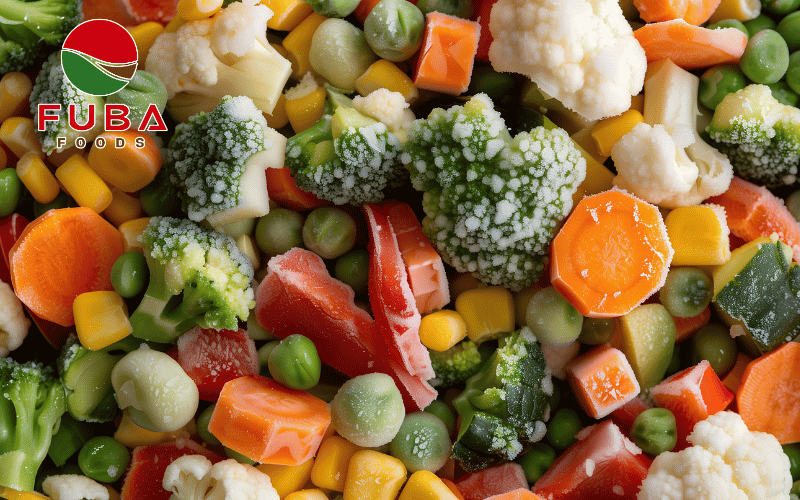
When frozen vegetables are used in food manufacturing, foodservice, or prepared food production, the cut format is more than a matter of appearance. The size and shape of each piece can affect cooking time, portion control, product consistency, processing efficiency, and the overall presentation of the finished product. This makes custom cut frozen vegetables an important sourcing option for companies that need ingredients adapted to a specific production process.
Unlike standard frozen vegetables with predetermined formats, custom-cut products can be prepared according to agreed requirements for shape, size, preparation method, packaging, and intended application. This gives buyers greater control over how an ingredient performs after thawing, cooking, mixing, or further processing.
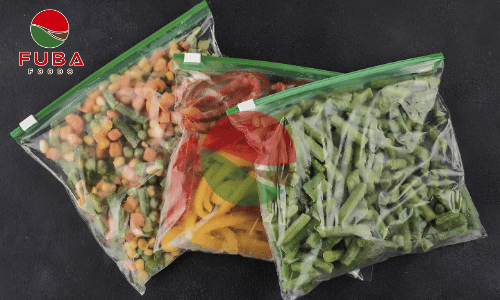
This article explains the main cut formats available for custom cut frozen vegetables, the specifications that should be defined before production, and how packaging options can be matched to different food manufacturing and foodservice requirements.
What Are Custom Cut Frozen Vegetables?
Custom cut frozen vegetables are vegetables that are prepared and frozen according to a defined product specification rather than being supplied only in a standard commercial format. The specification may include the cut shape, approximate dimensions, preparation method, color requirements, and packaging format.
For manufacturers, customization can solve a practical problem: the vegetable ingredient needs to fit an existing production line or recipe. A soup producer may require uniform diced vegetables for consistent cooking, while a ready-meal manufacturer may need slices or strips that distribute evenly throughout a finished product.
The objective is not simply to create a different-looking vegetable. A well-defined cut should support the way the ingredient will actually be handled, cooked, portioned, and packaged.
Why Cut Size Matters in Food Processing
Cut size directly influences the surface area exposed to heat, moisture, and other ingredients during processing. Smaller pieces generally cook more quickly, while larger pieces can retain more structure and provide a more noticeable texture in the finished dish.
Uniformity is equally important. When pieces vary significantly in size, smaller pieces may become overcooked while larger pieces remain underprocessed. For industrial production, this can make it harder to maintain the same sensory characteristics from batch to batch.
This is why specifications for custom cut frozen vegetables should be developed around the final application rather than selected solely according to visual preference.
Common Cuts for Custom Frozen Vegetables
Different vegetables and applications call for different cutting formats. The appropriate option depends on the characteristics of the raw material and how the finished ingredient will be used.
Dice Cut for Consistent Portioning
Dice cuts are suitable for soups, sauces, ready meals, fillings, and other products where even distribution and portion control are important.
Slice and Strip Cuts for Prepared Foods
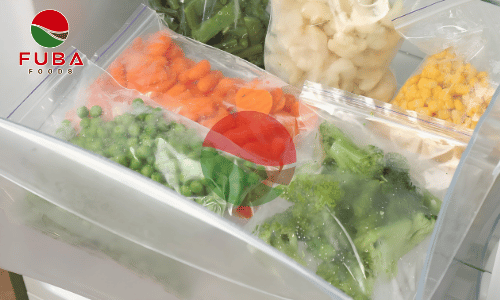
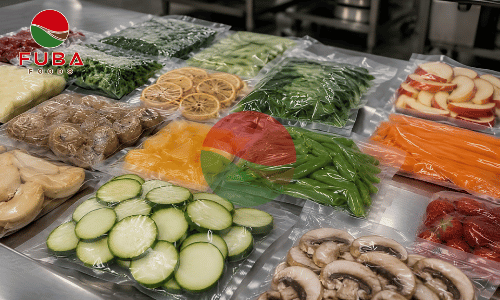
Slice and strip cuts work well when vegetables need to remain recognizable in products such as stir-fries, pasta, pizza toppings, salads, and ready meals.
Whole, Chunk and Random Cuts
Not every application requires precise geometric cuts. Whole vegetables, chunks, or random cuts may be preferable when a more natural appearance or larger pieces are desired.
For example, FUBA’s frozen durian range includes uniform chunk cuts, while its sweet potato portfolio includes a random-cut format. These examples illustrate how the appropriate format can vary according to the raw material and the intended end use.
Specifications to Define When Ordering Custom Cut Frozen Vegetables
Choosing a cut name alone is rarely enough for industrial procurement. A specification should communicate exactly what the buyer expects to receive so that production can be repeated consistently.
Size, Shape and Product Uniformity
The cut specification should define the desired size range and acceptable variation. For diced products, this may involve establishing the target dimensions of each piece. For slices or strips, length, width, and thickness may be more relevant.
The specification should also consider the natural variation of the vegetable. Some raw materials have irregular shapes or different densities, meaning a practical tolerance may be required rather than an unrealistic requirement for identical pieces.
FUBA’s production system includes sorting and grading according to size, color, and quality specifications before products move through preparation and freezing.

Processing Method and Preparation
The final specification should also state whether the vegetable is supplied raw, blanched, steamed, grilled, fried, or otherwise prepared before freezing.
This distinction matters because preparation can change the vegetable’s texture, color, moisture level, and cooking behavior.
For buyers, defining the preparation stage clearly helps ensure that the frozen ingredient fits the next step of the production process without unnecessary additional preparation.
How IQF Technology Supports Custom-Cut Vegetables
Custom cutting and freezing need to work together. A precisely prepared vegetable loses much of its practical value if the pieces freeze into large blocks or become difficult to separate during handling.
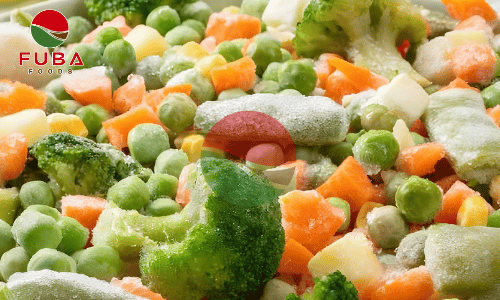
IQF, or Individually Quick Frozen technology, rapidly freezes individual pieces after preparation. This helps maintain separation between pieces while supporting the preservation of natural color, texture, flavor, and nutritional characteristics. FUBA’s processing flow places cutting and preparation before IQF freezing, followed by metal detection, packing, and controlled cold storage.
For industrial users, this separation can improve convenience during portioning and processing. Instead of having to break apart a frozen block, operators can take the quantity needed for a particular production batch.
FUBA operates six listed IQF freezing lines with a capacity of 500 kg/hour per line, alongside additional contact freezing and air-blast freezing systems. Its production facilities also include sorting, inspection, packaging, and cold-storage infrastructure.
Packaging Options for Custom Cut Frozen Vegetables
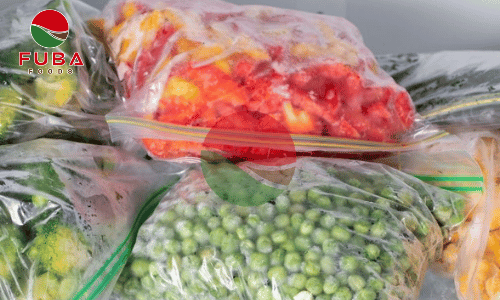
The right packaging format depends on how the product will be stored, transported, and used after delivery. A food manufacturer purchasing large volumes may prioritize bulk packaging, while foodservice operations may need smaller packs that are easier to handle in professional kitchens.
Bulk Packaging for Food Manufacturing
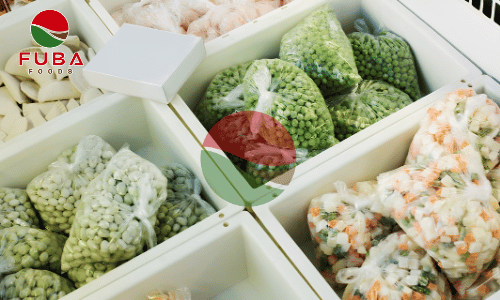
Bulk packaging is generally appropriate when frozen vegetables are transferred directly into an industrial production process. Fewer, larger packages can simplify warehouse handling and reduce the frequency of replenishment during production.
This format can be practical for manufacturers purchasing ingredients in larger quantities and managing their own portioning during production.
Foodservice and Retail Packaging
Smaller formats can be more appropriate when products are handled directly by foodservice operators or sold through retail channels.
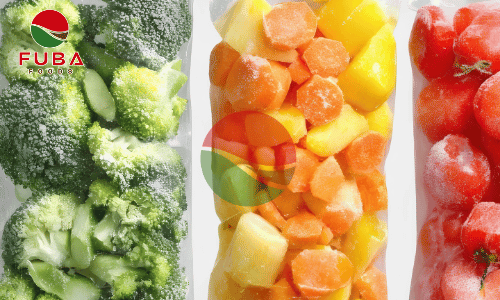
The key consideration is therefore not simply choosing the smallest or largest package. Packaging should match expected consumption volume, storage capacity, handling practices, and distribution requirements.
Matching Custom Cuts to the Final Application
The most effective approach to sourcing custom cut frozen vegetables is to begin with the finished product and work backward toward the ingredient specification.
For soups and sauces, diced vegetables may provide convenient portioning and consistent cooking. For stir-fries, strips or slices can provide a more recognizable appearance. Ready meals may require several vegetable cuts to be combined while maintaining similar cooking behavior. Pizza toppings, salads, pasta products, and foodservice dishes may each require different shapes, preparation methods, and pack sizes.
This flexibility becomes particularly valuable when a buyer is developing a new product or adjusting an existing recipe. Instead of redesigning the formulation around an available frozen ingredient, the ingredient itself can be specified around the production requirement.
What to Consider When Choosing a Custom-Cut Frozen Vegetable Supplier
A supplier should be evaluated not only on whether it can produce a particular cut, but also on whether that specification can be reproduced consistently at commercial volume.
Raw material sourcing is an important starting point. FUBA works with farming regions and growers across Vietnam, supporting year-round raw material availability through its sourcing network.
Processing capability is equally important. FUBA include six IQF lines, five metal detection systems, three X-ray inspection systems, an in-house microbiological laboratory, and three 500 MT cold-storage units.
For buyers, these capabilities provide a more complete basis for evaluating a manufacturing partner: not only whether the supplier can produce a custom cut, but whether it can maintain the required specification, quality controls, storage conditions, and supply continuity as order volumes grow.
Conclusion
Custom cut frozen vegetables give food manufacturers and foodservice operators greater control over ingredient performance, portioning, preparation, and presentation. The right cut depends on the finished application, while specifications should clearly define size, shape, preparation method, tolerances, and packaging requirements.
IQF technology adds another layer of practicality by helping individual pieces remain separated after freezing, while suitable packaging ensures that the product can move efficiently from cold storage to production or foodservice operations.
With a broad frozen vegetable portfolio, multiple cut and preparation formats, integrated processing facilities, and customized manufacturing capabilities, FUBA can support product specifications designed around different food applications and international supply requirements.


