

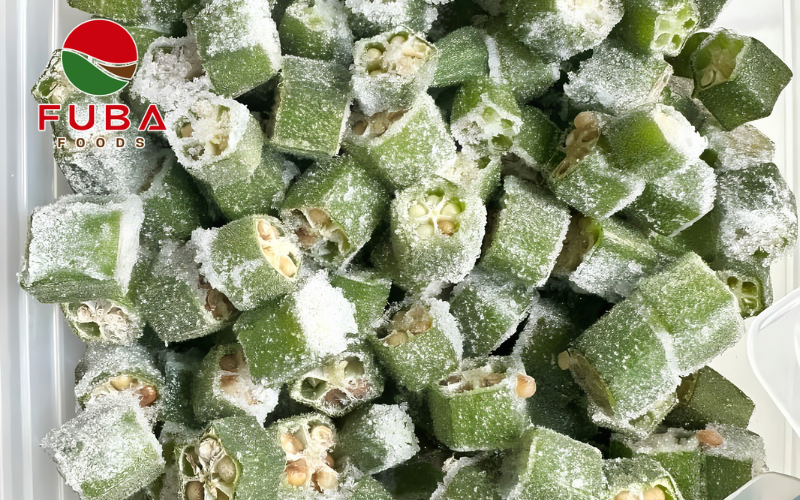
Okra is widely used across food manufacturing and foodservice, but sourcing it in frozen bulk quantities requires more than simply finding a product that meets the required format. As order volumes increase, factors such as product consistency, processing standards, packaging, and supply capacity become increasingly important to keeping production and distribution running smoothly.
A reliable bulk frozen okra supplier should therefore be able to deliver consistent product quality at commercial volumes while maintaining clear specifications, suitable packaging, stable cold-chain conditions, and dependable production capacity. For food manufacturers and distributors, working directly with a capable frozen food manufacturer can also provide better visibility and control across the supply process.

This article explores the key factors to consider when sourcing bulk frozen okra, from product consistency and manufacturing capabilities to quality control, packaging, storage, and supply reliability. It also explains what to look for when evaluating a supplier for ongoing commercial requirements, helping buyers assess whether a frozen okra source can meet their specifications and support long-term supply needs.
What Should a Frozen Okra Bulk Supplier Provide?
When sourcing frozen okra in bulk, buyers need a supplier that can meet the same requirements consistently across every shipment. Product specifications, cut size, quality, packaging, storage conditions, and order volume should all be clearly defined before regular purchasing begins.
For food manufacturers, this starts with the quality of the raw okra and continues through processing, freezing, inspection, packing, and storage. A supplier with control over these stages can maintain closer control over the finished product and reduce variations between batches.
Product flexibility can also be important. Depending on the application, buyers may need frozen whole okra, sliced okra, or slant-cut okra. Having several formats available from the same supplier can simplify purchasing when different products or customers require different specifications.
Why Buy Frozen Okra in Bulk?
Bulk frozen okra is particularly practical for businesses that use the ingredient regularly. Instead of purchasing fresh okra for each production cycle or ordering small frozen quantities repeatedly, buyers can plan inventory around their expected consumption.
The product is already cleaned, prepared, and frozen before delivery, which makes it easier to incorporate into commercial production. With the right storage and cold-chain conditions, frozen okra can also be kept available for planned production over an extended period.

Easier Production Planning
Fresh okra supply can vary depending on harvest conditions and seasonal availability. Frozen okra gives manufacturers a processed ingredient that can be stored and used according to their production schedule.
This can be useful for ready meals, soups, vegetable mixes, foodservice products, and other applications that require a regular supply of okra throughout the year.
Less Preparation at the Destination
Bulk frozen okra is supplied in a ready-to-use format. Depending on the specification, buyers can receive whole pods, slices, or slant-cut pieces instead of carrying out the cutting and preparation themselves.
For larger operations, this can reduce the need for additional labour and preparation equipment while making ingredient handling more consistent.
More Predictable Inventory
Buying in bulk allows businesses to plan frozen inventory based on expected production or sales volumes. Rather than depending on frequent fresh purchases, stock can be maintained in suitable frozen storage and released as required.
This benefit depends on proper cold-chain management. Storage, transportation, loading, and handling all need to keep the product at the required frozen condition.

Frozen Okra Formats Available for Bulk Supply
The right frozen okra format depends on how the product will be used. A supplier should be able to provide specifications that match the buyer’s processing requirements rather than offering only one standard format.
Frozen Whole Okra
Frozen whole okra keeps the natural shape of the pod and is suitable for products where the vegetable remains visible. It can be used in soups, stews, prepared meals, and foodservice dishes.
Whole okra can also give manufacturers more flexibility if they prefer to carry out additional cutting or preparation at their own facility.
Frozen Okra Slices
Frozen okra slices are suitable for recipes where the vegetable needs to be distributed throughout the finished product. They can be used in soups, sauces, ready meals, vegetable mixes, and other prepared foods.
For industrial production, consistent slice dimensions are important because they help maintain more uniform cooking, portioning, and ingredient distribution.

Frozen Okra Slant Cut
Slant-cut okra is diagonally cut into pieces, offering a different appearance while reducing preparation work at the destination. It can be used in prepared meals, soups, stews, cooked vegetable dishes, and foodservice applications.
For buyers handling several product lines, sourcing different okra formats from one supplier can also make procurement easier.
What Quality Standards Matter When Buying Bulk Frozen Okra?
Before placing a bulk order, buyers should establish a clear product specification with the supplier. The specification may cover the okra format, size or cut, colour, quality requirements, foreign-material controls, packaging, storage temperature, and shelf life.
Raw Material and Processing Control
Consistent frozen okra starts with suitable fresh raw materials. Before processing, the okra should be checked for quality, maturity, appearance, and suitability for the agreed product specification. Sorting at this stage helps remove unsuitable raw materials before they enter production.
The following processing stages also need to be properly controlled. Depending on the product specification, these may include washing, cleaning, sorting, grading, preparation, blanching where required, IQF freezing, inspection, metal detection, and packing.
At FUBA, okra is sourced through established agricultural supply relationships in Vietnam and inspected before entering the processing line. This allows the factory to assess the condition and suitability of the raw material at the beginning of production, while subsequent processing and inspection controls help maintain consistent finished-product specifications across commercial orders.

IQF Freezing Technology
IQF freezing is an important part of bulk frozen okra production because it allows individual okra pieces to be frozen separately rather than forming one solid frozen block. This makes the product easier to portion, handle, and incorporate into different food manufacturing and foodservice applications.
At FUBA, IQF freezing is integrated into the factory’s controlled processing flow, helping individual okra pieces freeze separately while maintaining consistent product specifications at commercial scale. The factory’s IQF infrastructure is supported by multiple freezing lines, with freezing conditions managed as part of the wider processing and quality-control system.
For bulk buyers, controlled IQF freezing can also support more consistent product performance across commercial orders. When combined with proper raw material preparation, inspection, packaging, and cold-chain management, the freezing process helps preserve the quality established before the product enters frozen storage.
Food Safety and Traceability
Food safety is another important part of supplier qualification, particularly when frozen okra is imported for further processing, foodservice, or distribution.
A qualified supplier should have documented food-safety procedures and traceability systems covering the movement of raw materials and finished products through the factory. Relevant certifications and inspection systems can provide additional information when buyers assess a supplier’s production controls.
The factory’s quality and food-safety systems include HACCP, ISO 22000, HALAL, and BRCGS, supported by traceability, metal detection, X-ray inspection, and an in-house microbiological laboratory.

Bulk Frozen Okra Packaging and Storage
Packaging needs to suit both the product and the way it will be handled after arrival. For bulk export, the listed format is a 10 kg carton with a PE inner liner. A 5 kg format is also available for foodservice, while smaller 500 g to 2 kg formats can serve retail requirements.
For manufacturers purchasing larger volumes, bulk cartons can make storage, transportation, and inventory handling more straightforward. Foodservice buyers may instead prefer smaller packs that are easier to handle in commercial kitchens.
Frozen okra should be stored at -18°C or below to maintain the required frozen condition. Under the specified storage conditions, the listed shelf life can reach up to 24 months.
Cold-chain control should continue after the product leaves the factory. Loading, international transportation, customs handling, and destination storage can all affect product condition, so buyers should consider the complete supply chain when evaluating a frozen okra supplier.
How to Evaluate a Frozen Okra Bulk Supplier
Price is only one part of supplier evaluation. For recurring orders, buyers should also consider whether the supplier has the production resources, quality systems, and supply infrastructure required to maintain the agreed specification over time.
Production Capacity and Supply Reliability
A supplier handling bulk orders needs sufficient production capacity to manage both initial and repeat shipments. Raw material sourcing, processing lines, freezing equipment, and cold storage all contribute to the supplier’s ability to maintain supply.
FUBA has a listed annual production capacity of 20,000 MT across its frozen fruit and vegetable operations, with more than 600 workers and exports to over 30 countries.

Its freezing infrastructure includes six IQF lines, each with a listed capacity of 500 kg per hour, together with three contact freezing lines, two air-blast freezing systems, and three cold-storage units with a capacity of 500 MT each.
For buyers, these capabilities provide an indication of the scale behind the supplier. More importantly, production capacity should be considered together with raw material sourcing and quality controls to determine whether the supplier can support repeated commercial orders.
Factory-Level Quality Control
Working directly with a manufacturer gives buyers clearer visibility into how the frozen okra is produced. Specifications can be discussed closer to the production source, while processing, inspection, packaging, and storage are managed within the same manufacturing operation.
An integrated factory setup can also reduce unnecessary handling between different parties. This may support more efficient sourcing and make communication around product specifications, packaging, and order requirements more straightforward.
For distributors and food brands, direct factory coordination can also be useful when developing OEM or private-label products with specific packaging or product requirements.
Why Direct Factory Sourcing Matters for Bulk Frozen Okra
The larger the order, the more important consistency becomes. A small difference in cut size, colour, or product condition may have little impact on a single purchase but become more significant when the same ingredient is used across multiple production batches.
This is why the manufacturing operation behind the product deserves careful attention. A reliable bulk frozen okra supplier needs to coordinate agricultural sourcing, processing, IQF freezing, quality inspection, packaging, cold storage, and shipment as part of one controlled supply chain.

For buyers, the goal is not simply to secure a large quantity of frozen okra. The more important consideration is whether the supplier can reproduce the agreed product specification and quality requirements across recurring shipments.
A manufacturer with integrated production can provide a more direct sourcing relationship, while OEM and private-label capabilities can offer additional flexibility for distributors and food brands with their own market requirements.
Conclusion
Choosing a bulk frozen okra supplier requires looking beyond product availability and price. Buyers should consider product formats, raw material quality, processing controls, food-safety systems, packaging, frozen storage, production capacity, and the supplier’s ability to maintain consistent specifications across repeat orders.
Whole, sliced, and slant-cut okra can serve different applications, while different packaging formats can accommodate manufacturing, foodservice, and retail requirements. When these factors are supported by controlled processing and a reliable cold chain, bulk frozen okra becomes easier to plan, store, and use at commercial scale.
For long-term sourcing, the manufacturing system behind the product is ultimately as important as the product itself. A supplier with strong control over sourcing, processing, freezing, inspection, packaging, and storage is better positioned to support consistent commercial supply.


